After the revocation of Jammu and Kashmir special status with the abrogation of Article 370 of the Constitution in August last year, the Indian Army has set out to buy land for its camps in the Valley.
In the first such instance, the Army has approached Baramulla administration, evincing interest in buying 129 kanal (6.5 hectares) of land at Kreeri high ground at Tapperwari in Pattan area of the north Kashmir district, where the troops are already temporarily stationed, according to a PTI report quoting defence sources.
The sources told PTI that the Quartermaster for Commanding officer of the 19 Infantry Division Ordnance Unit has written to the district administration, requesting it to inform if the administration wishes to sell the land to the Indian army.
The Army has sought the district administration reply by May 30, the PTI reported quoting the sources. It is perhaps for the first time that the Army has directly written to the department concerned for purchasing land in the Valley.
Prior to the abrogation of Article 370 on August 5 last year, the defence estates officer would write to Jammu and Kashmir government for getting lease of the land required by the Army.
Article 370 deals with special powers conferred upon the state of Jammu and Kashmir. It allows the state constituent Assembly to make its own Constitution, thereby giving it an “autonomous state†power. After the accession of the state to India in 1947, Article 370 served as a “mechanism for managing Centre-state relations with specific reference to Jammu and Kashmir,†senior journalist, late B G Verghese, had said in his book ‘A J&K Primer’.
Apart from the autonomy, Article 370 also lends other powers such as the need of “concurrence of the state government†if the central government plans to make amendments to the concurrent list of subjects.
A number of metropolitan areas have seen large-scale demonstrations on Friday over the death of a Minneapolis man in police custody on Memorial Day.
USA TODAY
Outrage over the death of George Floyd sparked protests in cities across the nation on Friday night, hours after a former Minneapolis police officer was arrested and charged with his murder.
Activists say it’s just another example of systematic racism in law enforcement, the latest in a series of high-profile black deaths that have exacerbated and inflamed racial tensions nationwide.Â
Former officer Derek Chauvin is facing third-degree murder and manslaughter charges after a bystander’s video circulated of him holding his knee to Floyd’s neck for more than eight minutes before Floyd died. But many protesters believe Chauvin’s should face more severe charges and other officers connected to the Floyd’s death should also be charged.
Demonstrators in many cities also gathered to protest local deaths at the hands of law enforcement.
In Indianapolis, they held a sign that read “Justice for Dreasjon Reed” — Reed died after a police pursuit that was broadcast on Facebook Live. In Milwaukee, they invoked the name of Joel Acevedo, who died after an altercation with a police officer in April.
As protests continue into their fourth night in Minneapolis, here’s what’s happening in cities around the nation:
Atlanta: Protesters clash with police, vandalize CNN headquarters
Protesters set a police car on fire, struck officers with bottles, vandalized the headquarters of CNN, and broke into a restaurant in downtown Atlanta as a demonstration that began peacefully became chaotic.
Protesters used barricades to break police vehicle windshields and jumped from car to car. Hundreds of the protesters confronted police outside CNN headquarters. They spray-painted the large, iconic CNN logo outside the building, breaking a windowed entrance. One protester climbed on top of the sign and waved a “Black Lives Matter†flag to cheers from the crowd.
Protesters were also walking on the interstate in downtown Atlanta and appeared to be trying to block traffic. The Georgia State Patrol was on the scene as of 9:30 p.m.
Earlier, as the protest appeared more calm, Kaity Brackett, 27, said she came out to the protest because she thinks the entire criminal justice system needs to be overhauled, starting with policing. She said the Ahmaud Arbery killing was a catalyst for her and referred to his death as a lynching. Arbery was killed on Feb. 23 by a former district attorney investigator and his son, who were not arrested until after video emerged months later.
Denver: Police use flash grenades, tear gas to hold off protesters at Capitol
People began to gather as early as 12:30 p.m. for a march to the Capitol, where protesters stood on the steps and chanted for change. They later took both sides of nearby North Broadway Street before heading to Civic Center Park to hear from speakers.
About an hour after the crowd had mostly dispersed, they regathered near the capitol, prompting law enforcement to push them back from the street to keep traffic moving through the area. Tensions escalated into the night.
– Bethany Baker, The Coloradoan (Fort Collins, Colo.)
San Jose, California: Protesters block five-lane Silicon Valley freeway
Protesters marched through the capital of the Silicon Valley, temporarily stalling traffic for about an hour on a five-lane freeway and prompting police intervention.
Video footage from KGO-TV showed vehicles at a virtual standstill on the southbound lanes of U.S. 101 in San Jose until protesters moved into the downtown area. Police later fired tear gas and nonlethal projectiles into a crowd that had grown to about 1,000 people, and officers in riot gear lined up to prevent them from further disrupting traffic near city hall, KPIX-TV reported.
Protesters smashed the windows of police cars and threw water bottles, according to TV station.
Elsewhere in California, hundreds of protesters demonstrated peacefully on the streets in the capital city of Sacramento, gathering near a police headquarters and shouting at police.
Des Moines, Iowa: Protest grows violent, bricks thrown at police carsÂ
Just before 8 p.m., protesters appeared to throw bricks at police cars, prompting officers in riot gear to push against protesters. The scene escalated, with at least one officer spraying chemical irritants on the crowd, including a Des Moines Register photographer.
Indianapolis: Black Lives Matter streams protest on Facebook Live
Dozens gathered in downtown Indianapolis to protest a fatal shooting earlier this month by an Indianapolis Metropolitan Police officer.
Around 7:30 p.m., the protest started to feel more tense, with the number of protesters growing to more than 50. They began engaging verbally with a vastly beefed up law enforcement presence, as the Indianapolis Metropolitan Police Department flooded the scene with officers and squad cars.
A local Black Lives Matter group broadcast the demonstration on Facebook Live, and called on “white allies” to move to the front to form a human barrier between black protesters and the assembled police officers.
Protesters linked arms and shouted “No justice! No peace!”
Hundreds of protesters gathered peacefully in front of police headquarters in Knoxville, Tennessee, in a rally hosted by Black Lives Matter Knoxville.
Davis Hayes, who ran for Knoxville City Council last year, led the crowd in a chant: “We have nothing to lose for our chains.â€
Alison Rose, who works with the National Alliance on Mental Illness, was the first white speaker at the protest, and she spoke directly to other white people.
“White people, get it together. Do the work. Educate yourselves,†she said into a microphone. “Get yourself so deep in history that you will find out the truth: Black history is this country’s history.â€
Louisville, Kentucky: Demonstrators gather again after Thursday violence
After violent protests erupted Thursday, groups of protesters continued to gather Friday night demanding justice for Breonna Taylor, an African American woman killed in her apartment by police officers in March.
Around 9:30 p.m. reports of loud bangs came followed by tear gas. Earlier, protesters pulled down the American and Kentucky flags in front of the Hall of Justice and set them ablaze. Moments later, some protesters threw objects at the building’s glass doors, more items were lit on fire and there was three loud bangs went off.Â
AÂ group of more than 1,000 people were estimated to be gathering around the Hall of Justice.
Memphis, Tennessee: About 300 protesters gather for third straight day
For the third straight day, protesters took to the streets of Memphis to speak out against police brutality and the recent deaths of three African Americans at the hands of police.
The first demonstrates arrived just before 6:30 p.m. Within an hour, the crowd had grown to about 300, the largest of the of the protests so far.
That was despite a series of road closures set up by the Memphis Police Department at every entrance into the area. While Wednesday, the overarching emotion seems to be anger, Friday night’s protest seemed to be about unity and healing.
– Desiree Stennett, Micaela A Watts and Laura Testino, The Commercial Appeal (Memphis, Tenn.)
Milwaukee: Protesters march in ‘solidarity,’ stop Interstate 43 trafficÂ
Hundreds rallied to denounce the police killing of George Floyd and other acts of police misconduct across the country before marching to Interstate 43 and shutting down part of the freeway.
The protest began with a moment of silence to honor Floyd, who died Monday after a Minneapolis police officer kneeled on his neck for more than eight minutes as he was gasping for air and pleading that he couldn’t breathe.
“We’re here in solidarity,” said Vaun Mayes, a community activist who organized the event outside the Wisconsin Black Historical Society.Â
Hours later, another demonstration took place in the city’s Jackson Park neighborhood to protest the death of Joel Acevedo, who died after an altercation with an off-duty Milwaukee police officer. The officer, Michael Mattioli, is accused of putting Acevedo in a fatal “choke hold” during a fight at his house and has been charged with reckless homicide.
Outside the White House on Friday, Secret Service could be seen after 7 p.m. taking at least one person into custody. Videos showed a large group of protesters gathering, with some burning flags and knocking over barricades. The protesters have moved from the White House to another part of the city.
Multiple reporters posted that they were inside the White House and that the Secret Service was not letting them leave the grounds during the lockdown.
Contributing:Â Savannah Behrmann, USA TODAY;Â The Associated Press
Read or Share this story: https://www.usatoday.com/story/news/nation/2020/05/29/george-floyd-protests-intensify-atlanta-memphis-indianapolis-milwaukee/5288305002/
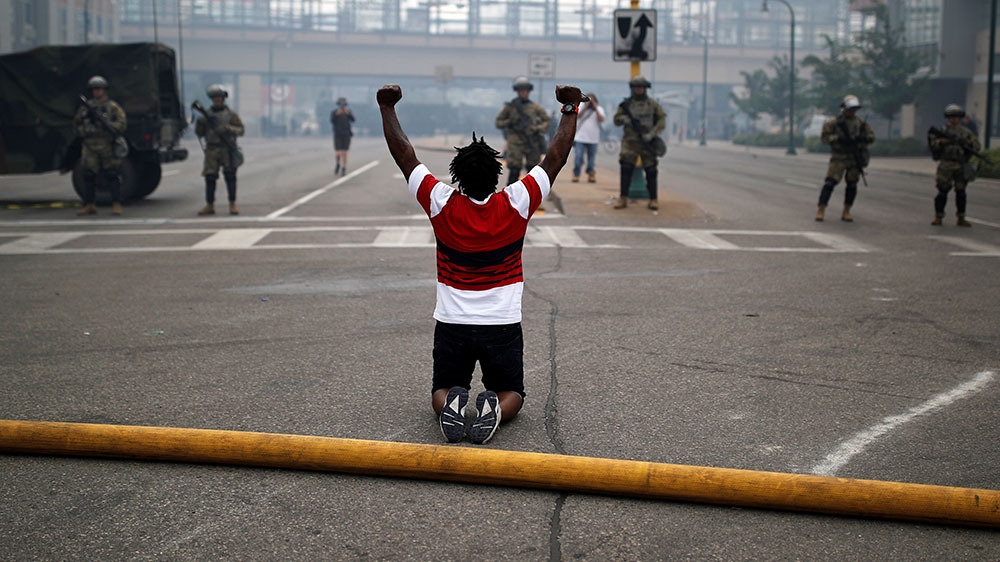
Protesters in the United States city of Minneapolis welcomed Friday’s murder charge against the white officer who knelt on the neck of George Floyd, an unarmed black man, but demanded the three other officers involved be arrested as well.
“It’s an absolute outrage because it isn’t just one officer who is responsible for the murder of George Floyd,” said Ayaan Dahir, a Minneapolis resident and activist. “They all need to be arrested and charged.”
More:
Floyd died on Monday after policeman Derek Chauvin pinned him to the ground as he repeatedly pleaded: “I can’t breathe.”
An eight-minute video of the incident shows bystanders urging Chauvin to get off of Floyd, but the officer continues to pin him down even as he goes motionless.
Chauvin, who was fired after the incident, was arrested on Friday, more than three days after Floyd died. He was charged with third-degree murder and manslaughter.
“We have evidence, we have the citizen’s camera’s video, the horrible, horrific, terrible thing we have all seen over and over again, we have the officer’s body-worn camera, we have statements from some witnesses,” said Hennepin County Attorney Mike Freeman in announcing the charges.
A protester reacts while gathering with others outside the city hall in Minneapolis, Minnesota [Carlos Barria/Reuters]
Three other officers involved were fired but have not been charged, angering protesters and community leaders who have demanded all four officers be held accountable.
“The unfortunate situation here is that because police are involved, the law protects them as well as the system,” said Jaylani Hussein, the director of the Minnesota chapter of Council on American-Islamic Relations.
“If they didn’t listen to George’s cries for help, they should have listened to the bystanders who were there witnessing this unfortunate situation,” Hussein told Al Jazeera. “All four need to be arrested and offered no bail.”
Protesters undeterred by curfew
The killing of Floyd has set off angry protests in Minneapolis and in major cities across the US.
Protesters in Minneapolis rallied on Friday night, despite a city-imposed curfew that began at 8pm (01:00 GMT).
Some protesters said they will continue to defy the curfew until all the officers involved in Floyd’s death are arrested, local media reported.
“They can’t arrest us all,” one protest leader was quoted as saying.
The Minnesota Freedom Fund, an organisation that pays bail for low-income individuals who are arrested, encouraged protesters planning to stay past curfew to write the group’s and partner group’s phone numbers on their arms in case of arrest.
Friday’s curfew, which will last until 6am (11:00 GMT) on Saturday and begin again later that night, was announced after three nights of protests rocked Minneapolis, with thousands taking to the streets to demand justice for Floyd and an end to police violence.
While the protests started peacefully, they descended into chaos, with fires and looting. Police have responded to protesters with tear gas and non-lethal projectiles. Protesters also say police have antagonised them even when they are marching peacefully. At one point a cable television crew was arrested – an incident for which authorities later apologised.
A man reacts as he confronts US National Guard members guarding an area of Minneapolis, Minnesota [Carlos Barria/Daylife]
On Thursday night, officers retreated from a police precinct as protesters overran the building, chanting, “no justice, no peace”. Some set fires in the building. Protesters rallied outside a different police building on Friday, a livestream by Unicorn Riot, an independent media organisation showed.Â
“It’s very clear that there is a lot of anger, not just about the death of George Floyd, but all the people who have been killed by police,” Dahir told Al Jazeera.
Responding to the violence, Minnesota Governor Tim Walz declared a state of emergency and dispatched the National Guard to the city. National Guard members could be seen in Minneapolis and neighbouring Saint Paul by mid-Thursday.
In addition to charges brought against all the officers, protesters are also demanding a special prosecutor be named in the case, saying they do not trust Hennepin County Attorney Freeman and pointing to the fact it took more than three days for an arrest to be made.
“That arrest of the officer should have happened since day one. And everything that has happened since, I hold Mike Freeman directly responsible,” Dahir said.
“What’s been happening – this uprising, this rebellion – is something that organisers have been saying for years was going to happen eventually,” Dahir said. “This isn’t something that can be undone. It’s not an accident, it’s not a coincidence, it is something that has been brewing for a long time and this is the straw that broke the camel’s back.â€
You know, I just had an opportunity to speak with the Floyd family, a group of them, most of them. They’re a close, decent, honorable family, loving one another. And once again we heard the words, and they heard them, “I can’t breathe†— an act of brutality so elemental, it did more than deny one more black man in America his civil rights and his human rights. It denied him of his very humanity. It denied him of his life, depriving George Floyd as it deprived Eric Garner of one of the things every human being must be able to do: breathe. So simple, so basic, so brutal.
You know, the same thing happened with [Ahmaud] Arbery, the same thing happened with Breonna Taylor, the same thing with George Floyd. We’ve spoken their names aloud. We’ve cried them out in pain and in horror. We’ve chiseled them into long-suffering hearts. They’re the latest additions to the endless list of stolen potential wiped out unnecessarily. You know, it’s a list that dates back more than 400 years. Black men, black women, black children.
The original sin of this country still stains our nation today, and sometimes we manage to overlook it. We just push forward with the thousand other tasks in our daily life, but it’s always there, and weeks like this, we see it plainly that we’re a country with an open wound. None of us can turn away. None of us can be silent. None of us can any longer, can we hear the words “I can’t breathe†and do nothing. We can’t fail victims, like what Martin Luther King called “the appalling silence of good people.â€
Every day, African-Americans go about their lives with constant anxiety and trauma, wondering who will be next. Imagine if every time your husband or son, wife or daughter left the house, you feared for their safety from bad actors and bad police. Imagine if you had to have that talk with your child about not asserting your rights, taking the abuse handed out to them so, just so they can make it home. Imagine having police called on you just for sitting in Starbucks or renting an Airbnb or watching birds. This is the norm black people in this country deal with. They don’t have to imagine it. The anger and frustration and the exhaustion is undeniable.
But that’s not the promise of America. It’s long past time that we made the promise of this nation real for all people. You know, this is no time for incendiary tweets. It’s no time to encourage violence. This is a national crisis, and we need real leadership right now. Leadership that will bring everyone to the table so we can take measures to root out systemic racism. It’s time for us to take a hard look at the uncomfortable truths. It’s time for us to face that deep open wound we have in this nation.
We need justice for George Floyd. We need real police reform to hold cops to a higher standard that so many of them actually meet, that holds bad cops accountable and repairs relationships between law enforcement and the community they’re sworn to protect. We need to stand up as a nation with the black community, with all minority communities, and come together as one America.
That’s the challenge we face. You know, it’s going to require those of us who sit in some position of influence to finally deal with the abuse of power. The pain is too immense for one community to bear alone. I believe it’s the duty of every American to grapple with it, and to grapple with it now. With our complacency, our silence, we are complicit in perpetuating these cycles of violence.
Nothing about this will be easy or comfortable, but if we simply allow this wound to scab over once more without treating the underlying injury, we’ll never truly heal. The very soul of America is at stake. We must commit as a nation to pursue justice with every ounce of our being. We have to pursue it with real urgency. We’ve got to make real the promise of America, which we’ve never fully grasped: that all men and women are equal, not only in creation but throughout their lives.
Again, George’s family, thanks for taking the time to talk to me. I promise you, I promise you, we’ll do everything in our power to see to it that justice is had in your brother, your cousin’s case. I love you all, and folks, we’ve got to stand up. We’ve got to move. We’ve got to change.
I want to share parts of the conversations I’ve had with friends over the past couple days about the footage of George Floyd dying face-down on the street under the knee of a police officer in Minnesota.
The first is an email from a middle-aged African-American businessman.
“Dude I gotta tell you the George Floyd incident in Minnesota hurt. I cried when I saw that video. It broke me down. The ‘knee on the neck’ is a metaphor for how the system so cavalierly holds black folks down, ignoring the cries for help. People don’t care. Truly tragic.â€
Another friend of mine used the powerful song that went viral from 12-year-old Keedron Bryant to describe the frustrations he was feeling.
The circumstances of my friend and Keedron may be different, but their anguish is the same. It’s shared by me and millions of others.
It’s natural to wish for life “to just get back to normal†as a pandemic and economic crisis upend everything around us. But we have to remember that for millions of Americans, being treated differently on account of race is tragically, painfully, maddeningly “normal†— whether it’s while dealing with the health care system, or interacting with the criminal justice system, or jogging down the street, or just watching birds in a park.
This shouldn’t be “normal†in 2020 America. It can’t be “normal.†If we want our children to grow up in a nation that lives up to its highest ideals, we can and must be better.
It will fall mainly on the officials of Minnesota to ensure that the circumstances surrounding George Floyd’s death are investigated thoroughly and that justice is ultimately done. But it falls on all of us, regardless of our race or station — including the majority of men and women in law enforcement who take pride in doing their tough job the right way, every day — to work together to create a “new normal†in which the legacy of bigotry and unequal treatment no longer infects our institutions or our hearts.
Fighting among Turkey-backed Syrian rebel groups in the Turkish-controlled city of Afrin in northern Syria left several civilians dead Thursday, including two children, according to war monitors.Â
Fierce clashes between the Hamzat Division and the Ahrar al-Sham and Jaish al-Islam factions erupted Thursday, said the UK-based Syrian Observatory for Human Rights. Three civilians, including two children, were killed in the gunfire, the monitoring group said.Â
Elizabeth Tsurkov, a fellow in the Middle East Program at the Foreign Policy Research Institute, wrote on Twitter that the fighting started after a group of fighters from the Hamzat Division walked into a shop run by a man displaced from Syria’s southwestern Ghouta region.Â
“They asked to purchase something for 300 lira [$0.16] on credit. The owner of the shop refused. In response, the Hamzat shot up the place & tossed a grenade, killing the shop owner and his son,†she wrote.Â
Afrin has been in the hands of Syrian fighters trained and equipped by Turkey since March 2018, when the Free Syrian Army captured the city from the Kurdish People’s Protection Units (YPG) militia, which Turkey considers an offshoot of the banned Kurdistan Workers Party.Â
Human rights groups have since documented the wide-scale persecution of locals by Turkish proxies, including forced conversions among the Yazidi religious minority.Â
“The current situation for Yazidis remaining in the Afrin is dire as they are forced to hide their identity, unable to practice their faith, and remain frightened for their safety,†the Yazidi advocacy group Yazda said in a statement today.Â
Yazidi activist and Nobel laureate Nadia Murad accused Turkey and its affiliated rebel groups of an ethnic cleansing campaign in Afrin.Â
“They are kidnapping women, killing civilians, and destroying houses and shrines,†she said on Twitter. “To date, the international community has failed to bring attention to these crimes.â€Â
Turkey denies war crimes were committed by its proxies.Â
Afrin was also the site of a deadly truck bombing last month. The YPG denied responsibility after Turkey accused the militia of carrying out the attack that killed more than 50 people.
For a fourth day, Americans took to the streets to decry the death of George Floyd, whose demise in the custody of Minneapolis police Monday was captured on video.
Protesters set a police car on fire, struck officers with bottles, vandalized the headquarters of CNN, and broke into a restaurant in downtown Atlanta as a demonstration that started peacefully quickly changed tone Friday evening.
An Atlanta Police car burns as people protest in Atlanta, Georgia on May 29, 2020.Dustin Chambers / Reuters
Some used barricades to break police vehicle windshields and jumped from car to car. Hundreds of the protesters confronted police outside CNN headquarters. They spray-painted the large, iconic CNN logo outside the building, breaking a windowed entrance. One protester climbed on top of the sign and waved a “Black Lives Matter†flag to cheers from the crowd.
Some demonstrators pelted officers who came over with bottles, striking some of them. Other bottles thrown at authorities exploded behind the police line, but no officers appeared to get hit. Protesters chanted, “Quit your jobs.â€
CNN broadcast scenes from the building’s lobby where law enforcement had been positioned. At one point, some small explosions that appeared to be firecrackers thrown by protestors into the building pushed CNN’s Nick Valencia to retreat farther into the building.
At least nine police vehicles were damaged during a demonstration there, according to NBC affiliate WXIA. As fires burned at multiple places in the city, the College Football Hall of Fame was vandalized, according to the station.
Let our news meet your inbox. The news and stories that matters, delivered weekday mornings.
Atlanta Mayor Keisha Lance Bottoms delivered an impassioned address to demonstrators, urging them not to burn down a city with a deep legacy of African American advancement.
“This city that has had a legacy of black mayors and black police chiefs,” Bottoms said. “if you care about this city then go home. This won’t change anything.”
“We are better than this,” she said.
The crowd also spoke out against the deaths of Ahmaud Arbery, fatally shot while he was jogging, and Breonna Taylor, killed by police during a raid of her home.
In Washington, D.C., the White House was put on lockdown as demonstrators gathered at nearby Lafayette Square. Some buildings in the area were tagged with graffiti.
In the New York City borough of Brooklyn a police ban was burned as a crowd surrounded it, according to NBC New York. Multiple people were arrested across the city.
In Los Angeles, demonstrators gathered near City Hall and in South L.A. Demonstrators appeared to attack a police officer who able to get away, according to video broadcast by NBC Los Angeles.
Protesters later blocked one the 110 freeway downtown.
Hundreds of people marched on the Las Vegas Strip and chanted, “No justice, no peace!†and “Black lives matter,” NBC affiliate KSNV reported.
In Charlotte, North Carolina, scheduled to host the Republican National Convention in August, multiple arrests have been made amid demonstrations, NBC affiliate WCNC reported.
Demonstrations were also expected to take place in Boston, Chicago, Dallas, Denver, Houston, Louisville, Kentucky, Milwaukee, Wisconsin, and Oakland, California.
In Minneapolis, where a third night of demonstrations erupted into riots Thursday night, protesters returned to the streets and blocked interstate 35W, according to NBC affiliate KARE.
Floyd, 46, was killed after Officer Derek Chauvin put his knee on his neck for more than 8 1/2 minutes after police were called to a report of counterfeit money used at a market.
Chauvin was arrested and charged with murder Friday. He faces charges of third-degree murder and manslaughter, Hennepin County Attorney Mike Freeman announced.
Dennis Romero
Dennis Romero writes for NBC News and is based in Los Angeles.
The Associated Press and Jason Abbruzzese contributed.
HONG KONG — Protesters have deleted their social media accounts, afraid that their messages could be used against them under China’s new national security laws. Young parents have scoured the internet for instructions on emigration. Organizers have planned rallies, only to cancel them at the last minute in the face of impenetrable police blockades.
Hong Kong’s protest movement — which last year cowed the local government and humiliated the authorities in Beijing who direct it — is in crisis. The tactics that had pushed officials to retreat at times are suddenly inadequate against an aggressive police force, fear of the coronavirus and a Chinese Communist Party that has run out of patience. Many protesters feel they have exhausted their options.
“It’s the beginning of the end,†said Michael Mo, a protest organizer and local official.
The Chinese government’s plan to impose security laws on Hong Kong that could curtail the city’s civil liberties has left the freewheeling and decentralized opposition movement seeking not only a next move, but a new vision.
Its campaign for democracy was always a long shot, targeting a local government whose leadership is only accountable to Beijing. But China’s direct intervention has made the challenges even more explicit, forcing a more fundamental reckoning about how to fight back, what the goal is — and whether it is even worth it to try.
Further complicating their calculus, the protesters, a jumble of students, teachers, politicians and activists, find themselves at the center of a fight between China and the United States. China’s leader, Xi Jinping, sees the security push as necessary to protect the country’s sovereignty, while President Trump has cast it as an encroachment on civil liberties, moving on Friday to strip away some of Hong Kong’s privileges with the United States.
Some protesters say they will continue to march, futile though it may be, while others who had thrown Molotov cocktails say they now prefer boycotts or strikes. Some want to preserve Hong Kong’s relative autonomy from China, while others have joined the once-taboo call for outright independence.
Many are pinning their hopes on the United States’ pressure on China, but others fear they will become pawns in their rivalry.
What binds many of the protesters together, more than anything, is weariness and dread.
Their demands for universal suffrage — which would allow for direct elections of Hong Kong’s chief executive and all lawmakers — and for a more accountable police force remain unmet, despite months of demonstrations. Now that Beijing has escalated the fight, many protesters realize that they may not be able to do the same.
“We tried almost everything we could think of last year,†said Alex Tang, 32, a labor organizer. “Maybe we will come up with something better later. But in this moment, the people just feel tired.â€
The movement’s wounded conditionhas been most evident in the place where it first showed its strength: the streets.
Protests against the national security laws in the past week drew thousands, demonstrating that months of pandemic-induced stasis had not dampened their anger. But the turnout fell far short of the hundreds of thousands — and at times, more than a million — who attended some of last year’s marches.
Many demonstrators have been deterred by the police’s increasingly forceful response. Last year, peaceful protesters were given wide latitude, and when clashes erupted, they raged for hours. Protesters lobbed bricks and gasoline bombs, while officers responded with tear gas and rubber bullets.
Now, swarms of anti-riot officers, under the command of a new police chief appointed by Beijing, scatter even peaceful demonstrators with water cannons and pepper spray from the outset. On Wednesday, protesters called off a rally at the legislature after hundreds of police officers preemptively surrounded the complex.
When the protesters poured into the streets instead, the police detained them en masse, in some cases within an hour. More than 360 were arrested on Wednesday on top of 180 earlier in the week.
Organizers have acknowledged that for some, the cost of protesting may now be too high.
“My gut feeling is that it might let really peaceful protesters, average Joes, stay at home instead,†Mr. Mo said of the pending security laws. “They are afraid of being arrested, harassed by police.â€
Google searches for the word “immigration†in Hong Kong spiked after the national security announcement, an indication that some residents may be searching for an exit strategy. So many protesters, fearing future arrests, deleted their accounts on Telegram, a messaging app that others began urging people to stay online.
“If you are timid, you will lose your whole life,†a widely circulated message said. “Only if you bravely face everything will there be a turning point.â€
But the alternatives to street protests seem increasingly risky.
Activists suggested that labor unions and boycotts of pro-Beijing businesses could offer new avenues for resistance. That approach had worked in August, when large numbers of air traffic controllers called in sick, forcing the cancellation of more than 200 flights.
In February, even as the coronavirus made large gatherings impossible, a medical workers’ strike helped force the government to close parts of the border with the mainland.
Some protesters fear that the security laws, which will be sweeping in scope, could target unions and nongovernmental organizations, many of which formed out of last year’s protests.
The language of the security plan, which China’s legislature approved on Thursday, is broad: China could impose laws punishing any “acts and activities†that threaten national security, according to state media. The Global Times, a state-run tabloid, suggested that tweets critical of Beijing could run afoul of the rules.
Officials in Hong Kong and Beijing have dismissed fears of overreach, promising to uphold Hong Kong’s relative autonomy. But on the mainland, the party has accused church leaders, union leaders and other organizers of undermining state security.
Timing is also not on the unions’ side. The pandemic has further battered Hong Kong’s economy, and some workers are reluctant to strike when unemployment is high, said Mr. Tang, the labor organizer, whose union of information technology workers is one of the newly formed groups.
That could change if the global recession, on top of a crackdown, worsens the deep income inequalities fueling many young protesters who feel that they have little to lose.
“If you just give them some time, and the environment is getting worse, they may just say, ‘Screw it. I’ll go out anyway,’†Mr. Tang said.
In perhaps the clearest sign of how Beijing’s latest move has forced many protesters to reassess their strategy, calls for independence for Hong Kong — once a fringe idea — have become common at recent demonstrations.
Historically, most democracy supporters had dismissed the idea of independence as impractical and needlessly divisive, pointing to Hong Kong’s cultural and economic ties with China. They pushed instead to preserve the city’s high degree of autonomy enshrined in the “one country, two systems†political formula enacted in 1997 after Britain returned Hong Kong to China.
But activists said the new push by Beijing proved that the status quo was untenable, and that it had jolted awake protesters who thought they could work within the system.
“Maybe they still had some hope in the coming election, or they still had some optimistic expectation in the future of the movement,†said Ventus Lau, 26, a prominent organizer who identifies as a member of the protests’ “radical†wing, referring to legislative elections in September.
The brazenness of the security laws, which bypassed Hong Kong’s government, was “a very good reminder†for those people, he continued.
“We’re already facing the darkest hour,†Mr. Lau said. “And we will continue to fight.â€
Still, independence remains a deeply fraught, risky topic. Beijing has said that the national security laws would target secession. Candidates for elected office can be disqualified for supporting independence.
Several protesters who have joined the recent pro-independence chants said the calls were largely symbolic.
“When I call for independence, I am simply expressing a wish for the things I am supposed to have,†such as human rights and free expression, said Win Kwan, a 50-year-old clerk at Sunday’s protest. “We keep coming out to marches and protests, but it seems like we hadn’t gotten anything.â€
Many protesters’ true hope, they said, rested with the international community, as they no longer believed that Hong Kongers’ own actions would have any effect on Beijing. In addition to appealing to the United States and Britain, other protesters have lobbied the United Nations and European Union to condemn the Communist Party.
Many protesters welcomed the United States’ move this week announcing that it no longer saw Hong Kong as significantly autonomous from China — a designation that, though intended to punish the mainland, would also jeopardize the city’s position as a global commercial hub. Mr. Trump moved forward on Friday with plans to revoke the city’s special status with the United States, as well as to sanction Chinese and Hong Kong officials seen as responsible for the erosion of freedoms in the semiautonomous region.
It is unlikely that such moves would sway the party. Beijing sees many of the city’s activists as colluding with hostile foreign forces bent on using Hong Kong to infiltrate the mainland — a threat that the security laws expressly seek to quash.
The protesters know they are in for a long fight.
“Just because we might not see the results in our lifetime doesn’t mean that our efforts would disappear,†said Alice Chan, a 35-year-old high school teacher who attended Sunday’s protest. “Everything we do now is building the foundation for the generations to come.â€
WASHINGTON — Attorney General William P. Barr on Friday labeled the images of the death of George Floyd, a black man in Minneapolis whom a white police officer knelt on for nearly nine minutes, as “harrowing†and “deeply disturbing†and vowed that the federal investigation into his death would proceed quickly.
“I am confident justice will be served,†Mr. Barr said in a statement as protesters across the country condemned the actions of the officer, Derek Chauvin, who was charged Friday by the local authorities with third-degree murder and manslaughter.
But the Trump administration’s years of inaction on police violence and President Trump’s embrace of law enforcement have made civil rights advocates wary of the Justice Department’s involvement in the Floyd case. The administration has largely dismantled police oversight efforts, curbing the use of federal consent decrees to overhaul local police departments. Mr. Barr has said that communities that criticize law enforcement may not deserve police protection, and Mr. Trump has encouraged officers not to be “too nice†in handling suspects.
Advocates for police overhaul said in interviews on Friday that they were in a difficult position: After denouncing the federal government’s retreat from police accountability — and civil rights enforcement more broadly — they are now wary of its intentions.
“Our confidence in a federal intervention in cases like this is wholly dependent on the track record of the administration that is stepping in,†said Derrick Johnson, the president of the N.A.A.C.P. “This administration lacks credibility when it comes to addressing issues of justice, fairness and race.â€
Mr. Barr said that any federal charges would be “based on the law and facts,†and that they would not come until after local charging decisions.
To bring federal civil rights charges in the Floyd case, prosecutors have to meet a difficult bar: proving that Mr. Chauvin intended to violate Mr. Floyd’s civil rights and acted on that wish, Mr. Johnson said. Prosecutors are often reluctant to bring such cases because they are so difficult to win.
“We are confronted with the stark reality this family may not see justice, even with the prevailing evidence in broad daylight from multiple camera views that there was no resisting, no physical provocation, that he was subdued and cuffed, that he said he can’t breathe, and that blood was coming out of his mouth,†Mr. Johnson said.
Mr. Barr’s announcement suggested no broader investigation into possible abuses in the Minneapolis Police Department, a move that local activists have demanded. Congressional Democrats also asked the Justice Department this week to open an investigation into the police. The city has a history of accusations of police abuse, and in 2017, an officer in a Minneapolis suburb was found not guilty of manslaughter in the death of Philando Castile, a black motorist.
Under President Barack Obama, the Justice Department aggressively sought to combat excessive use of force by the police. The department and local police departments signed 14 consent decrees, court-enforced agreements detailing remedies like additional police training or data collection.
The Justice Department under Mr. Obama most likely “would have looked at Minneapolis given the pattern of problems that were apparent,†said Jonathan Smith, a former department official who negotiated several of the decrees.
Justice Department findings typically prompted the consent agreements. Police in Ferguson, Mo., where the fatal shooting in 2014 of an unarmed black teenager by a white officer set off a national debate over the use of police force, fined and arrested African-Americans in part to balance the city’s budget, the department found. It concluded that the Baltimore police were more concerned with accumulating statistics than reducing violent crime.
Mr. Trump’s first attorney general, Jeff Sessions, moved to rein Justice Department efforts to investigate patterns of allegations of misconduct by the local police.
The department under Mr. Trump has entered into consent decrees with the police in Ville Platte and the sheriff’s office in Evangeline Parish, La., based on an investigation opened in 2015, and opened a so-called pattern-and-practice investigation into the police in Springfield, Mass. It has also pursued abuses in prison systems in Alabama and New Jersey.
But critics said that the department’s overall approach did little to address allegations of police misconduct.
“They’ve just really been dismissive about the fact that police abuse happens, and the fact that it’s a problem the federal government can and should do something about,†said Christy E. Lopez, a former deputy chief in the special litigation section of the civil rights division during the Obama administration.
She pointed to comments that Mr. Trump made in 2017 to the police on Long Island, suggesting that they should not protect the heads of suspects ushered into police cars. At the time, police departments around the country distanced themselves from the president’s position.
“It’s been the tenor of this entire administration and of the D.O.J.,†Ms. Lopez said. “That absolutely sends a message to police officers on the street.â€
Mr. Sessions repeatedly argued that criticism of the police or excessive oversight could damage the morale of officers, harming their ability to control crime. Mr. Barr, in his own public comments, has stressed that abuses reflect “bad apples†more than systemic breakdowns.
Minority communities have long criticized Mr. Barr’s full-throated support of law enforcement, beginning with his first stint as attorney general under President George Bush, when he advocated on behalf of maximum sentencing laws that laid the groundwork for high rates of incarceration among black people.
Civil rights groups, including the N.A.A.C.P., opposed his confirmation last year. During his confirmation hearing, Mr. Barr defended his record but said that such a strict approach on sentencing was now unnecessary.
Critics wary of the Justice Department’s intervention in the Floyd case also pointed to statements Mr. Barr made over the past year in which he backed the police and cast protesters as endangering public safety.
He warned in December that critics of the police risked losing law enforcement protection, saying, “If communities don’t give that support and respect, they may find themselves without the police protection they need.†And he said last summer that officers were unfairly scrutinized when people resisted arrest while the fact that suspects who resisted arrest, endangering themselves and the police, “frequently goes without mention.â€
“The cynicism that people have is well-grounded,†said David Rudovsky, a civil rights lawyer in Philadelphia and a senior fellow at the University of Pennsylvania Law School who has long worked on police accountability cases.
The burden in the Floyd case is on law enforcement “to show that they can actually do a credible investigation,†he said.
Mr. Barr’s defenders pointed to his first stint as attorney general, when the acquittals of four white Los Angeles police officers in the beating of a black motorist, Rodney King, incited protests and riots in Los Angeles and across the country.
The Justice Department intervened, charging the officers with violating Mr. King’s civil rights. Federal prosecutors secured guilty verdicts against two of the officers, and many civil rights advocates said that the federal government had helped secure justice for Mr. King.
“Bill did take a very personal interest in the case,†said George Terwilliger, Mr. Barr’s top deputy at the time. “The damage that can be done to law enforcement interests when officers engage in criminal acts can’t be underestimated.â€
Mr. Terwilliger said that every attorney general should have a record of solid support for police, “but that doesn’t mean that when law enforcement authority is abused, that you’re going to lay down.â€
Mr. Floyd’s death has echoes of the death of Eric Garner, who died after an officer on Staten Island wrapped his arm around Mr. Garner’s neck. The encounter was captured on video and Mr. Garner’s dying words of “I can’t breathe†became a rallying cry for demonstrations.
A local grand jury voted not to indict the officer, Daniel Pantaleo, and the Justice Department declined to charge him after a five-year investigation, saying it could not prove beyond a reasonable doubt that he had willingly and knowingly violated Mr. Garner’s civil rights. The New York Police Department ultimately dismissed Mr. Pantaleo over his use of an illegal chokehold on Mr. Garner.
The warning was omitted even though choirs can become “super-spreader†events infecting large groups of people at once. Singing can increase the intensity of “aerosol emission†of the coronavirus. Nearly all 61 members of a choir in Washington state became infected with COVID-19 after a single rehearsal in March, a CDC study found. Two people died.Â
The CDC just last Friday issued safety guidelines for restarting religious services. It recommended then that religious communities “consider suspending or at least decreasing use of choir/musical ensembles and congregant singing, chanting, or reciting during services or other programming.†(The original guidelines are available via web archive.)
The “act of singing may contribute to transmission of COVID-19, possibly through emission of aerosols,†the CDC warned.
But those guidelines suddenly vanished.Â
Sources told the Post that the CDC was ordered by White House officials to make the change.
But a source insisted to NPR that the CDC “posted the wrong version of the guidance,†adding: “The version that is currently up on the website is the version cleared by the White House.â€
The guidelines no longer recommend suspending choirs. Now the CDC simply urges that faith-based organizations promote “social distancing at services and other gatherings, ensuring that clergy, staff, choir, volunteers and attendees at the services follow social distancing … to lessen their risk.â€
Communicable disease expert Lea Hamner of Skagit County Public Health, the lead author of the CDC Washington choir report, told NPR she is worried about the changes — and reopening houses of worship.
“As a public health official, I would strongly encourage that religious services continue to happen remotely or in cars,†she wrote in an email. Large group gatherings should “not take place unless strict safety measures are put in place such as physical distancing, wearing face coverings or masks, providing tools for excellent hand hygiene, and not attending while ill,†she added.
Sources told Politico that he made the move to shore up support from the religious right, which was beginning to slip away.Â
The choir changes were also a push by White House officials not to alienate the evangelical community, the Post reported, regardless of increased health risks.
The CDC earlier this month issued a report warning about “super-spreader†events where the coronavirus might be “highly transmissible in certain settings, including group singing events.†The study detailed the contagion of 52 of 61 singers at a single choir practice in Washington state in March.
“Choir practice attendees had multiple opportunities for droplet transmission from close contact … and the act of singing itself might have contributed to SARS-CoV-2 transmission,†the study noted. “Aerosol emission during speech has been correlated with loudness of vocalization, and certain persons, who release an order of magnitude more particles than their peers, have been referred to as super-emitters and have been hypothesized to contribute to super-spreading events. Members had an intense and prolonged exposure, singing while sitting 6–10 inches from one another, possibly emitting aerosols.â€
An additional 26 cases in the community occurred among people who had contact with those who participated in the church events. One of them also died.
“This outbreak highlights the potential for widespread transmission of … the virus that causes COVID-19, both at group gatherings during church events and within the broader community,†the study warned. “These findings underscore the opportunity for faith-based organizations to prevent COVID-19 by following local authorities’ guidance and the U.S. Government’s Guidelines.â€
A HuffPost Guide To Coronavirus
Calling all HuffPost superfans!
Sign up for membership to become a founding member and help shape HuffPost’s next chapter
We use cookies on our website to give you the most relevant experience by remembering your preferences and repeat visits. By clicking “Accept”, you consent to the use of ALL the cookies.
This website uses cookies to improve your experience while you navigate through the website. Out of these, the cookies that are categorized as necessary are stored on your browser as they are essential for the working of basic functionalities of the website. We also use third-party cookies that help us analyze and understand how you use this website. These cookies will be stored in your browser only with your consent. You also have the option to opt-out of these cookies. But opting out of some of these cookies may affect your browsing experience.
Necessary cookies are absolutely essential for the website to function properly. These cookies ensure basic functionalities and security features of the website, anonymously.
Cookie
Duration
Description
cookielawinfo-checbox-analytics
11 months
This cookie is set by GDPR Cookie Consent plugin. The cookie is used to store the user consent for the cookies in the category "Analytics".
cookielawinfo-checbox-functional
11 months
The cookie is set by GDPR cookie consent to record the user consent for the cookies in the category "Functional".
cookielawinfo-checbox-others
11 months
This cookie is set by GDPR Cookie Consent plugin. The cookie is used to store the user consent for the cookies in the category "Other.
cookielawinfo-checkbox-necessary
11 months
This cookie is set by GDPR Cookie Consent plugin. The cookies is used to store the user consent for the cookies in the category "Necessary".
cookielawinfo-checkbox-performance
11 months
This cookie is set by GDPR Cookie Consent plugin. The cookie is used to store the user consent for the cookies in the category "Performance".
viewed_cookie_policy
11 months
The cookie is set by the GDPR Cookie Consent plugin and is used to store whether or not user has consented to the use of cookies. It does not store any personal data.
Functional cookies help to perform certain functionalities like sharing the content of the website on social media platforms, collect feedbacks, and other third-party features.
Performance cookies are used to understand and analyze the key performance indexes of the website which helps in delivering a better user experience for the visitors.
Analytical cookies are used to understand how visitors interact with the website. These cookies help provide information on metrics the number of visitors, bounce rate, traffic source, etc.
Advertisement cookies are used to provide visitors with relevant ads and marketing campaigns. These cookies track visitors across websites and collect information to provide customized ads.