She was tricked as a teen into prostitution. A decade on, she has no work and faces starvation

0

Daulatdia, Bangladesh — Nodi was 14 years old when she says she was deceived and sold into one of the world’s biggest brothels.

Already married with a young baby, she had gone to look for her husband, who was known to gamble in the area in eastern Bangladesh. Nodi says she met a driver who offered to help, but he turned out to be a broker, who sold her to a madam in the Daulatdia brothel complex.

“I was tricked,” said Nodi, who only wants to be identified by the first name that she uses with clients. “Then I got trapped here.”

Once her husband and family found out what had happened, she says they refused to rescue her, due to the shame associated with the brothel.

More than a decade after she was sold and abandoned — and with Bangladesh under lockdown to prevent spread of the Covid-19 virus — the 25-year-old is facing a new problem: hunger.
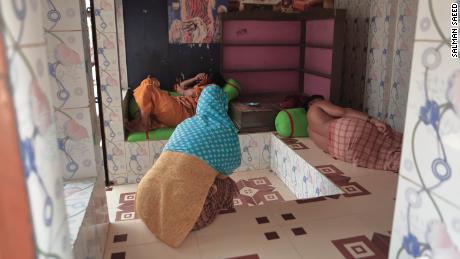
“Because of this coronavirus pandemic, we are now in trouble,” said Nodi. “We have no work.”

In late March, Bangladesh imposed a nationwide lockdown to prevent the spread of Covid-19, which has infected more than 36,000 people in the country, including more than 520 who died, John Hopkins University figures show.

As businesses and transport networks were shut down across Bangladesh, government-sanctioned brothels were also closed, with no clients allowed to enter. Since 2000, prostitution has been legal in Bangladesh, but it is regarded by many as immoral.

“Our brothel has been locked down,” said Morjina Begum, executive director of Bangladeshi charity Mukti Mohila Samity (‘Free Woman Union’ in English). “We do not allow any outside customers. Now sex workers do not have any income.”

Begum, who is a former sex worker from the brothel, added that the government, police and local NGOs including her organization are supplying relief to the women.

But several women in the brothel told CNN that the aid is not nearly enough.

Nearly 1,500 women and girls are packed inside the 12-acre site, which resembles an overcrowded slum, with densely packed alleyways lined with corrugated iron shacks, small shops and open sewers.

Many of the women have given birth to children inside the brothel, and researchers say there are currently 500 children in there, including 300 under the age of six.

“We are not getting any (food),” Nodi said. “If it continues, children will die from starvation. We pray that the virus will go away.”

Some women send their children to live with family members or at charity shelters outside the brothel, because they don’t want them to be part of this life. Nodi says she has no contact with her son, now 11, who is growing up with her former in-laws in Dhaka. It’s better that way, she says.

“We want our children to be away from us so that they can become good human beings,” Nodi said.

Usually, around 3,000 men visit the brothel every day, many of them truck drivers or day laborers who stop off at Daulatdia due to its prime location next to a train station and a ferry terminal on the Padma River, a major channel running from the Ganges.

“If it continues, children will die from starvation. We pray that the virus will go away.”

Nodi

From late afternoon onwards, the women and girls stand around in the narrow lanes as the men walk through. Once a negotiation is complete, the clients enter one of the small rooms, which usually consist of a brightly-colored bed, and a small cupboard or wardrobe. The men pay as little as $2 for sex, and around $20 for an overnight stay.

“Earlier I could have earned ($60) per day. Some days it could be ($20) and some days I would earn nothing,” Nodi said. “Now, everything is dependent on God.”

Each sex worker in the brothel has to pay daily rent to the madams, who act as a go-between for more than a dozen landlords which own this area of land. When the girls arrive via a broker, often for a sum of around $200-300, they are forced to pay off this debt to the madams.

A 2018 study conducted by the non-profit research organization, the Society for Environment and Human Development (SEHD), found that around 80% of the 135 sex workers surveyed said they had been trafficked or tricked into going to a brothel, said Philip Gain, the SEHD director.

“The conditions in the brothel are so horrible,” said Gain, the director of SEHD. “No-one would come unless they had been tortured or abused.”

Gain said there is a country-wide network of traffickers who find girls for the brothels, who are often persuaded with promises of well-paid work in a factory, or brought by force.

“Once a girl is sold into a brothel, she is trapped, it is very hard to get out,” Gain added.

More than 200 girls have arrived in Daulatdia in the past five or six years after being trafficked by a broker, says Sipra Goswami, coordinator for the charity BLAST, Bangladesh Legal Aid and Services Trust, which helps to rescue underage girls from the brothels. The organization also offers the girls legal aid and accommodation in shelters, or helps them to reintegrate with their families. Most of the underage girls they rescue are aged 12-16, Goswami adds.
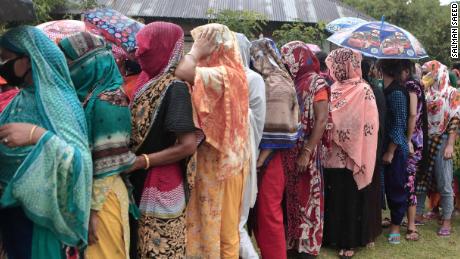
Women queue up to receive an aid delivery at the Daulatdia brothel in Bangladesh on May 14.

“They are socially excluded and vulnerable,” Goswami said. “Nowadays their condition is (at the) very worst (because of Covid-19). The after effects will be awful for them.”

Local police chief Ashiqur Rahman denied there are any underage sex workers in the brothel.

Rahman said that since he took the post in January, there have been three trafficking cases reported, adding that he tries to personally interview the women that arrive to make sure they were not forced.

Bangladesh’s Home Minister, Asaduzzaman Khan, said via text message “the law of the land prohibits trafficking in persons and there are severe penalties for the culprits. Our law enforcement agencies are vigilant and they act immediately on any such culpable crimes. Even during these extraordinary circumstances of the pandemic, we are in full alert.”

During a charity aid delivery at the brothel on May 14, hundreds of women jostled in the rain as they tried to secure one of the bags of rice being handed out; their desperation occasionally turning to frustration as tempers frayed in the crowd.

While there are no reported Covid-19 cases in Daulatdia, there was no social distancing during the distribution, although many of the women wore masks.
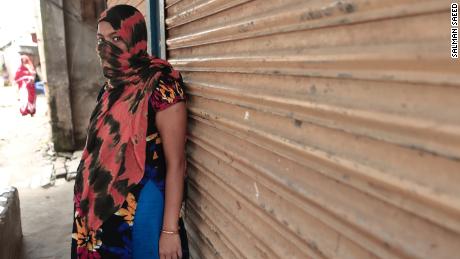
There are around 500 children in the brothel, most of them fathered by the men who visit the complex. This woman, who did not want to give a name, says she is eight months pregnant.

The local government also made an aid delivery to the brothel on March 28, which included 10kg of rice, hand sanitizer and other items for more than 1,300 women, according to Rubayet Hayat, executive officer of the local sub-district of Goalanda. He added that the country’s Prime Minister, Sheikh Hasina, also arranged for 200 of the poorest women to receive a $30 cash handout via mobile payment transfer.

The local police force — which is guarding the brothel’s entrance to stop customers entering during the lockdown — has also made multiple deliveries of rice in the past few months, according to Rahman.

“Firstly, we need to save their lives from the Covid,” he added. “Then, we try to help with the other things.

“We support them as much as possible, but this is not sufficient I think,” Rahman said. “They are in a critical situation.”

Nodi says the relief is sometimes unfairly distributed, meaning some women are left hungry.

“Now we are facing a lot of problems here, with the relief, some of us are getting it, and others are not,” she said. “If everyone gets relief, everyone will be happy.”

Shurovi, 22, was born in Daulatdia to a mother who worked there.

She was raised in a nearby safe home run by a charity, and received a good education before getting married and moving to Dhaka. But after four years, the couple separated when her husband found another wife.

Shurovi, who only wants to be identified by her first name she uses with clients, had been doing some part-time work as an actress in Bangladeshi TV soaps — a “dream job,” she said. But when the work ran out, and she was left homeless after the separation, her economic situation deteriorated and she reluctantly returned to Daulatdia, a place she thought she had escaped.
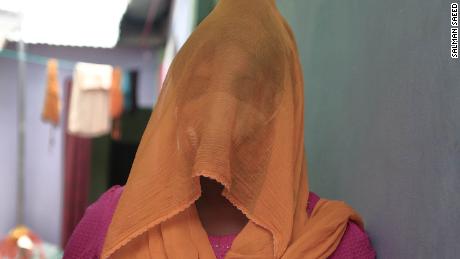
Shurovi, 22, was born in the Daulatdia brothel to a sex worker mother. She was brought up outside by a charity, but ended up returning after her marriage fell apart and she was left homeless.

She came back with a target: to be out of there within two years with enough money to buy some land.

But that aim started fading after she got pregnant with her son, fathered by a client. She also had to take out a large loan to pay for an emergency C-section during the birth. And now, her exit strategy is looking more out of reach, as she spends what little she has put aside just to survive.

“I am facing a financial crisis which threatens our survival,” Shurovi said. “If I do not have any income, I cannot support my child. I cannot manage to feed myself as well as my family.”

Shurovi says she can no longer afford diapers or baby milk, which is more than $7 for a carton.

“The support we are getting from the government is not enough,” she said. “They are not providing anything for children or any cash for our family.”

“If I do not have any income, I cannot support my child. I cannot manage to feed myself as well as my family.”

Shurovi

Shurovi’s son is 10 months old, and he lives most of the time with her mother in another room within the brothel complex.

“People who are born in these brothels, it is not their choice, they should always get a chance to live normally in society,” Shurovi said.

But the key to getting out — and staying out — is opportunity and support, she adds.

“It seems like we have died before death,” Shurovi said. “If the government does not think about us, we will be in great trouble.”

Salman Saeed reported from Daulatdia, Bangladesh and Rebecca Wright wrote from Hong Kong.

Source link

Weather forecast, alerts and UVB index for all South African provinces, 27 May 2020

Weather data provided by the South African Weather Service. For a detailed forecast of your province, click here.

Warnings: None.

Watches: None.

Special weather advisories: Very cold conditions are expected over the southern parts of Free State and Northern Cape on Wednesday, as well Chris Hani, Joe Gqabi districts and northern parts of Dr Beyers Naude local municipality in the Eastern Cape today.

Frost is expected over the extreme eastern and eastern Northern Cape as well as over the Free State on Wednesday, as well as the Chris Hani, Joe Gqabi districts and northern parts of Dr Beyers Naude local municipality in the Eastern Cape and in places in Gauteng.

Gauteng: Fine and cool, becoming cold from the south in the afternoon

UVB sunburn index: Low.

Mpumalanga: Fine and cool, becoming cloudy with evening drizzle and fog along the escarpment

Limpopo: Fine and warm, becoming partly cloudy with evening fog along the escarpment

North-West Province: Partly cloudy, windy and cool to warm.

Free State: Partly cloudy, windy and cool.

Northern Cape: Cloudy, windy and cold to cool with isolated showers and rain in the west and south but scattered in the extreme south-west. It will be fine and cool in the east where it will become partly cloudy from afternoon. Light to moderate snow can be expected over the southern high ground from the evening where it will be very cold. The wind along the coast will be light to moderate north-westerly becoming fresh south-westerly in the afternoon.

Western Cape: Cloudy and cold to cool with scattered showers and rain in the west spreading to the east from late morning but widespread in the south-west. Light snow can be expected over the western high ground in the afternoon spreading to the eastern high ground in the evening. It will be very windy. The wind along the coast will be strong to gale north-westerly south of Cape Columbine becoming strong to gale westerly to south-westerly in the afternoon, otherwise light to moderate north-westerly becoming fresh to strong south westerly in the afternoon.

UVB sunburn index: Low.

Western half of the Eastern Cape: Fine, cool and windy, becoming cloudy from the south west with isolated showers and rain spreading eastwards but scattered along the coast. Snowfall is expected in the evening and overnight on the mountains. The wind along the coast will be strong to gale force westerly to south-westerly.

Eastern half of the Eastern Cape: Fine, warm and windy. It will become cloudy from the west in the evening, with isolated showers, spreading to the Lesotho border overnight. Light evening snowfall is expected over the northern mountains. The wind along the coast will be moderate north-westerly, becoming strong south-westerly, but gale force late in the day west of Kei River.

Kwazulu-Natal: Fine and warm but cool on the western high-ground. The wind along the coast will be moderate north-easterly, becoming moderate to fresh south-westerly in the evening from the south.

UVB sunburn index: High.


Source link

Tibetan Students, State Workers Barred From Religious Events in Lhasa

Chinese authorities are closely watching government employees and students in Tibet’s regional capital Lhasa during the Buddhist holy month of Saga Dawa, forbidding them from participating in traditional religious gatherings, according to sources in Tibet.

Saga Dawa, which falls on the fourth month of the Tibetan lunar calendar and began this year on May 23, commemorates the Buddha’s birth, death, and enlightenment, and is traditionally celebrated in Buddhist countries around the world.

Though Lhasa’s famous Jokhang Temple and other religious sites are now open to the public, “students, government workers, and persons drawing a state pension are not allowed to take part in religious events,” one resident of the city told RFA’s Tibetan Service.

Parents of Tibetan schoolchildren have likewise been warned in meetings with Chinese officials not to permit their children to attend religious ceremonies during Saga Dawa, RFA’s source said, speaking on condition of anonymity.

“Authorities have warned that Communist Party members, government workers, and students who are found to have attended religious ceremonies will face severe consequences,” the source said.

“Police activity in Lhasa is also increasing at this time,” he added.

“During the initial outbreak of coronavirus in Lhasa, the schools in Tibet were all closed for a considerable time,” a second source in Lhasa said.

Lhasa area schools have meanwhile finally opened following a long period of shut-down owing to fears of the spread of coronavirus in the city, another source in Lhasa told RFA.

“During the initial outbreak of coronavirus in Lhasa, the schools in Tibet were all closed for a considerable time,” the source, a parent of schoolchildren said, also speaking on condition he not be named.

“Gradually, the schools reopened, but the kindergartens and day care centers mostly stayed closed, opening again only on May 25,” he said.

Authorities in Tibetan-populated areas of China have long sought to restrict the influence on children of Tibetan Buddhist religion, traditionally a focus of Tibetan cultural and national identity, sources in the region say.

Reported by Yangdon Demo for RFA’s Tibetan Service. Translated by Dorjee Damdul. Written in English by Richard Finney.


Source link

Rennie free to focus on Wallabies after finishing at Glasgow

“With sport in Australia planning to return soon, making the change now will also allow Dave to begin his new role as head coach of the Australian national team,” Bombrys said.

“We are grateful to Dave for everything he has done for our club over the past three seasons, and particularly for how he has been supportive of the current situation, as well as his willingness to share his vast coaching knowledge with all of our coaches.”

Dave Rennie had been due to take over as Wallabies coach on July 1 but will now travel to Australia a month earlier.Credit:Louise Kennerley

Rennie has been in contact with his Wallabies assistants and RA for months but is clear now to direct all his energy towards reviving the stocks of the national team.

It is unclear when Rennie and wife Stephanie will travel to Australia, although reports in Scottish media suggest he will depart at the earliest opportunity.

Loading

They will likely face two weeks in isolation upon arrival in Sydney.

Former Chiefs coach Rennie led Glasgow to the final four of the Pro14 in his two full seasons in charge.

They reached the quarter-finals of the European Champions Cup last year but narrowly missed out on the last eight this season.

Scottish Rugby chief executive Mark Dodson said Rennie’s tenure had been a success.

“He has brought on a young, exciting group of players at Glasgow over that period, reached a Pro14 final and led his coaching group at the club superbly.”

AAP

Source by [author_name]

Experts Predict How Coronavirus May Change Hotel Stays

0

The COVID-19 pandemic has altered the travel industry in seemingly every way imaginable. One area undergoing massive changes ― and preparing for more ― is the hotel business.

Public health experts are generally still advising against nonessential travel, but as states start to reopen, people are venturing off and booking hotel stays. And hotels are working to meet new demands in the age of COVID-19.

“Travelers want to feel safe, period,” Melanie Lieberman, senior travel editor at The Points Guy, told HuffPost. “Hotels will have to consider every amenity and service and determine what they can do to give travelers additional peace of mind. And though many of these changes may be temporary, some may be permanent.”

What might some of these changes be? HuffPost spoke to Lieberman and other travel experts to find out what the hotel experience may look like going forward.

Emphasis On Cleanliness

“Travelers will certainly hear hotels talk about their sanitization and cleaning protocols, and certain properties or brands may seek cleanliness certifications,” Lieberman noted. “The key here will be communicating their cleanliness standards to guests.”

Many hotels are already touting “enhanced” cleaning standards, which can include more thorough or frequent disinfecting of high-touch surfaces, the use of more aggressive products, and even new sanitation technology.

“Marriott, for example, said it’s going to use electrostatic sprayers and hospital-grade disinfectants,” Lieberman said. Other examples include the American Hotel and Lodging Association’s “Safe Stay” initiative, which includes new cleanliness measures, as well as Hilton’s “CleanStay” program and Accor’s “ALLSAFE” plan.

“Such things as UV light sanitizer or tech that can assist with social distancing have already started to show promise,” said Robb Monkman, founder and CEO of the hospitality safety brand React Mobile. “Hotels are also making use of digital signage reminding guests and staff about best practices.”

The increased emphasis on cleanliness could also lead to changes in many hotel room layouts and amenities. While there’s been a recent push toward the more eco-friendly bulk toiletry dispensers, some brands may return to single-use bottles. Hand-washing stations and hand sanitizers may also appear in key areas. And minibars could become a thing of the past.

“Hotels will need to evaluate what they put in the room beyond furniture as it will need to be sanitized on a daily basis, including throw pillows and blankets, printed menus, barware, and much more,” said Rob Karp, founder and CEO of the travel planning service MilesAhead. “A specific example is the chocolate or candy that many hotels leave in rooms at turndown ― I think many properties will begin to realize that guests won’t want this additional treat if it means that it could potentially be contaminated.”

Self-Service And Contactless Tech Solutions

“People go to a hotel to enjoy being taken care of, and now in a post COVID-19 world, hotels will need to find new ways to provide excellent service with limited human interaction,” said Adam Deflorian, founder and CEO of the hospitality technology and marketing firm AZDS Interactive Group.

That’s where technological advancements come in.

“Industry experts say ultraviolet, germ-killing lighting, germ-killing robots and contact-tracing apps could all be embraced by the hospitality industry.”

– Melanie Lieberman, senior travel editor at The Points Guy

“There will be an acceleration of self-service tech solutions in hotels,” said Konrad Waliszewski, co-founder and CEO of the travel app TripScout. “Services that would have happened anyway over the next decade ― such as self-service and contactless check-ins, mobile keys, mobile check-ins, and mobile SMS/chat for requests ― will become the norm for hotels.”

The ability to use your phone to unlock your hotel room would be a game-changer, as would in-room automation like mobile apps to turn on the lights, control the TV, and order room service. Monkman noted that some hotels could even implement food delivery robots — like Cleo and Leo at Chicago’s EMC2 Hotel.

“Every hotel brand and individual property will respond differently to the call for change, but some hotels have turned to technology in a big way. Industry experts say ultraviolet, germ-killing lighting, germ-killing robots and contact-tracing apps could all be embraced by the hospitality industry,” Lieberman suggested. “The Westin Houston Medical Center is already using germ-fighting robots, so it’s no longer the stuff of science fiction.”

Although recent research suggests that the coronavirus does not spread as easily through contaminated surfaces as previously thought, these measures are still useful to reduce risk and make guests and employees feel safer.

“Many hotels were adopting mobile digital check-in and digital keys prior to the pandemic — so it’s possible, after COVID-19, the days of the hotel room key will be numbered,” Lieberman said. “Or maybe not. As with almost everything these days, there’s a lot of uncertainty, and the situation is always changing.”

Masks And Temperature Checks

“Unquestionably, I think you’ll begin to see mask requirements for guests and staff,” said Deflorian. “It is proven that face coverings can significantly reduce the spread of the coronavirus. I think you’ll begin to see the opportunity to have branded masks for employees, as well as new training methods to teach staff how to show emotions while still wearing their face covering.”

Whether or not hotels require masks in public spaces may vary based on local and national requirements for businesses as well.

“Many hotels may choose to implement temperature checks upon arrival,” Deflorian added. It’s possible this kind of temperature screening technology will come along with previously mentioned enhancements like mobile check-in, digital keys and contactless payment.

Many hotels are already requiring guests and staff to wear masks.

Spacing Changes

“Most, if not all hotels, will be mandated to have fewer rooms open for service, and they will use this to market their properties as safe and secluded vacation destinations,” Karp predicted. “For example, if a hotel or resort has 100 rooms, only 60 will be available for bookings.”

He added that many hotels may implement minimum multiple-night-stay policies (i.e. requiring guests to stay for more than a night or two) to make up for lost revenue while maintaining a lower occupancy.

Having fewer guests on the property will help keep people spaced out, as will changes in lobby layouts and other public areas.

“I think from an operations standpoint, you’ll start seeing lobbies with socially distanced tables, frequent disinfectants and more outdoor seating and dining,” Deflorian said.

Monkman added that he foresees physically distanced queues, partitions at front desks and no scheduled entertainment offerings that require guest interactions. He noted that some brands like Accor are even offering guests free access to telemedicine consultants and connections to other medical services.

Bye-Bye, Buffets

“I think the days of buffets are gone,” Deflorian said. “Even well after a full recovery, I think guests will be very much concerned about buffets, but I do think there will be an increase in demand for in-room dining.”

Lieberman, however, believes buffets will survive but are not likely to remain self-service. Physically distanced lines and barriers like sneeze guards may also alter the experience.

“As the pandemic picked up, we saw a significant reduction in buffet service all across the travel industry. Airport lounges, for example, suspended self-service stations in favor of prepackaged food with individually wrapped flatware and single-serve condiments,” she said. “Some Las Vegas resorts closed buffets altogether. As with most things, we’ll probably see a gradual, phased approach to hotel buffets. Some might opt for grab-and-go, individually packaged foods, while others might opt for buffets to be staffed, rather than self-service.”

“I think from an operations standpoint, you’ll start seeing lobbies with socially distanced tables, frequent disinfectants and more outdoor seating and dining.”

– Adam Deflorian, founder of AZDS Interactive Group, a hospitality tech firm

Beyond buffets, new hotel dining procedures might involve dining rooms operating at reduced capacity and more guests reserving private dining rooms or balconies for meals. Monkman suggested automats could make a comeback.

Reservations For Amenities

“Similar to guests making a massage appointment, hotels may now require advance-timed reservations for using the tennis court, pool, spa and other amenities where guests can be in close proximity,” Karp noted.

“Golf courses in the age of the COVID-19 pandemic are operating by spacing tee times to promote safe distancing,” he added. “Any use of public facilities at hotels and resorts will need to be treated with extreme care as many guests, including potential carriers, use it on a daily basis.”

Elevator Challenges

Elevator safety has become a concern not only for hotels, but for high-rise office buildings and apartment complexes as well. Deflorian and Monkman believe that frequent sanitizing and limits on the number of riders will be common practice.

“Americans will be in the best shape of all time because most of us will choose the stairs,” Deflorian joked.

“If nothing else, travelers should expect to see hand-sanitizing stations deployed to high-touch areas all over hotels, including by elevators,” Lieberman noted. “Who knows? Maybe elevator attendants will make a comeback.”

More Direct Bookings

Waliszewski believes more travelers will book their stays directly with the hotel, rather than a third-party service like Expedia or Booking.com.

“Travelers struggled to figure out if the cancellations and changes were the responsibility of the hotel or who they booked it through,” he said, recalling the early days of the pandemic when people rushed to alter their travel plans. “Many who didn’t book directly with a hotel got screwed, or at least had a lot more hassle.”

Waliszewski also thinks hotel brands may capitalize on this shift of power away from those third-party sites.

“More people will book directly with the hotel in order have more flexibility and protection,” he said. “You already saw brands like Marriott only give reward points to customers who book directly, but expect many more perks to not be available unless booking direct.”

New Packages And Programming

“Hotels will need to figure out ways to entice guests to come, which will be challenging, particularly because the airline lift is so limited,” Deflorian said. “I think for resorts, we will begin to see all sorts of new outdoor programming and new fitness, ‘one of a kind’-type experiences ― paddleboarding, snowshoeing, backcountry skiing, etc.”

Waliszewski believes hotels may cater to local travelers craving a “staycation” as stay-at-home measures are lifted.

“People will appreciate much more what’s in their own neighborhood, will want to support local businesses, and will have to do something different since many of the obvious nature experiences will be crowded and booked up,” he said. “The hotels that embrace this with earlier check-in times and better spa packages will help offset their decline of business travelers.”

Source link

Indonesia Probes Death of Sixth Man Linked with Chinese Fishing Boats

0

A 26-year-old Indonesian died aboard a Pakistani boat last week, two months after being removed from a Chinese ship after suffering health problems indicative of forced labor, officials and activists said, bringing to six the number of deaths linked to Chinese fishing boats since December.

On Tuesday, Indonesia’s foreign office said it was coordinating with police and other agencies to investigate the May 22 death of Eko Haryanto at sea near Pakistan. He and a fellow Indonesian reportedly were transferred to the Pakistani boat in March by the captain of the Xianggang Xinhai, the Chinese boat, after Eko complained about his ailing hands, according to Destructive Fishing Watch (DFW), an Indonesian activist group.

“The minister has coordinated with relevant institutions and National Police’s General Crimes Unit to investigate the case,” Teuku Faizasyah, spokesman for the Ministry of Foreign Affairs, told BenarNews, an RFA-affiliated online news service.

Eko’s body was taken to a hospital in Karachi after he died at sea, and the ministry was planning to return his body and repatriate the other Indonesian, Hamdan, as soon as coronavirus-related travel restrictions were lifted, Teuku said.

“Hamdan is now at the Indonesian Consulate General shelter in Karachi, while Eko’s body is still in the hospital,” Teuku said.

Death reported to complaint center

Hamdan reported Eko’s death through the Fisher Center Tegal, a complaint center coordinated by DFW in Central Java province. In his report, Hamdan provided a video that showed Eko unable to move his right hand.

“The video showed that he was having symptoms of paralysis such as stroke, where he could not move his right hand, plus depression and severe stress. Based on the initial screening, there was forced labor,” Mohammad Abdi Suhufan, the coordinator of DFW, told BenarNews, referring to a viewing of the video.

Eko and Hamdan worked more than 12 hours a day on the Chinese boat and Eko was ordered to keep on working although he had complained about a pain in his hands, Abdi said.

The pair had worked aboard the Xianggang Xinhai since November 2019, according to DFW. Both men were promised a monthly salary of U.S. $300 (4.4 million rupiah) but had not been paid, Hamdan alleged in his complaint to DFW.

The two had been recruited for the Chinese boat by PT Mandiri Tunggal Bahari, the same Indonesian manpower recruitment firm allegedly involved in the case of Herdiyanto, an Indonesian crewman who died on a Chinese fishing boat, Luqing Yuan Yu 623, and whose body was tossed into Somali waters on Jan. 23 a week after his death, Abdi said.

“The government should make sure PT Mandiri Tunggal Bahari takes full responsibility for Eko’s death,” Abdi said.

During the past two weeks, Indonesian police have named five people from four local agencies who were allegedly recruiting workers for two Chinese fishing boats, the Luqing Yuan Yu 623 and Long Xin 629, as suspects in human trafficking. Police have arrested all five but they have not filed charges under the country’s anti-human trafficking laws.

Authorities opened the case into Herdiyanto’s death after a video, which showed his body being thrown overboard off Luqing Yuan Yu 623, had circulated on social media, while a second video showed him being assisted by three other people because he could not walk.

Central Java police were conducting the probe into PT Mandiri Tunggal Bahari, said Ferdy Sambo, director of the general crimes unit at the national police, without going into detail.

Police launched the probe into the Hediyanto case after the Indonesian government earlier this month complained to the Chinese government about the deaths of four other Indonesians who had allegedly worked in harsh conditions as crew member on Chinese fishing boats. Bodies of three of those four were allegedly thrown overboard, a crew member said in an interview with South Korean media.

On May 10, Indonesian Foreign Minister Retno Marsudi condemned the alleged mistreatment of the four Indonesian sailors, and said she had been told they were forced to work at least 18 hours a day. Indonesia and China were launching a joint investigation into the allegations of abuse, Retno said at the time.

On Tuesday, officials at the Chinese embassy in Jakarta could not be immediately reached to answer questions about Eko’s death.

Reported by BenarNews, an RFA-affiliated online news service.


Source link

China’s Young Struggle for Jobs in the Post-Outbreak Era

0

Ms. Huang, who graduated last year from one of China’s most prestigious drama schools, got an offer in December for her first job in show business, working for a company that books bands for bars in Beijing and Shanghai.

The coronavirus, which virtually froze China for weeks, brought that gig to an end before it began. Ms. Huang has picked up freelance film production and publicity work, but she has slashed her spending and is counting her money.

“When it was April and I still couldn’t start my job, I started to feel worried,” said Ms. Huang, 24. “I began worrying that I may not be able to work this year at all. I can’t just keep waiting.”

Relations with the United States are at their lowest point in decades and Hong Kong is seething with fear and anger, but China’s biggest problem by far is getting its people back to work. Millions of workers were laid off or furloughed while China battled the coronavirus outbreak. Many of those who kept their jobs have seen their pay cut and future prospects narrow.

China’s youngest workers in particular have entered perhaps the country’s toughest job market in the modern era. Many are reducing their expectations to take any job they can get. The pressure is about to intensify: Another nearly 8.7 million young college graduates are waiting in the wings this year.

China is not the only country where younger workers are facing a jobs crisis — young adults in the United States are particularly vulnerable in the downturn. But for the world, global growth will be hard to rekindle until China gets fully back to work. And the damage to the Communist Party could be long lasting. It derives its political power from the promise of delivering a better life for the Chinese people, a promise that has become increasingly difficult to fulfill.

Demonstrating the depths of the uncertainty, Chinese leaders meeting in Beijing since last week parted with precedent and declined to set an annual economic growth target. But they have unveiled other goals that detail their biggest worries, including cutting unemployment in the cities and taming food inflation, which has jumped because of outbreak-related supply disruptions and an unrelated swine disease.

Chinese leaders have acknowledged broader problems in the work force. China’s factory workers have been hit by the trade war with the United States. Service sector companies like online delivery firms are hiring, but these jobs offer low pay and high stress.

Last week, at the opening of China’s annual parliamentary session, Li Keqiang, China’s premier, cited both unemployment and the hundreds of millions of underemployed workers doing odd jobs with flexible hours and low pay. “We will make every effort to stabilize and expand employment,” he said.

To help, China’s top leaders pledged this weekend to “use all possible means” to create jobs, including a goal to create nine million new jobs this year. But many of its plans borrow from Beijing’s old playbook, which include spending on public works, funding wasteful state-run companies and keeping the financial sector supplied with new money.

Those tactics have proven to be less effective in recent years. Even when banks are pushed to lend to smaller businesses, China’s biggest group of employers, the borrowing burden is still too high for many companies. Spending on public works gets less bang for the buck than it once did, as China’s economy matures and as its work force becomes increasingly college-educated and office bound.

China’s current official unemployment statistics, while considered imprecise by many economists, nevertheless suggest the depth of the problem for young workers. The jobless rate for people between the ages of 16 and 24 totaled nearly 14 percent, more than twice the official figure for the nation as a whole.

In forums online, young job seekers share their frustrations. “I’m about to cry,” one person recently wrote on Weibo, the popular Chinese social media service. “Finding a job is as difficult as finding a boyfriend.”

Many use words like “lost” to describe their state of mind. “I’ve exhausted all kinds of software for job hunting,” another person wrote. “Did not find a job! What more can you do!! I’m going to lose faith.”

Many of these job seekers have lowered their salary expectations and are choosing to focus their energy on finding job security at a state-owned company. While private firms are typically more popular, competition for jobs among them has become fierce, according to a recent survey of 3,000 university graduates by Liepin, a recruitment platform. Three-quarters of graduates said they expected to earn less than $1,100 a month, one of the lowest salary ranges in the survey.

Guo Minghao, a computer science major, won an internship in December. In January, as the outbreak erupted, it was rescinded. He has since interviewed at two dozen other companies that he considered sure bets for job offers. None came.

“For the first time, I felt for sure the impact of the epidemic environment had finally started to affect me,” said Mr. Guo, who added that his darkest moment was in March, typically the best time to look for a job.

Then, with the help of one of his teachers, he finally won an internship at a smaller company in the southern city of Shenzhen. But his friends worried that life in that modern, glittering city will be more expensive than the northern rust belt province of Heilongjiang where he went to school.

Mr. Guo considers himself lucky — his starting salary will be around $980 a month — which he said would be enough to cover basic expenses. He is confident that he can then turn the internship into a job and get a raise.

Mr. Guo’s friend, 22-year-old Lin Yuxin, is taking a different route. He decided against pursuing a job in a big city at a company like Tencent, the Chinese internet giant and ultimate symbol of success for computer science graduates. In today’s market, he figured, safety is more important than prestige, higher pay or career advancement.

“The larger private enterprises like Tencent, their probability of closing down might be something like 0.00001, but it’s nothing compared to state-owned enterprises,” Mr. Lin said.

Chinese companies that are hiring can afford to be choosy. Recruiters can choose from a larger pool of candidates, said Martin Ma, a human resources officer for iSoftStone, a software development company that has more than 60,000 employees and counts big foreign and domestic companies as clients. Starting salaries are lower.

“The posts available for graduates are all basic, and the salary isn’t too high,” Mr. Ma said. “The graduates do not fully understand the market. Their expectations are quite high.”

Ms. Huang, the drama-school graduate, was inspired by her parents to go into entertainment. Her mother had been an opera singer, of a style popular in southern China, and her father had been a musician in her troupe.

She attended the Central Academy of Drama, which boasts Chinese film stars like Zhang Ziyi and Gong Li among its alumni, and graduated with a dream of someday producing plays and performances of her own.

The coronavirus upended those plans. She now lives on $500 a month, with half going to rent for her apartment in the commuter town of Yanjiao near Beijing, that she gets from savings, her family and from the cash gift she received during the Lunar New Year holiday in January.

“Many of my plans have been disturbed,” Ms. Huang said. “I also hesitate to place orders for many things I wanted to buy.”

Ms. Huang is considering whether she can pursue a master’s degree abroad. That route would require the world to shrug off its outbreak-era limits on travel, which seems far from certain anytime soon.

“Because of the pandemic, the whole world is in a disarray,” Ms. Huang said. “So I feel stuck in limbo.”

Coral Yang contributed research. Cao Li contributed reporting.

Source link

The horror games: Chillingly good entertainment and sleepless nights

Looking for a new horror game to get your heart pumping and the adrenaline rushing? Then have a look at these three horror games which are guaranteed to have the desired effect.

Outlast 

If you are looking for gore, horror, and a very strong adrenaline rush, then this horror survival game is perfect for you. It’s played in first-person mode as investigative journalist Miles Upshur. You must investigate Mount Massive Asylum, a very remote psychiatric hospital located in the deep mountains of Lake County, Colorado.

The game is filled with enough gore and bothersome scenes to keep you up at night and jump scares that will keep you on your toes. You do not get a moment of peace and this game will keep you hooked.

And more good news? This is only the first game in the series. Check out Outlast: Whistleblower, followed by Outlast 2, which continues the original story.

Little Nightmares

This is a really good horror game that will definitely keep you hooked. It tells the story of Six, a nine-year-old girl who must escape from a huge ship called The Maw out in the middle of the ocean. She must start from the bottom of The Maw and find a way out.

The game has beautiful graphics and a very eerie atmosphere. There are moments that will leave your heart pumping and have you panicking. And do not be fooled by the cute cover — you will see some very disturbing things…

Amnesia: The Dark Descent

This game, much like Outlast, is a first-person survival horror game in which you play as Daniel who is navigating Brennenburg Castle. You must avoid multiple dangers as you make your way through the castle, as well as solve various puzzles.

This game is very atmospheric and will have you on your toes the entire time. It does not hold back on the scares and will have chills running down your spine even when nothing is happening on screen. This game is a definite must-play for any horror game fans and be sure to check out the rest of the games in the Amnesia series. 

Check out these games and enjoy them. You probably will not be getting any sleep again any time soon. Goodluck!


Source link

At Least A Dozen Local TV Stations Are Running ‘News’ Segments Produced By Amazon

Last week, Amazon, the online shopping behemoth, emailed local TV newsrooms across the country to pitch a pre-scripted video package touting its new fulfillment center safety protocols. The trillion-dollar company is in damage control mode amid mounting reports alleging that it has endangered its warehouse employees during the pandemic.

“Amazon is giving your viewers for the first time an inside look at it’s [sic] buildings to see how the company has transformed it’s [sic] operations in response to COVID-19,” the company said in its email to various newsrooms, which HuffPost obtained and reviewed.

Its scripted segment — which flaunts how Amazon has reportedly “transformed its operations” to protect its workers — provides no context about the expansive COVID-19 outbreaks inside some facilities, or the company’s recent firing of a dissenting employee, or the eight Amazon warehouse workers who are known to have died from the virus. 

At least a dozen news stations — including affiliates of ABC, NBC and CBS — have aired near-verbatim or modified versions of the segment in recent days, HuffPost found. Only one station that did so, ABC’s WTVG in Toledo, Ohio, disclosed the report was “from Amazon.”

Other journalists refused to run the segment outright.

“More than 30 of [Amazon’s] workers have gotten COVID-19 in Kenosha and it refuses to cooperate with the local health department. Yet @amazon still has the gall to send newsrooms this pre-packaged trash and hopes a self-respecting news operation would run it,” tweeted A.J. Bayatpour, a reporter for WKOW 27 in Madison, Wisconsin.

Bayatpour told HuffPost that of all the PR tactics he’d seen in his more than a decade of news experience, he’d never received “a full-on prepackaged news story” before.

“It’s our policy that we would not run something like that,” he said in a phone interview on Tuesday. “We need to be able to ask questions ourselves; we can’t just simply take what someone’s giving us and not be able to question it at all. If something’s prepackaged, of course we can’t do that, and for us that’s where the line is.”

Amazon told HuffPost that its video package was not promotional, and claimed that many companies have produced similar videos for news outlets.

“We welcome reporters into our buildings and it’s misleading to suggest otherwise,” said a spokesperson. “This type of video was created to share an inside look into the health and safety measures we’ve rolled out in our buildings and was intended for reporters who for a variety of reasons weren’t able to come tour one of our sites themselves.”  

The company sent the segment to newsrooms just days ahead of its annual shareholder meeting, in which investors plan to address concerns about warehouse workers’ wellbeing, as Courier Newsroom reported.

In its scripted video, Amazon notes that it has implemented more than 150 new health and safety measures including thermal screenings, sanitizer and masks for workers, as well as newly installed hand-washing stations, social distancing set-ups and regular facility deep-cleanings. It features glowing soundbites from three Amazon employees, including Stanaleen Greenman, who works in one of the company’s more than 175 warehouses.

“I feel safe coming to work every day,” she says. “The littlest job I do in here could mean the world to everybody else outside.”

The coronavirus outbreak has triggered a surge in Amazon orders, causing its stock to hit an all-time high. This unprecedented demand has also placed extraordinary pressure on its warehouse employees, whose functions are considered to be essential, though the company said it has hired an additional 175,000 associates.

Workers across the U.S. have protested against Amazon’s coronavirus response, accusing their employer of prioritizing its revenue above their safety. The company has repeatedly refused to disclose how many workers have contracted the virus.


Source by [author_name]

Most Medicare Enrollees May Soon Only Pay $35 A Month For Insulin

WASHINGTON (AP) — Medicare recipients will be able to get prescription plans that limit copays for insulin, a potential savings of hundreds of dollars, the White House announced Tuesday in a pivot to pocketbook issues that could influence November’s election.

The new benefit — to be formally unveiled at a Rose Garden event Tuesday afternoon — is being touted as a major accomplishment by Trump administration officials eager to change the subject from the grim drumbeat of coronavirus pandemic news.

Older adults who pick a drug plan offering the new insulin benefit would pay a maximum of $35 a month starting next year, a savings estimated at $446 annually. Fluctuating cost-sharing amounts that are common now would be replaced by a manageable amount.

The new insulin benefit will be voluntary, so during open enrollment this fall Medicare recipients who are interested must make sure to pick an insurance plan that provides it. Most people with Medicare will have access to them.

Stable copays for insulin are the result of a deal shepherded by the administration between insulin manufacturers and major insurers, Medicare chief Seema Verma told The Associated Press. The three major suppliers, Eli Lilly, Novo Nordisk and Sanofi, were all involved.

“It was a delicate negotiation,” Verma said. Drugmakers and insurers have been at odds in recent years, blaming one another for high prices. “I do think this is a big step.”

The deal comes as President Donald Trump returns to the issue of drug prices, trying to woo older people whose votes are critical to his reelection prospects.

The cost of insulin is one the biggest worries for consumers generally concerned about high prices for brand name drugs. Millions of people with diabetes use insulin to keep their blood sugars within normal ranges and stave off complications that can include heart disease, blindness, kidney failure and amputations. People with diabetes also suffer worse outcomes from COVID-19.

Trump last week told Republican senators at a Capitol Hill meeting he still wants to pass a bill this year to lower drug costs, saying “I think you have to do it,” according to a summary from an attendee. Bipartisan legislation to limit price increases and reduce costs for older people with high drug bills is pending in the Senate.

An AP-NORC poll in May found that 54% of adults 60 and older said they disapproved of how Trump is handling his job as president, while 45% approved.

The fate of drug pricing legislation ultimately seems to rest with House Speaker Nancy Pelosi, who has a much more ambitious plan for Medicare to negotiate prices for the costliest drugs, not just insulin. Pelosi would use expected savings to provide vision, dental and hearing coverage for older adults. Most Republicans oppose that approach as an expansion of government price-setting.

Although the White House and Pelosi’s office were in conversations last year about prescription drug legislation, the relationship between the two leaders has been tense and angry for months.

White House Counselor Kellyanne Conway told AP the administration can’t wait for the Democratic-controlled House on drug prices. “Waiting for them to act is very perilous,” Conway said.

Verma, head of the Centers for Medicare and Medicaid Services, said 1,750 insurance plans that offer drug coverage to Medicare recipients have agreed to provide insulin for a maximum copay of $35 a month next year. It will be available through “enhanced” plans that may cost more per month but offer additional benefits such as reduced cost-sharing on certain drugs. The cap on copays is expected to lead to a small increase in premiums.

Importantly for patients, the new benefit would cover a range of insulin products, including pen and vial forms for rapid-acting, short-acting, intermediate-acting and long-acting versions.

One out of three people with Medicare have diabetes, and more than 3 million use insulin. At list prices, the drug can cost more than $5,000 a year. Although insured patients don’t pay that, they do notice rising copays that are based on the full cost. People who can’t afford their insulin may try to cope by reducing their doses, a dangerous calculation that can put their lives in jeopardy.

Medicare’s prescription drug benefit is offered by private insurers, either as a stand-alone “Part D” drug plan added to traditional Medicare, or as part of a managed care plan under Medicare Advantage. The taxpayer-subsidized private plans are closely regulated by the government, but by law Medicare is barred from negotiating drug prices — something Democrats including presidential candidate Joe Biden want to change.

Insurers and drugmakers welcomed the announcement. The industry group America’s Health Insurance Plans called it an “excellent example of public-private partnerships where everyone wins.” The Pharmaceutical Research and Manufacturers of America said it’s pleased to see the administration focused on lowering out-of-pocket costs for patients.

Medicare estimates that about 6 in 10 beneficiaries are already in prescription drug plans that will offer the new insulin benefit. Those whose plans don’t offer the new option can switch during open enrollment season, which starts Oct. 15. Medicare’s online plan finder will help beneficiaries find plans that cap insulin copays.

The insulin benefit will be available in all 50 states, Washington, D.C., and Puerto Rico. Participation is voluntary for insurers and Medicare recipients alike.

In a twist, the new Trump insulin option stems in part from experimentation authority that Medicare gained under the Obama-era Affordable Care Act, which the White House is seeking to overturn as unconstitutional.

Associated Press writer Hannah Fingerhut contributed to this report.


Source by [author_name]