Tuesday, April 21, 2026

Shearing Sheep, and Hewing to Tradition, on an Island in Maine

With travel restrictions in place worldwide, we’ve launched a new series, The World Through a Lens, in which photojournalists help transport you, virtually, to some of our planet’s most beautiful and intriguing places. This week, Greta Rybus shares a collection of photographs from a set of islands in Maine.


Three miles off the coast of Maine, in a remote area northeast of Acadia National Park, lies a cluster of islands — including Little Nash Island, Big Nash Island and Flat Island — populated only by sheep.

The Wakeman family, who live on the nearby mainland, are the year-round caretakers. Alfie Wakeman works full-time as a pediatric provider in the local clinic. His wife, Eleni, works full-time as a speech-language pathologist and the assistant fire chief for the local volunteer fire department. Their three daughters — Wren, Lilly and Evie — are all college-age or newly graduated.

Each spring, Alfie leaves his medical practice for three weeks to live on Big Nash Island for the lambing season. (In his text messages, Alfie includes smiley faces when he talks about going to the island, or about new lambs; sad faces punctuate his texts when he discusses leaving the island.) The sheep, wild and self-sufficient, are able to thrive off the providence of the island. But every so often a sick lamb needs special care.

About a century ago, a 10-year-old girl named Jenny Cirone — the daughter of the lighthouse keeper on Little Nash Island — began raising sheep. She would go on to tend her flock for more than 80 years.

Alfie, Eleni and their daughters knew Jenny well. They lived next door to her and helped her care for the island and its sheep. They still understand this part of the world largely through Jenny and her stories.

Jenny knew everything about the island and the ocean around it. She hauled lobster traps with Alfie almost until the day she died, a month shy of 92. She remembered each sheep, its lineage, how much wool it made. She gave names to every lamb, and to each spot on the ocean floor that was good for a lobster trap.

At the end of lambing season, a community gathers on Big Nash to help round up and shear the sheep. (The other islands’ sheep will be sheared, too, but those require smaller crews.) The volunteers — around 40 people — include a handful of knitters and spinners; they often wear sweaters made of Nash Island wool. Some show up because they live down the road and are accustomed to pitching in. Others are lured by an adoration of good wool. Still others come because of the island itself — for the tradition, for the memory of Jenny.

Before they’re sheared, the sheep must be rounded up — a process that requires considerable patience. Around 20 people sweep the island methodically; no animals can be left behind on the little hills or rocky beaches, and the sheep shouldn’t be spooked. (Sheep are notoriously skittish.) Everyone joins in — their arms outstretched, their hands sometimes clasped together — as they funnel the sheep toward a corral made of salvaged driftwood.

When the corral is full, the crew works to pull lambs from underneath the sheep, moving them to a separate pen; there, the rams are castrated and the ewes’ tails are docked. Each lamb and sheep is carefully checked and given any necessary care. Meanwhile, the shearers skim whirring blades along the bodies of the sheep, their hands and the clippers hidden under the thick wool. (Much of shearing is done blindly, by feel.)

The work is physically demanding, but the shearers move quickly, often without pausing for food or water. After hours of labor, and once the last sheep’s wool has been removed, the shearers return their tools to their cases, the blades slick with lanolin, and the group migrates to a cabin — Big Nash’s lone building — for a potluck meal: baked beans, a salad, turkey, rhubarb cakes. A simple rule is announced: “The shearers eat first.”

Another roundup will happen again in the fall: The sheep will be gathered, checked and tended to. Some will stay on the island, growing thick with wool, while most of the males and a handful of ewes will be brought to the mainland to be processed as meat.

The sheep chosen for slaughter will be scooped up, their soft woolen bodies carried from the driftwood pen, down the rocky beach, to a dinghy. Then, from the dinghy to the family’s lobster boat, until sheep are packed from bulkhead to transom, calm and blinking in the sun. Volunteers will sit on the sides of the boat or climb onto its top as it motors back to the mainland. A waiting truck will bring the sheep to the local butcher.

Maine was once a land of shepherds. Its islands and coastal communities were dotted with the fleeced bodies of sheep, its shrubs and trees grazed into oblivion. Historical photos show wide expanses of pasture that have now become thick with forests and houses.

Back then, there were more families like the Wakemans, who raised their own animals and grew their own food, who gathered people together to share both their work and a meal, who used dark humor and whispered their thanks on the days when animals gave up their wool or became food.

Some of the sheep spend their entire lives on these islands, from birth to death. They become the islands. Their sun-bleached bones are entrenched in the earth, embedded in the grassy knolls and wetlands where they once grazed, their bodies decomposing to nourish a new generation.

Jenny Cirone is also here; her gravestone sits at the far end of Big Nash, her ashes buried in the place with the best view of the lighthouse. She, too, is a part of the island — the grass, the sea, the sheep, the story.

Source link

The Office Elevator In COVID Times: Experts Weigh In On Safer Ups And Downs

0

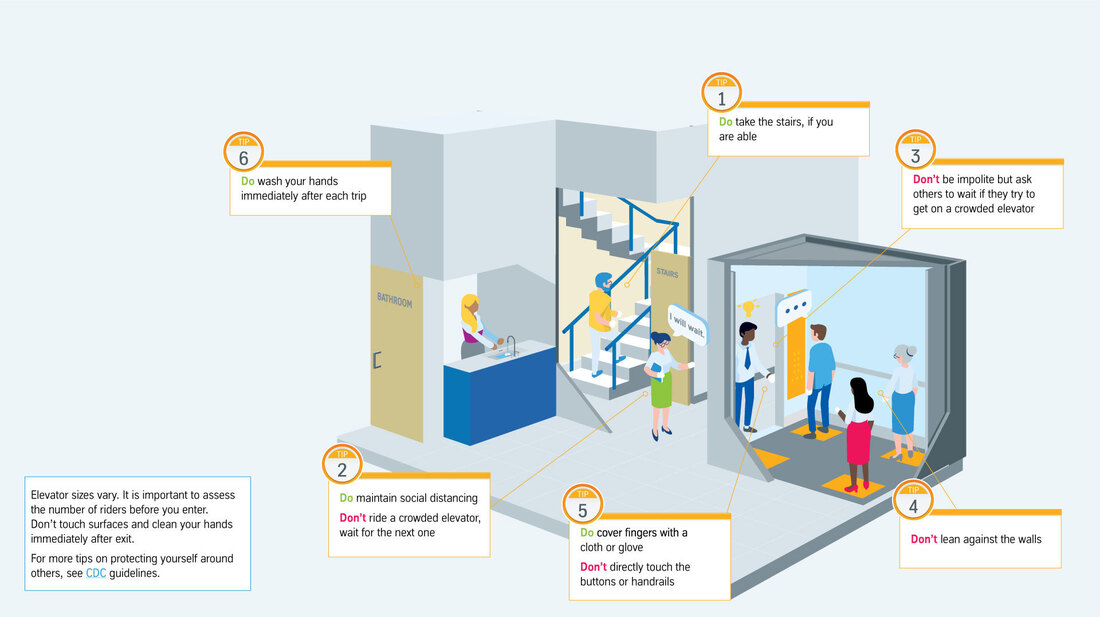
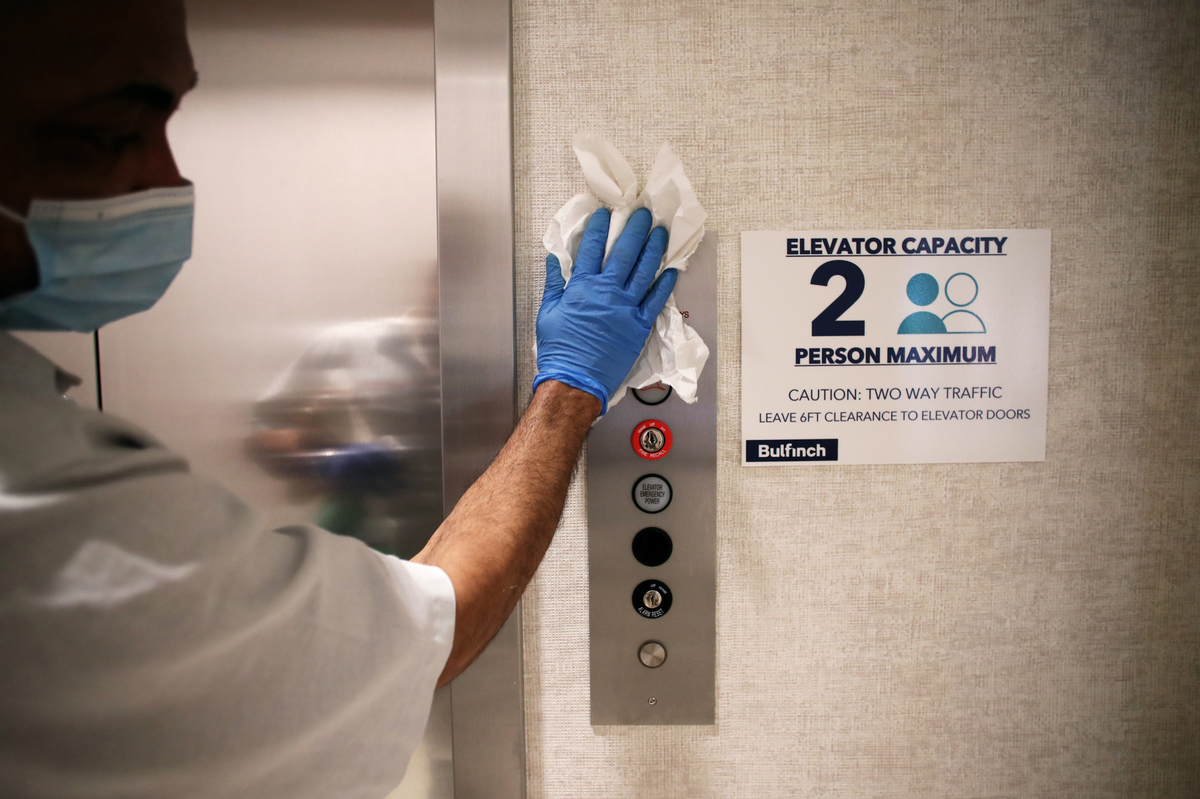
Elevator safety measures that take COVID-19 into account are posted at Cambridge Discovery Park, a life sciences office development in Cambridge, Mass.

Craig F. Walker/Boston Globe via Getty Images


hide caption

toggle caption

Craig F. Walker/Boston Globe via Getty Images

Elevator safety measures that take COVID-19 into account are posted at Cambridge Discovery Park, a life sciences office development in Cambridge, Mass.

Craig F. Walker/Boston Globe via Getty Images

When the American Medical Association moved its headquarters to a famous Chicago skyscraper in 2013, the floor-to-ceiling views from the 47th-floor conference space were a spectacular selling point.

But now, those glimpses of the Chicago River at the Ludwig Mies van der Rohe-designed landmark, now known as AMA Plaza, come with a trade-off: navigating the elevator in the time of COVID-19.

Once the epitome of efficiency for moving masses of people quickly to where they needed to go, the elevator is the antithesis of social distancing and a risk-multiplying bottleneck. As America begins to open up, the newest conundrum for employers in cities is how to safely transport people in elevators and manage the crowd of people waiting for them.

If office tower workers want to stay safe, elevator experts think they have advice, some practical, some not: Stay in your corner, face the walls and carry toothpicks (for pushing the buttons). Not only have those experts gone back to studying mathematical models for moving people, but they are also creating technology like ultraviolet-light disinfection tools and voice-activated panels.

“When there is risk of disease spreading from human to human, continuing to maintain a clean and safe vertical transportation system is critical to help people return to work and safe living,” says Jon Clarine, head of digital services at Thyssenkrupp Elevator.

A schematic from Thyssenkrupp Elevator details the various risk points for viral transmission in and around elevators, and explores ways to minimize that risk.

thyssenkrupp Elevator


hide caption

toggle caption

thyssenkrupp Elevator

After all, most elevators are inherently cramped, enclosed spaces that can barely fit two people when they are safely spaced 6 feet apart, much less the dozen or more that elevators in commercial and residential buildings were designed to hold. They’re a minefield of touchable buttons and surfaces. Air circulation is limited to what a few vents and the opening doors can manage. Plus, they’re usually mobbed during the morning, lunchtime and evening rushes.

The good news is, while infection transmission is possible if people happen to leave behind respiratory droplets of virus in the elevator, the time spent on a ride is short, says infectious disease expert Dr. Steven Lawrence of Washington University School of Medicine in St. Louis.

But still, he says, “you’re in a small box.”

Pack a mask, sanitizer and tissues or toothpicks

To mitigate those risks, elevator experts stress that those riding elevators should wear masks, resist touching surfaces as much as possible and use items such as disposable tissues or indeed those toothpicks to touch the buttons. Also, use hand sanitizer frequently. The Centers for Disease Control and Prevention recommends limiting time in elevators and taking one-directional stairs instead, when possible, as well as abiding by the 6 feet of distance.

Karen Penafiel, executive director for the National Elevator Industry Inc. trade association, also recommends people face the elevator walls and not talk — to minimize spread of respiratory droplets that could carry the coronavirus.

“It makes sense when you think about it, but it’s so contrary to every social protocol we have been raised with,” Penafiel says. “It’s not comfortable.”

But the biggest hang-up across city skylines for offices and residences may be the recommendation by Penafiel and other elevator experts to limit the number of passengers in most elevator rides to four to accommodate social distancing — one person in each corner. That creates a logistical challenge for building managers and employers who have thousands of people to move within a single building.

AMA Plaza owner Beacon Capital Partners plans to limit its elevator riders to four at a time, according to an email from company spokesperson Maureen Richardson. The same goes for the more than 90-floor One World Trade Center in New York City and the roughly 8,000 people who report to work there, says Jordan Barowitz, spokesperson for the Durst Organization, which oversees the management of the iconic skyscraper.

Cutting the number of people moving up a building per ride — in some places by as much as two-thirds — means people wait and wait, huddling in the lobby, coughing, sneezing and talking loudly.

“That’s where you’re going to get the queuing,” says Chris Smith, vice president of marketing and product strategy for elevator manufacturer Otis Elevator Co., optimistically using a word suggesting orderly standing in line.

It’s no wonder Smith’s customers have been calling nonstop about the elevator bottleneck. So Otis staffers have been simulating for customers how staggered times for starting the workday and different employee spacing could help slow the flow of traffic.

There’s math in elevator safety

It all comes down to hard math. On a normal day, more than 3,000 people work in the 52-story AMA building. With only four passengers at a time, which is about half the number of riders in a typically crowded elevator, that translates to about 750 elevator rides each morning launching from 24 elevator cabs (and that’s not counting the trips made by separate freight cabs).

The Langham, a luxury hotel occupying the building’s first 13 floors, will be placing a sign with graphics in the elevator foyer to encourage social distancing, says spokesperson Deepika Sarma. Hotel staffers are looking into possible decals for the floors of the elevators indicating where to stand, and requiring riders wear masks.

Another tenant of AMA Plaza, WeWork, whose business model depends on people renting its office space, will be placing signage denoting safe distances in the elevator lobbies of its buildings, as well as touch-free hand sanitizer dispensers. WeWork CEO Sandeep Mathrani told CNBC that 40% of its sites occupy office space low enough within buildings that people could take the stairs instead.

But climbing, say, 36 flights of stairs isn’t an option for most people. (Top stair racers take five minutes to cover that many floors. It takes a person of average fitness up to 25 minutes.) And stairs aren’t viable in buildings of any height for those with physical disabilities or mobility issues or when carrying heavy loads.

To be sure, those who live in high-rises have already been navigating these questions — whether in luxury buildings with resources or public housing units without.

But as more offices look at reopening, Otis and Thyssenkrupp have been swamped with calls from customers asking for new technology to help them manage these new challenges, given the coronavirus pandemic. Destination dispatching, in which employees can swipe a key card at a turnstile that notifies the elevator where they need to go, has seen a surge of interest due to its touchless control — and during the pandemic, elevators have been reprogrammed to limit the weight load to a smaller number of passengers.

Other product offerings in the works include calling the elevator via cellphone, antiviral stickers for elevator buttons, lobby concierge-run elevators, express service for each elevator ride, ultraviolet-light HVAC purification systems and even elevator buttons that riders can activate with their feet, voice or hand gestures.

To reduce the need to touch buttons, Otis’ Smith says, elevators could be placed into “Sabbath service” mode, where they automatically go to each and every floor — a service offered for decades for those whose religion dictates they not operate electrical devices on certain days.

“It’s all about helping customers manage risk”

Brand-new businesses designed to make elevators safer are emerging. Over two months ago, Philip Rentzis helped found Ashla Systems, which sells ultraviolet-light systems designed for elevators that are similar to those used to kill viruses for hospital instruments. At least 100 buildings have already signed up to install the technology, he says, in part because building owners are terrified about the long-term costs of keeping up their new rigorous cleaning regimens.

Michael Rogoff, president of the New York City and South Florida residential management firm Akam Living Services Inc., says the staff in some of his buildings are cleaning the elevator more than once per hour — or even after every use. When residents complain that they shouldn’t have to pay for communal amenities they’re not able to use, he points to the new cleaning costs.

“The elevator cleaning and disinfecting is just on a whole new level than it was previously,” Rogoff says.

But even as companies evaluate their suite of elevator options, harsh realities are emerging of how challenging it will be to move the workforce where it needs to be, Thyssenkrupp’s Clarine says.

“Look, you’re going to disrupt the flow of traffic in your building, but how long are you willing for that to be an inconvenience before it becomes a disruption?” Clarine says. “It’s all about helping customers manage risk, and some want to manage more so than others.”

For now, the American Medical Association says it plans to allow its roughly 1,000 employees to return to the offices approximately 30 days after government leaders lifted their stay-at-home orders. City orders were loosened Wednesday.

The association’s initial return-to-work phase will begin with “approximately 10% of employees on a voluntary basis,” according to a statement issued by association media manager Robert Mills. It’s not yet clear when — or how — it will be able to get the rest of its staffers up to their offices in the sky.

Kaiser Health News is a nonprofit, editorially independent program of the Kaiser Family Foundation. KHN is not affiliated with Kaiser Permanente.

Source link

The Idea: Build It, and They Can Find Coronavirus Tests

For the past two months, the nine-to-five jobs at their recruiting software company were just the start of a busy work day for Joe Essenfeld, Boris Kozak and Matt Geffken.

After a short break for dinner and a little family time, the three friends would jump on an 8:30 p.m. Zoom call with a dozen other volunteers to work on AllClear, a website to help people find information about testing locations for Covid-19, and stay at it until 2 or 3 a.m.

AllClear now has a directory of more than 10,000 locations in the United States where people can be tested for Covid-19 or for antibodies to the coronavirus. The listing for each location is displayed on a map and contains information such as the test type and whether an appointment is necessary.

The excitement of doing something new felt familiar to the three men, who worked together at Jibe, a software company Mr. Essenfeld started. Last year, Jibe was sold to iCIMS, a recruiting software company where they still work. But there is no financial reward awaiting them this time. They have already spent $35,000 of their own money for something that they promise won’t ever make a cent.

They are representative of a digital volunteerism that has emerged during the pandemic. As the coronavirus has spread and frustration with the federal response to the crisis grew, some entrepreneurs and engineers applied their start-up ethos to help.

Among them are Carl Bass, former chief executive of the software company Autodesk, for example, is assembling 1,500 face shields a day for nurses and doctors from a robotics warehouse in Berkeley, Calif., and sending them across the country. Lan Xuezhao, founding partner of Basis Set Ventures, a venture capital firm in San Francisco, tapped her connections in China to procure tens of thousands of medical masks straight from the factories for hospitals.

When Messrs. Essenfeld, Kozak and Geffken, who all live in the New York metro area, set out to build AllClear in mid-March, the original vision was to create a social network for people to share their experiences with the virus, including whether they had been tested.

It was the type of half-joking, half-serious idea that the trio regularly bounce off one another, like the time they considered selling caffeinated pickles or iced coffee that smelled like hot coffee. But as the seriousness of the pandemic became clear, they felt the itch to do something.

“Feeling powerless during this crisis was difficult to deal with,” Mr. Essenfeld said. “But building this has been helping us cope with that.”

They honed in on making it easy to find testing sites. At the time, it was difficult to find information on where and how people could be tested. The information that was available was dispersed across the internet on a variety of websites and came from local health agencies, hospitals and even social media. The data was often unreliable and inconsistent.

The challenge of collecting and organizing data, however, was familiar to them. At their start-up, they had faced similar issues with job listings, information that changed frequently and was dispersed across the web.

“We’ve done this over and over again,” Mr. Kozak said. “We were confident in our ability to get it done and we weren’t confident in the government’s ability to do it.”

There is no shortage of websites to help people find testing locations. But some are run by local or state health agencies and provide locations only within a specific region. Other websites are run by health care providers and show only affiliated locations. Some sites by volunteer groups use unverified, crowdsourced information. Apple is allowing health care providers and labs to register as testing locations that will appear on Apple Maps, but it requires busy labs and medical offices to come forward.

AllClear’s creators say they believe their site is the only national testing location service providing verified information that is not affiliated with a health care provider or a specific type of test.

“These grass-roots initiatives are a great step in the right direction,” said Jim Kyung-Soo Liew, associate professor of finance at the Johns Hopkins University’s Carey Business School, who created an online tool to track drive-through coronavirus testing sites across the United States. “Being able to test easily is important in helping curb the spread of the disease.”

With no background in medical testing, the three men contacted two doctoral candidates from Cornell University’s medical school for advice. The pair, whom Mr. Essenfeld had met at a genetics conference, were the first to agree to volunteer by helping to organize the specific information to collect about testing sites and how it should be displayed.

The AllClear founders also tapped their professional network from their start-up days, and reached out to Orrick, Herrington & Sutcliffe, a San Francisco law firm that represented Jibe since its early years.

The firm agreed to take on AllClear pro bono to handle the nonprofit paperwork and make sure the project complied with data privacy rules and guidelines for handling health information under the Health Insurance Portability and Accountability Act, or HIPAA. They also drafted terms of service.

The men recruited volunteers to help work on the look and function of the site. They leaned on friends and current and former colleagues to bring on engineers, designers and product strategists. The group has now grown to more than 30 volunteers, many of whom gather on a nightly Zoom planning call.

  • Updated June 5, 2020

    • How many people have lost their jobs due to coronavirus in the U.S.?

      The unemployment rate fell to 13.3 percent in May, the Labor Department said on June 5, an unexpected improvement in the nation’s job market as hiring rebounded faster than economists expected. Economists had forecast the unemployment rate to increase to as much as 20 percent, after it hit 14.7 percent in April, which was the highest since the government began keeping official statistics after World War II. But the unemployment rate dipped instead, with employers adding 2.5 million jobs, after more than 20 million jobs were lost in April.

    • Will protests set off a second viral wave of coronavirus?

      Mass protests against police brutality that have brought thousands of people onto the streets in cities across America are raising the specter of new coronavirus outbreaks, prompting political leaders, physicians and public health experts to warn that the crowds could cause a surge in cases. While many political leaders affirmed the right of protesters to express themselves, they urged the demonstrators to wear face masks and maintain social distancing, both to protect themselves and to prevent further community spread of the virus. Some infectious disease experts were reassured by the fact that the protests were held outdoors, saying the open air settings could mitigate the risk of transmission.

    • How do we start exercising again without hurting ourselves after months of lockdown?

      Exercise researchers and physicians have some blunt advice for those of us aiming to return to regular exercise now: Start slowly and then rev up your workouts, also slowly. American adults tended to be about 12 percent less active after the stay-at-home mandates began in March than they were in January. But there are steps you can take to ease your way back into regular exercise safely. First, “start at no more than 50 percent of the exercise you were doing before Covid,” says Dr. Monica Rho, the chief of musculoskeletal medicine at the Shirley Ryan AbilityLab in Chicago. Thread in some preparatory squats, too, she advises. “When you haven’t been exercising, you lose muscle mass.” Expect some muscle twinges after these preliminary, post-lockdown sessions, especially a day or two later. But sudden or increasing pain during exercise is a clarion call to stop and return home.

    • My state is reopening. Is it safe to go out?

      States are reopening bit by bit. This means that more public spaces are available for use and more and more businesses are being allowed to open again. The federal government is largely leaving the decision up to states, and some state leaders are leaving the decision up to local authorities. Even if you aren’t being told to stay at home, it’s still a good idea to limit trips outside and your interaction with other people.

    • What’s the risk of catching coronavirus from a surface?

      Touching contaminated objects and then infecting ourselves with the germs is not typically how the virus spreads. But it can happen. A number of studies of flu, rhinovirus, coronavirus and other microbes have shown that respiratory illnesses, including the new coronavirus, can spread by touching contaminated surfaces, particularly in places like day care centers, offices and hospitals. But a long chain of events has to happen for the disease to spread that way. The best way to protect yourself from coronavirus — whether it’s surface transmission or close human contact — is still social distancing, washing your hands, not touching your face and wearing masks.

    • What are the symptoms of coronavirus?

      Common symptoms include fever, a dry cough, fatigue and difficulty breathing or shortness of breath. Some of these symptoms overlap with those of the flu, making detection difficult, but runny noses and stuffy sinuses are less common. The C.D.C. has also added chills, muscle pain, sore throat, headache and a new loss of the sense of taste or smell as symptoms to look out for. Most people fall ill five to seven days after exposure, but symptoms may appear in as few as two days or as many as 14 days.

    • How can I protect myself while flying?

      If air travel is unavoidable, there are some steps you can take to protect yourself. Most important: Wash your hands often, and stop touching your face. If possible, choose a window seat. A study from Emory University found that during flu season, the safest place to sit on a plane is by a window, as people sitting in window seats had less contact with potentially sick people. Disinfect hard surfaces. When you get to your seat and your hands are clean, use disinfecting wipes to clean the hard surfaces at your seat like the head and arm rest, the seatbelt buckle, the remote, screen, seat back pocket and the tray table. If the seat is hard and nonporous or leather or pleather, you can wipe that down, too. (Using wipes on upholstered seats could lead to a wet seat and spreading of germs rather than killing them.)

    • Should I wear a mask?

      The C.D.C. has recommended that all Americans wear cloth masks if they go out in public. This is a shift in federal guidance reflecting new concerns that the coronavirus is being spread by infected people who have no symptoms. Until now, the C.D.C., like the W.H.O., has advised that ordinary people don’t need to wear masks unless they are sick and coughing. Part of the reason was to preserve medical-grade masks for health care workers who desperately need them at a time when they are in continuously short supply. Masks don’t replace hand washing and social distancing.

    • What should I do if I feel sick?

      If you’ve been exposed to the coronavirus or think you have, and have a fever or symptoms like a cough or difficulty breathing, call a doctor. They should give you advice on whether you should be tested, how to get tested, and how to seek medical treatment without potentially infecting or exposing others.


Mr. Kozak said no one said no when he asked for help.

To collect the information about testing locations, AllClear posted an advertisement on Upwork, which helps companies hire freelancers, looking for researchers to scour the internet. It offered to pay $4 to $7 per hour for the work, depending on the location and experience of the researcher.

After a day, around 130 freelancers from around the world expressed interest. Through interviews, they narrowed the pool to 20 candidates, focusing on those who had demonstrated some knowledge of the virus. On the first night, the 20 candidates came back with information about 2,000 testing locations.

Eventually, AllClear whittled the group down to five researchers — two from India, two from Egypt and one from Poland — who work 40 hours a week and monitor 10 states each. The researchers comb sites from state and local agencies, medical providers and even Twitter for leads on possible testing site information. A team of volunteers verifies that the information is correct before it is published.

So far, AllClear has spent $35,000 to pay researchers as well as cloud computing costs to keep the site up. It is hoping to find a sponsor to pay the running costs.

The site became public in late April. It is drawing several thousand people a day, and soon its location results will start appearing in Google search results.

As the crisis continues, the number of testing sites has grown and the type of information has changed. For example, some locations now offer testing for the virus as well as antibody tests.

The trio said finding testing sites was just the beginning. Ultimately, their goal is to help people go back to living more normal lives.

“Our technology and efforts will continue to focus on helping reduce anxiety around getting tested and finding out the results,” Mr. Essenfeld said.

Source link

The TikTok House Wreaking Havoc Next Door

When a group of young men moved into a 7,800-square-foot mansion on a quiet street in the Bel Air section of Los Angeles in late January, their new neighbors took notice. Some assumed they were tech entrepreneurs. How else could they afford rent?

Soon, the block’s residents began to observe what one might call frat-like behavior. The six young men and their friends blasted music until late at night. They received a steady stream of food delivery, unusual in a family neighborhood where most cook at home. The garage, which was frequently left open, was piled high with Amazon boxes. Trash accumulated on the sidewalk. A giant TV that had been destroyed sat outside for several days.

The neighbors traded stories and speculated about what was going on in a block-wide group chat. Finally, one neighbor confronted them. That’s when the men identified themselves as members of the Sway House, a collective of TikTok and YouTube influencers.

The group, which has been called “the One Direction of TikTok,” is made up of several creators famous for their party-boy antics: Bryce Hall, 20; Jaden Hossler, 19; Josh Richards, 18; Quinton Griggs, 17; Anthony Reeves, 18; Kio Cyr, 19; and Griffin Johnson, 21. They are one of several collab houses that have cropped up all over Los Angeles in recent months. But while most of those groups are tucked away in secluded areas on the outskirts of the city, the Sway House is in the middle of a swank residential neighborhood and has made life for the people who share the block a nightmare.

Amit Runchal, who works in tech, and Mindy Acevedo, a law student at U.C.L.A., are temporarily living in the house next door. Since mid-March, Ms. Acevedo, 31, and Mr. Runchal, 40, have been working and studying there, which has been challenging with all the noise.

“In the morning we hear paintball guns. I don’t think they sleep,” Ms. Acevedo said. “There’s a pool outside. Whenever they’re hanging out by the pool, the sound just carries. We can hear them shouting ‘chug, chug, chug.’ I’ve heard someone throwing up at night outside.”

The men cruise through the neighborhood in a beat-up gray car emblazoned with the house’s name. Neighbors described how the quiet street has been transformed into what one said “feels like Coachella.” This echoes similar complaints made in 2017 against the YouTuber Jake Paul’s West Hollywood party house, but with a new twist: The Sway House members have repeatedly ignored social distancing guidelines during the coronavirus pandemic, even throwing large parties and posting about them on Instagram.

This has caused further problems for their neighbors. One neighbor said that women have shown up her doorstep at least four times in the middle of the night after mistaking her home for that of the Sway House. (The Times agreed to grant her anonymity in order to speak without repercussion.) She said her and her husband feel scared and violated. (Cellphone service on the street is limited, and several houses don’t have clear street numbers, so it’s easy to confuse one address for another.)

Renee Maltz, 62, has noticed an uptick in foot traffic in the area since the social media stars moved in. “You see the youngest people in the street, just standing,” she said. “They stand there sort of zombielike.” Her husband, Jeff Charlston, 70, said the house has become a sort of a nightclub on occasion. “I’ve seen girls parking down the street then walking down in groups, almost as if they don’t know if they’re going to get in,” he said.

Two neighbors say they have confronted the members of the Sway House directly about the chaos. Others have called the police to file noise complaints. After Ms. Acevedo texted Mr. Hall on May 21 to let him know that she was once again filing a noise complaint with the L.A.P.D., he chided her by responding, “Aren’t you the babysitter?”

“I felt very powerless,” Ms. Acevedo said.

“To our knowledge there have been no formal noise complaints,” Warren Lentz, the C.E.O. of TalentX, manages the house’s members and provides them with the house in exchange for content. “We have been in frequent communication with both the L.A.P.D. and city counsel to ensure the safety of the neighborhood. In order to follow proper protocol, we hired security for our clients and the house.” The owner of the property did not return a request for comment.

In interviews, several neighbors said that they wanted to resolve things with the Sway House members directly but were concerned about possible repercussions.

“There’s an undercurrent of fear and intimidation both from all the stories in the media about people getting doxxed, swatted, harassed, especially if you’re a woman, which many of these neighbors are who are dealing with this stuff are,” said Mr. Runchal. “With fans and actual people mistakenly showing up to our houses, there’s a virtual and a physical threat.”

Members of the Sway House regularly hang out in an empty lot across the street from their rental property. A couch has appeared in front of the lot. Some neighbors say they have seen Sway House members and their guests hanging out there, in some cases smoking. “It’s like they’re testing limits for the very first time in their life,” said Ms. Maltz.

Given all that’s going on in the world, people who live near the Sway House said they felt bad complaining about unneighborly behavior. But those on the neighborhood group chat were pleased to learn last Saturday night that at least two of the house’s members, Mr. Richards and Mr. Hossler, would be moving out and into their own apartment.

Their departure followed a recent road trip across America which resulted in the arrest of two house members on drug charges, as well as some online backlash. Residents took it as a sign that perhaps things would soon return to some semblance of normalcy. “Things have quieted down significantly in the past few days,” Mr. Charlston said.

“I feel bad when I’m like, ‘You don’t belong here,’” Ms. Acevedo said, acknowledging that she too is a “guest” in the neighborhood. “But I wish they cared more about anything other than getting famous on the internet.”


Source link

Where Has Seal Been? Watching Your Instagram Stories (and ‘Plandemic’)

0

Ms. Olea insisted her company does not use this type of software. “The problem is they’re not safe. We implement the same strategy, but in a manual format so that Instagram doesn’t flag it because that’s technically against terms and guidelines,” she said, adding: “How would Seal feel if I got his account deleted?”

When software providers have contacted Ms. Olea in the past, she has turned them away; their services, she said, not only defy Instagram’s policies but also make her job much more difficult. She is concerned that as Instagram begins to crack down on automated software, companies like hers could be punished and her celebrity accounts banned.

Mass Poller’s low prices have also forced her to justify the higher cost of Social Light to her clients. According to Ms. Olea, there’s simply no comparison: “It’s like Starbucks over McDonald’s coffee.”

The strategy may be working. Lauren McKenzie, a business analyst from Surprise, Ariz., said that she wasn’t following Seal, “but I noticed him watching one of my Stories and ended up following him after. Then, he would just continuously and randomly pop up along with a chunk of other musicians.”

“My initial reaction was absolute shock, glee and excitement,” she said. “I’m 35. He’s definitely a significant chunk of my childhood and young adulthood. He’s always seemed like the nicest, most chill guy. I’m very honored.”

Others, like Christina Cacouris, a 25-year-old writer and curator in Brooklyn, have been less impressed. “The first time I saw Seal pop up on my Instagram Story was around mid-March,” she said. “I was at the beach and posted a little video of dogs, and he opened it. I thought, weird, but OK.”

Source link

‘If they make that decision, I’ll understand it’: McGregor concedes days could be numbered

“It doesn’t help the players, doesn’t help the club, doesn’t help the fans. If that decision is made, I’ll wear it.”

Ben Hunt and the Dragons look on after conceding another try.Credit:Getty

The St George lllawarra board are due to meet next week, and the coach’s future will no doubt be at the top of the agenda. While McGregor believes he is the man to lead the club out of the dark times, he accepted the blame for the club’s dreadful form post match.

“I’m an optimist. But I’m a realist. And I know my team isn’t playing well enough at the moment,” he said.

“I’m the coach of that and I have confidence and belief in my team. At the moment, I think they’ve lost that belief in themselves, I think. I accept the blame.”

He also believes he has not lost the players, despite the disastrous drop in form in the last 12 months.

“No one at the club has come forward and said anything to me,” he said.

“I believe in the players and have confidence in my staff. I know how hard they work through the week. We’re just not going out and playing the way we are doing things. That’s the disappointing side of things.”

The match was played at the standard expected off two teams without a solitary win between them.

It was 15th vs 16th. Hardly above Canterbury Cup standard. On today’s evidence, it’s hard to envisage either team finishing above those positions come the end of the season.

There was more to smile about for Bulldogs fans. Kieran Foran made a world of difference to the Bulldogs’ attack. His experience was sorely missed as Manly ran riot against Dean Pay’s side last week and he was barking orders from the outset.

Dylan Napa and Aiden Tolman aren’t the flashiest of front row pairings but they dominated the middle third. The former had 163 metres, the latter 170.

And while there were 10 handling errors between the two teams in the first half alone, the Bulldogs’ share of those dropped balls largely came inside the Dragons’ 20.

One of the oldest sayings in the book is that if at first you don’t succeed, you try and try again. That summed up the Bulldogs’ attack.

While they probably should have been further in front than 10-2 at the half time break, they did score the only try of the first half through Adam Elliott.

Tries to Nick Meaney and Reimis Smith in the second half put the result beyond all doubt.

Reimis Smith goes over for the Dogs.

Reimis Smith goes over for the Dogs.Credit:AAP

There was at least some spark amongst the Bulldogs. They may not be the most skilled or have any players with any significant X-factor but their effort can’t be questioned.

The Dragons, on the other hand, are a lost cause. They made the Bulldogs look as good as the Warriors did last Saturday. The Warriors were then thumped by Penrith on Friday night.

One week ago, the Bulldogs’ defence couldn’t cope with Tom Trbojevic and Manly. It was a glorified training run for Des Hasler’s side. On Monday night, their defence looked worthy of a finals-bound team.

It’s now 81 days since the Dragons have scored a try. They are now the only winless team in the NRL in 2020.

Most Viewed in Sport

Loading

Source by [author_name]

Stock Markets Drift Lower in a Bad Sign for Wall Street

European stocks open lower despite a strong day in Asia.

Major European markets opened lower on Monday despite a moderately strong day in Asia and a booming Friday on Wall Street.

Stocks in Britain, France and Germany were down, though by less than 1 percent, in morning trading. The sluggish performance came after markets in Japan and Taiwan rose more than 1 percent, leading a rally in the Asia-Pacific region. Futures markets signaled that Wall Street would open slightly lower.

Further demonstrating investor indecision, prices for U.S. Treasury bonds were mixed during early trading.

Stocks got a boost on Friday after U.S. jobs figures came in much stronger than expected. But investor worries seemed to return on Monday. Global stocks have risen strongly in recent days on government stimulus efforts and signs of recovery in some of the places hit hardest by the coronavirus pandemic. Some investors now wonder how long governments will be willing to give the global economy a push, and how long it will take for the world’s growth engines to come back to full speed.

Something remarkable is percolating in the commercial real estate market: Investors may end up losing millions in tax savings on gains from the sale of their properties because of the coronavirus pandemic.

Like-kind real estate exchanges, also known as 1031 exchanges (after the provision in the Internal Revenue Code), allow investors to sell a commercial property and pay no tax on the gains as long as the money from that sale is reinvested in other real estate. It could be a similar building, land or even air rights.

To reap the benefit, real estate investors need to identify a replacement property 45 days after the sale of the original property and close on the purchase within 180 days. If the criteria are met, the investors can defer taxes on the gains from the sale of the property. The deferral can extend until the investor’s death, at which point the capital gains tax is wiped out.

If the criteria are not met, the investors face not only an enormous tax bill for the gains but additional taxes for deductions taken while they owned the building. That can amount to millions of dollars for some properties.

As lockdowns complicated closing deals, the real estate industry lobbied the Treasury Department to get extensions on those dates. But once the relief was granted, deals began to fall apart.

Mortgage rates may be appealingly low, but people shopping for a new home this spring face a challenging market.

Demand, which was pent up during coronavirus stay-at-home orders, and a dearth of homes for sale are keeping prices high and setting off bidding wars in some areas as states continue to reopen for business. Some buyers may also find it tougher to qualify for mortgages, as lenders require higher credit scores and bigger down payments in response to higher unemployment and economic uncertainty in the pandemic.

Nationally, the median price for a home, excluding new construction, was about $287,000 in April, up more than 7 percent from a year earlier, the National Association of Realtors reported.

Now, with many states lifting restrictions on home tours, the housing market is reawakening. Shoppers are feeling more comfortable visiting properties: About two-thirds of people who attended an open house within the past year said they would attend an open house now “without hesitation,” a separate survey from the Realtors association found.

But some sellers remain cautious. They want to show homes by appointment only, and they want offers from serious buyers who have been preapproved for financing, said Lawrence Yun, chief economist with the association. “They don’t want casual shoppers,” he said.

Catch up: Here’s what else is happening.

  • An aviation dispute between the Trump administration and China appears to be softening, with the United States on Friday saying it will allow Chinese carriers to collectively operate two weekly round-trip flights to the United States. The announcement comes two days after the Transportation Department said it would ban all such flights in response to a similar ban on American passenger flights to and from China. After the department made that announcement, the Chinese government said it would allow two American airlines to operate weekly flights, paving the way for the reversal on Friday.

Reporting was contributed by Ann Carrns, Matt Phillips, Paul Sullivan and Carlos Tejada.

Source link

With no active Covid-19 cases, New Zealand is lifting almost all its coronavirus restrictions

0

(CNN) — Almost all coronavirus restrictions in New Zealand will be lifted tomorrow, Prime Minister Jacinda Ardern has announced, after the country reported no active cases.

Social distancing, however, is still encouraged and Ardern said New Zealand’s international borders will remain shut to non-residents to prevent new outbreaks. Residents arriving in New Zealand will still have to quarantine for two weeks.

New Zealand currently has no active coronavirus cases, and no positive cases reported in the past 17 days. There has been no one receiving treatment in hospital for Covid-19 for the past 12 days and it has been 40 days since the last case of community transmission.

“This freedom from restrictions relies though heavily on the ongoing role that our border controls will play in keeping the virus out … The virus will be in our world for some time to come,” Ardern said at a press conference Monday.

The announcement came as the global number of confirmed coronavirus infections surpassed 7 million on Monday, according to Johns Hopkins University’s tally, with more than 402,000 people killed. New Zealand has had 1,504 confirmed cases and 22 deaths.

New Zealand’s lockdown timetable

The first case of coronavirus was confirmed in New Zealand on February 28 — more than a month after the United States confirmed its first infection.

On March 14, when the country had six cases, Ardern announced that anyone entering the country would need to self isolate for two weeks, which at the time was among the toughest border restrictions in the world. Foreign nationals were banned from entering the country on March 20.

Days later, on March 23 — with no deaths and when there were 102 confirmed cases — Ardern announced the country was entering “level three” lockdown. Non-essential businesses were closed, events and gatherings canceled and schools closed to all children except those of essential workers.

Employers were told to allow working from home where possible, public transport was reserved for essential workers, and discretionary domestic air travel between regions was banned.

At midnight on March 25, New Zealand moved to the strictest level 4 lockdown, with people told not to leave home except for essential exercise near the home, while maintaining social distancing.

On April 9, despite a decline in cases, Ardern tightened border restrictions so that all citizens and permanent residents arriving in New Zealand were required to spend two weeks quarantined in an approved facility rather than at home.

Travel bubble looms?

New Zealand and Australia have been in discussions to establish a “travel bubble,” which would allow residents to travel freely between the neighboring nations without a need for quarantine.

Both countries have mostly controlled their local coronavirus outbreaks and have large tourism industries which have been severely impacted by widespread travel restrictions.

However, Ardern warned Monday that such a corridor could still be months away.

“I don’t want New Zealand businesses or even Kiwis who want to travel across the ditch to be given a false start. I’d rather share timelines when we have much more certainty,” she said.

“(Australia is) making progress state by state, but it’s not universal.”

Source link

Protesters tear down statue of slave trader as anti-racism demonstrations take place worldwide

0

In the UK capital, largely peaceful protests turned heated in the evening on Sunday as activists and police clashed near Downing Street. Officers were seen pushing and using their batons, with some even punching and grabbing protesters as they approached the line of police.

Prime Minister Boris Johnson later claimed that the “demonstrations have been subverted by thuggery” and said he will hold those responsible to account.

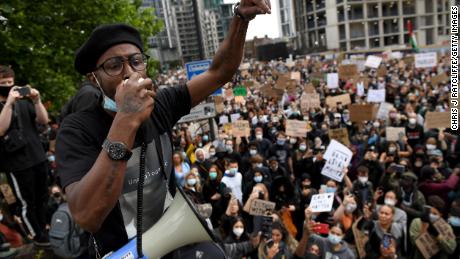
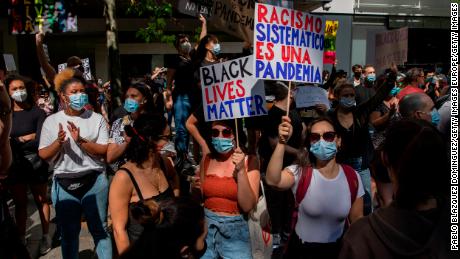
Some defied coronavirus lockdowns and warnings from politicians to do so. Many protesters wore masks during the weekend’s rallies, while some carried messages that racial inequality is also a public health crisis.

They marched in solidarity with tens of thousands in the US, whose protests on Saturday were the biggest yet since video of Floyd’s death at the hands of a white police officer ignited a wave of anger and action.

But they turned out to draw attention to racial injustice in their own nations, too.

Colonial-era statues ripped down with ropes

In London, thousands congregated outside the US Embassy on Sunday despite British ministers saying that public protests ran the risk of increasing the spread of Covid-19.

Chants of “No Justice, No Peace” and “Black Lives Matter” bounced off the building in the Vauxhall region of the city, with a jubilant atmosphere for much of the day.

“Together, we will let our voices be heard. Enough is Enough. Black people cannot keep suffering,” one protester addressed the crowd.

At times, the activists chanted “The UK is not innocent.” Others had messages for the US President, with one sign reading: “Black lives trump your ego, Mr. President.”

The previous day, activists had descended onto Parliament Square in the center of the city. Protests were peaceful for several hours, but turned heated in the evening when police and crowds faced off outside Downing Street.

In one incident, video posted online showed a police horse suddenly bolting, causing its officer to crash into a street light and fall to the ground. The loose horse then caused panic as it ran through groups of protesters, before making its way back to police stables.

“I stand with you. George Floyd’s brutal killing must lead to immediate and lasting change everywhere,” London Mayor Sadiq Khan said in a Sunday message to protesters, while condemning the minority who turned violent and reminding activists to try to limit physical interactions.

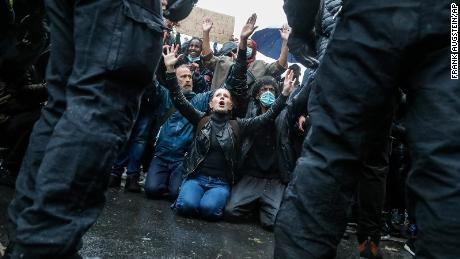
Demonstrators kneel facing police officers during another Black Lives Matter march in London on Saturday.

A number of Boris Johnson’s government ministers had previously urged protesters to avoid gathering at all for public health reasons, with Home Secretary Priti Patel saying on Saturday: “I would say to those that want to protest, please don’t.”

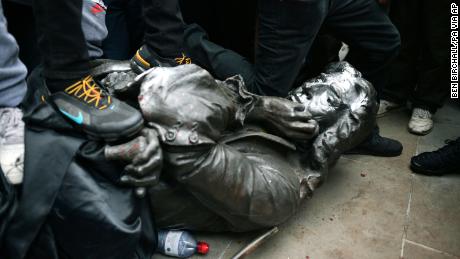
Similar protests took place in Edinburgh, Scotland — and a dramatic scene unfolded in Bristol, southwest England, where activists tore down a statue of 17th century slave owner Edward Colston.

Protesters pull down a statue of slave trader Edward Colston during a Black Lives Matter protest rally on College Green, Bristol, England, Sunday June 7, 2020.

The monument had stood in the city center since 1895 but had become increasingly controversial, with petitions created to demand its removal. On Sunday it was ripped down with ropes to loud cheers from a crowd of demonstrators.

Europe’s streets filled after months of lockdown

The messages of those protesters were echoed by thousands more around the world.

In Spain, permission was given for demonstrators to assemble outside the US Embassy but, after defying orders from the government, protesters marched through the city to Puerta del Sol — one of the best-known and busiest places in the city.

Demonstrators were seen holding placards and chanting phrases including “Donald Trump is a criminal.”

According to figures released by the government’s delegation in Madrid, approximately 2,000 protesters were in attendance; organizers say 4,000 people attended.

In Madrid, a protester warns that "Systemic racism is a pandemic."
Protesters kneel holding placards in Rome.

Lisa Okpala, a spokeswoman for CNAAEB — an anti-racism platform in Spain — told CNN that the purpose of the demonstration was to show support for the Black Lives Matter movement in the US and to “denounce and demonstrate against structural and institutional racism” in the country.

“We felt not only sad because, as I said, racism is a problem here also, but also we felt the rage that the people in the United States are feeling now, especially the black community. So, there is a mix between sadness and rage,” Okpala said.

Thousands more gathered in Rome’s Piazza del Popolo — the major square that just weeks ago had sat empty, a defining image of Italy’s devastating coronavirus outbreak.

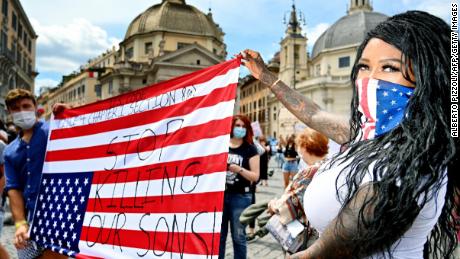
Protesters hold an upside-down US flag in Rome.

Activists there took a knee in silence for a full eight minutes in a symbolic tribute to Floyd, who died after police officer Derek Chauvin pressed his knee on his neck for 8 minutes and 46 seconds.

During the demonstration, the protesters were addressed by representatives of Italy’s migrant community and American expatriates; the names of all those killed in the US as a result of police brutality were listed and commemorated by the crowd.

While the large gathering made it difficult for protesters to adhere to the government’s social distancing guidelines, those demonstrating in the piazza were seen to be attempting to maintain a one-meter gap between themselves, with many also wearing masks and face coverings.

Meanwhile in Warsaw, streets were lined outside the American embassy. The previous day, crowds have swarmed through Paris and other French cities like Lille, Marseille, and Nice.

Crowds outside the US Embassy in Warsaw, Poland.
Players from both teams take a knee in protest prior to the Bundesliga match between SV Werder Bremen and VfL Wolfsburg in Germany on Sunday.

Court allows Sydney protests to go ahead

Hours earlier, cities in Australia had been similarly active.

A court in the country overturned an injunction that banned a march and rally in Sydney on Saturday, allowing thousands to gather in the city.

Performances from Aboriginal protesters took place, and demonstrators held banners calling for an end to deaths in police custody both in the US and in Australia.

Activists in Brisbane on Saturday.
Small crowds gather outside the US Embassy in Hong Kong.

New South Wales state officials had sought to ban the protest due to social distancing concerns and received an injunction Friday night. The New South Wales Court of Appeals overturned it in time for the actions to take place.

Another rally took place in Brisbane and Melbourne.

In Hong Kong, smaller crowds gathered outside the Consulate General of the United States. And in Seoul, South Korea, activists in face masks held up signs on Saturday to commemorate Floyd’s death.

CNN’s Laura Perez Maestro, Al Goodman, Duarte Mendonca, Ben Wedeman and Alessandro Gentile contributed reporting.

Source link

GOP recruits army of poll watchers to fight voter fraud no can prove exists

Republicans are recruiting an estimated 50,000 volunteers to act as “poll watchers” in November, part of a multimillion-dollar effort to police who votes and how.

That effort, coordinated by the Republican National Committee and President Donald Trump’s re-election campaign, includes a $20 million fund for legal battles as well as the GOP’s first national poll-patrol operation in nearly 40 years.

While poll watching is an ordinary part of elections — both parties do it — voting rights advocates worry that such a moneyed, large-scale offensive by the Republicans will intimidate and target minority voters who tend to vote Democratic and chill turnout in a pivotal contest already upended by the coronavirus pandemic.

Some states allow poll monitors to challenge a voter’s eligibility, requiring that person’s ballot undergo additional vetting to be counted. In Michigan, for example, a challenged voter will be removed from line and questioned about their citizenship, age, residency and date of voter registration if, according to election rules, a vote challenger has “good reason” to believe they are not eligible. They are required to take an oath attesting that their answers are true and are given a special ballot.

The Trump campaign says the aim is to prevent voter fraud before it happens, despite researchers, academics and the president’s own voter fraud commission all failing to find evidence that widespread fraud exists in years of searching.

The poll-watch operation is part of a “voter suppression war machine,” said Lauren Groh-Wargo, CEO of Fair Fight Action, the voting rights group founded by Democrat Stacey Abrams. Abrams lost her 2018 bid for governor in Georgia in a tight race clouded by allegations of voter suppression that drew national attention to issues of ballot access.

Groh-Wargo said the full “machine” includes everything from Trump’s rhetoric on voter fraud to Republican-led state legislatures passing laws that may make voting more difficult for certain groups, as well as spending taxpayer dollars looking for the voter fraud the president and other Republicans claim occurs. Georgia, for example, established a voter fraud task force in April.

But a coordinated poll-watch effort, advocates warned, is particularly dangerous because of the GOP’s history of using monitors to intimidate minority voters.

“We know that the targets of these actions, as we’ve seen in the past at our polls, are voters of color,” said Barbara Arnwine, president and founder of Transformative Justice Coalition, in testimony to Congress in early June, in reference to the poll watchers.

While many states are working to expand mail voting to respond to the public health threat of the novel coronavirus, poll watchers can also monitor — and sometimes challenge — absentee ballots, too.

Freed from court restrictions, Trump team seizes ‘new opportunity’

After the Democratic National Committee sued the RNC for allegedly sending armed, off-duty police officers to patrol the polls in minority neighborhoods in a 1981 election, a federal “consent decree” put in place a year later sharply curtailed the Republican Party’s ability coordinate poll watchers by requiring prior judicial approval.

But that consent decree was allowed to expire at the end of 2017, and a judge in 2018 declined to extend it.

“What we haven’t seen in a long time — in decades — is large-scale efforts to try to question and challenge voters’ eligibility at the polls,” said Wendy Weiser, who directs the Democracy Program at the Brennan Center for Justice at New York University School of Law. “The reports and the announcements that the RNC has been making suggest that that is part of the program that they’re trying to mount.”

At a panel about “defeating the left’s voter fraud machine” at the Conservative Political Action Conference in February, Trump campaign senior counsel Justin Clark said the GOP had been hamstrung for decades by the legal ruling.

“For about 40 years, the Republican Party has been fighting this battle with one hand tied behind its back,” he said. “In 2020, we have a brand-new opportunity to be able to activate an Election Day operation program that’s really robust.”

(Weiser noted the GOP wasn’t barred from doing the work of poll watching — it was barred from doing it without getting court approval to ensure the efforts weren’t discriminatory.)

Clark told the audience that the campaign and the party hoped to “leverage about 50,000 volunteers to be able to watch the polls” with the goal of preventing “systemic failures” and “malicious” fraud — people voting multiple times.

“Everybody in this country who wants to vote and is eligible to vote, should be able to vote — once,” he said to a chuckling crowd.

Clark and the Trump campaign did not respond to requests for interviews.

History of intimidation and discrimination

“Lifting of the consent decree allows the RNC to play by the same rules as Democrats. Now the RNC can work more closely with state parties and campaigns to do what we do best — ensure that more people vote through our unmatched field program,” RNC spokesperson Mandi Merritt told NBC News.

She also said the idea “that this is somehow a Republican suppression effort is completely bogus.”

But voting rights advocates say conservative activists and Republicans have a worrisome history, such as the allegation that the RNC sent armed, off-duty police officers to patrol polls in minority neighborhoods. Additionally, the party posted signs warning that ”it is a crime to falsify a ballot or to violate election laws,” according to contemporaneous news reports.

Adell Adams of the South Carolina Elections Commission talks with Rep. Jim Clyburn, D-S.C., as hundreds of students wait to vote at Benedict College in Columbia, S.C., on Nov. 2, 2004. Democratic leaders alleged that Republican Party poll watchers targeted the precinct at the predominantly black college to discourage young black people from voting.Mary Ann Chastain / AP file

In 2004, Ohio Republicans citing fraud sent 3,500 poll watchers into polling locations with plans to challenge voters they deemed ineligible; a court ruling noted that the poll challengers in Hamilton County, which includes Cincinnati, were heavily concentrated in minority-majority polling places.

True the Vote, a group that grew out of the tea party movement in Texas and has ties to the conservative movement, was accused of intimidating voters with its poll-watching operation in 2010.

Groh-Wargo, whose group is partnering with Democratic state parties, said she had no doubt that GOP poll-watching efforts would have an effect.

“We fully expect that they’re targeting all precincts that have students, Native Americans, Latinos, African Americans, refugee communities,” she said, noting her group was seeking to counter the effort with voter hotlines and poll watchers of their own.

“It’s completely unprecedented,” she said, decrying it as a “burn it down, win at all costs, institutions be damned, they’re gonna do whatever it takes” strategy.

Marc Elias, a top elections lawyer who frequently litigates on behalf of Democrats, said he expects the GOP’s 2020 poll watchers will challenge individual ballots and voters — arguing that a signature doesn’t match on an absentee ballot or using public records to allege a voter’s registration is inaccurate or out of date.

“They’re not going to sit idly by and ensure the lines move swiftly. They’re recruiting these folks so they go to polls and either intimidate voters, or at a minimum slow the process,” he said.

The pandemic raises the stakes even further.

“What we saw in Wisconsin during COVID shows how much worse it can get,” Elias said, referring to hourslong lines that resulted from a reduced number of polling locations during the state’s April presidential primary. Democrats, citing health concerns, had fought unsuccessfully to postpone the election.

Long lines will be made longer by cleaning protocols. High rates of absentee-ballot rejections will disenfranchise more people, while absentee-ballot systems will be tested by a surge of mail ballots, and already-tight budgets will be tested by printing and postage costs. New York officials recently pointed to a national envelope shortage as another unexpected issue.

Republicans have sparred with Democrats over additional election funding, because Democrats want mail voting to be an option for everyone. Trump, meanwhile, has falsely claimed that vote-by-mail is riddled with fraud and threatened to withhold federal funds from states that expand the option.

Trump, who lost the popular vote in 2016 by nearly 3 million votes, also said mail-in voting — a system election officials say and research has shown increases participation in elections — posed an existential threat to the GOP itself.

“MAIL-IN VOTING WILL LEAD TO MASSIVE FRAUD AND ABUSE. IT WILL ALSO LEAD TO THE END OF OUR GREAT REPUBLICAN PARTY,” Trump tweeted.


Source link