Sunday, April 19, 2026

Big Pharma rejected vaccine prep efforts, watchdogs say

0

In 2017, the European Commission proposed working with the pharmaceutical industry to research ways to get vaccines against dangerous bugs to the market quicker, before an outbreak actually occurs.

Industry declined to sign on, according to a new investigation published Monday by two NGOs focused on corporate accountability.

It’s a particularly timely critique within a broader attack on the Commission’s collaboration with Big Pharma, known as the Innovative Medicines Initiative, as the world races to find treatments and vaccines to help both humans and economies recover from the coronavirus.

With IMI’s survival up for debate as part of negotiations over the EU’s next seven-year budget, the NGOs Corporate Europe Observatory (CEO) and Global Health Advocates are urging member countries and MEPs to reject renewing the public-private partnership without major reforms.

The Brussels pharma lobby EFPIA counters that preparation for meeting urgent needs is at the soul of IMI, and that this particular project just wasn’t a good fit. But the watchdogs say it reflects how IMI is too hobbled by industry influence to serve the public good.

Behind the curve?

Three years ago, the Commission proposed a new research project on the decision-making process for vaccine approvals. The aim was to “facilitate the development and regulatory approval of vaccines against priority pathogens, to the extent possible still before an actual outbreak occurs,” according to a letter from DG Research Deputy Director-General Signe Ratso to Martin Pigeon, a researcher for CEO.

The effort would also help regulators use alternative methods to confidently approve immunizations.

After discussions with industry partners, “the topic idea was eventually not taken up by the EFPIA companies,” Ratso said.

Marine Ejuryan, Global Health Advocates’ advocacy manager, said the industry’s refusal “to work on biopreparedness, even with public subsidies … demonstrates many of the inherent problems with the current biomedical profit-driven R&D model.”

Its agenda, she added, is “overly dominated by industry priorities while sidelining poverty-related and neglected diseases, including coronaviruses, simply because these are not profitable for the industry.”

EFPIA spokesman Andrew Powrie-Smith disagreed, writing in an email that drugmakers did have “significant interest” in the idea.

Ultimately, however, the specifics seemed “better suited” to groups “focused on regulatory evolution rather than a public-private consortium focused on removing scientific bottlenecks,” he contended.

For their part, IMI and the Commission noted in statements to POLITICO that the public-private partnership does have projects that can help fight the coronavirus, launched both before and during the current outbreak.

They include a 2015 biopreparedness initiative known as ZAPI, which resulted in antibodies for the MERS coronavirus that are now being studied to see if they could work against the COVID-19 bug.

Further, they said, some of the elements of the 2017 vaccines proposal have been incorporated into a fast-tracked IMI topic launched in the early days of the current coronavirus emergency, which is already funding eight projects.

As Ejuryan sees it, however, IMI’s coronavirus efforts have come too late.

“An effective response to epidemics requires timely and sustained investments,” she said. “Otherwise, when a pandemic emerges, the research and development simply hasn’t been done in time to respond effectively.”

But Powrie-Smith rejected the watchdogs’ report as a “biased” salvo launched as part of an ongoing campaign against the industry. The emphasis on the 2017 vaccine discussion, he said, “shows an eye for a headline and fundamental lack of knowledge on the topic.”

“IMI has, and continues to play a key role on biopreparedness, focused on its core purpose of accelerating the development of diagnostics and therapeutics,” he said.

Uneasy partnership

Since it started in 2008, IMI has been a bête noire of watchdog NGOs, like the Gates Foundation-backed Global Health Advocates and CEO, which gets funding from George Soros’ Open Society Foundation.

IMI2, the current iteration, has a €3.3 billion budget over seven years, with half coming from the Horizon 2020 research grant program and the other half from industry.

The idea is that the EU taxpayers offer funding to non-profit researchers or small biotech firms, while EFPIA members match the euro figure with either grants or “in-kind” contributions. Projects are supposed to focus on areas where breakthroughs are desperately needed, or where the market doesn’t provide incentives for new investments, like antibiotics.

It’s meant to fight Europe’s “innovation paradox,” as a Commission spokesperson put it: “We have very good science but little innovation and market deployment.”

The problem, according to the NGOs, is that IMI isn’t fulfilling its mission to address unmet need. Rather, investments heavily skew toward research in areas like cancer and Alzheimer’s, which are already key targets for the industry, while other conditions on the World Health Organization’s list of priorities, like AIDS, tobacco use and strokes — not to mention the so-called neglected tropical diseases that primarily affect low-income countries — get little attention.

There have also been some high-profile spats between industry and its non-profit collaborators: A network of European specialists in antimicrobial resistance pulled out of an IMI project in 2017 citing “unresolved problems of conflict of interest in shaping policy recommendations” by its industry partners.

The Commission spokesperson rejected the suggestion that IMI is ignoring unmet needs: Alzheimer’s still has few treatment options, for example, and the Commission “massively” funds research into diseases of poverty in other ways, if not IMI.

An IMI spokesperson added that while the public-private partnership didn’t launch its Ebola vaccine initiative until 2014, when the West African outbreak started, it was not on the WHO’s list of priorities in 2013, ruling it out as a strategic research topic.

Unused innovations

One project could have great implications for poor African countries trying to manage HIV, the report notes. But the findings aren’t being used.

The 60-year-old drug flucytosine is a key treatment for people living with HIV-weakened immune systems who are more vulnerable to fungal infections, a top cause of HIV-related death. But it’s not available in much of Africa and Asia because of its cost and lack of generic options.

A project to find a cheaper, more environmentally-friendly way to produce the drug — involving the pharma giant Sanofi, the University of Durham and €10 million from the EU — achieved its goal by early 2017.

Yet neither Sanofi nor Durham appears to have given manufacturers in poor countries the rights to use this new production method. (Durham told the report authors it’s working on it. Sanofi didn’t respond to requests for comment by the NGOs nor to POLITICO’s request for comment Sunday.)

The new method also works for one of Sanofi’s other existing HIV drugs, leading the report to question whether IMI “has merely provided Sanofi with a handy — and publicly-funded — cheaper process in the production of two of its existing medicines.”

The IMI spokesperson acknowledged that there’s not much it can do if companies don’t follow through. Usually, IMI participants report that they’re using the results when the projects close out.

But ultimately, “projects are not obliged to report to us in the long term after the end of the project,” the spokesperson said. “This makes it very hard to follow up on long-term impacts.”

The Commission is working on the next round of the public-private partnership, which would likely see the medical device industry added to the mix along with drugmakers.

Acknowledging the report, a Commission spokesman said that “all constructive criticism is welcome and will be factored into the impact assessments and proposals for the next generation” of public-private partnerships.

Cristina Gonzalez contributed reporting.


Source by [author_name]

How Merkel caved to Macron

0

Angela Merkel has finally caved to France’s Emmanuel Macron | Guido Bergmann//Bundesregierung via Getty Images

Opinion

Redistribution will not cure Europe’s ailments.

By

Updated

Josef Joffe serves on the Editorial Council of Die Zeit in Hamburg. He is also distinguished fellow of Stanford’s Hoover Institution.

HAMBURG — Once the uncrowned empress of Europe, Angela Merkel has finally caved to France’s Emmanuel Macron.

Ever since Macron captured the Elysée in 2017, the German and French leaders have been locked in silent combat over Europe. Merkel stood for reformist vigor and fiscal virtue: no bail-outs, no eurobonds and keep your hand out of our coffers. Macron preached spending, redistribution and centralization.

Now it seems the coronavirus crisis has delivered victory to Paris. Macron and Merkel’s joint unveiling of a European recovery fund worth half-a-trillion euros to bail out the sinking EU economy will remake the bloc in France’s image, turning Europe into a continent-sized welfare state.

The new recovery fund signals an unprecedented power shift from 27 sovereign nations to the European Commission. This unelected body will borrow hundreds of billions and, in the name of “European solidarity,” hand them over as gifts, not loans.

How will the mammoth debt be repaid? We’ll worry about that later. Who would feed at the trough? A large part will go to the usual suspects, known as “Club Med” or the “Olive Belt” led by France — a pre-destined beneficiary of the coming cash bonanza — and running from Lisbon to Madrid, Rome and Athens.

As Hamilton, so Macron: The idea is to spread the wealth and fatten the center.

This power shift recalls America’s fabled “Alexander Hamilton moment” of 1790 when the Feds assumed states’ debts piled up during the Revolutionary War. The first Treasury chief’s generous gesture came with hardball politics, laying out the road to ever-more power for Washington.

As Hamilton, so Macron: The idea is to spread the wealth and fatten the center. Add Merkel who muses: “Alone, the nation-state has no future.” Onwards and upwards for the United States of Europe.

There’s are good reasons however, why such a move has been resisted until now.

As ostensibly compelling it may be, the U.S.-EU analogy falls flat. The differences are glaring. Unlike the 13 ex-colonies, the EU-27 cannot rely on a common history, language and culture. They’ve been around, as separate identities, since the Roman empire. After crystalizing into nation-states circa 1500, they have fought to the death whoever tried to unify Europe under his knout, from Habsburg to Hitler.
Today, war may be out, but sovereignty is still in. France will not cede the scepter to Germany, and vice versa. The rest will not defer to the duo, nor to Brussels. Since the start of the pandemic, in fact, the nation-state has reasserted itself, as countries close borders and coddle sickly national industries.

And then there’s the harmful incentives the recovery fund creates, given the eurozone’s current composition (and the varying willingness to reform among its members).

Jaundiced economists warned from day one that a common currency requires a real state based on nationhood and obligation. Absent such overriding attachment, how could Brussels take from Peter in Berlin to give to Paolo in Rome?

Under the euro, capitals must part with sovereignty over economic policy, a pillar of the nation-state. The price is cruel. States can no longer devalue to stay competitive, for francs and liras are gone. Instead, they’re told to stop splurging and borrowing to buy off powerful domestic interests like public-sector unions. They have to get their house in order with painful market reforms that replace short-lived relief with solid growth.

France and Italy, No. 2 and No. 3 respectively in the EU’s GDP ranking, have not swallowed the bitter medicine. Instead, they have continued to rack up debt along with the rest of the Olive Belt. After all, why swallow it when you know you no longer have to pay a hefty devaluation premium under the solid-gold euro? Pocket the cheap money instead.

As deficits and debits soared, the logical next step was a “transfer union.” Eager to get into the EU kitty, they preferred the dole to more debt.

Meanwhile, Austria, Holland, and the Scandinavians gathered around the German CFO to insist on reform-minded fiscal discipline. The result has been a 20-year power struggle, in which communal virtue kept grinding up against national egotism.

Merkel’s new tune is not as revolutionary as it sounds | Andreas Gora/Getty Images

Now, suddenly, Merkel has openly broken ranks, sacrificing Teutonic rigor to Macron’s Gallic ambitions. But if you look to the euro’s tortured history, this is not all that surprising: For years, profligacy has trumped prudence.

Ever since European Central Bank chief Mario Draghi famously vowed in 2012 “to do whatever it takes to preserve the euro,” the ECB has dodged the treaty constraints. And behold: At each point, those brutal, arrogant Germans fussed and fumed — and then paid up.

The “Club Med” countries got the message: Berlin, which profits most from integration, will not let the project sink.

Merkel’s new tune is not as revolutionary as it sounds; it just formalizes routine practice. Sure, the so-called frugals are not amused, but they will be bought off. The recovery fund will kick in, as have all the other recue mechanisms since Greece went bankrupt.

The harsh truth is that a mountain of free cash will not be enough to cure Europe’s ailments.

So, let’s hold the applause for the Franco-German “engine.” Its recovery fund is where short-term relief trumps Europe’s long-term needs. Why will national governments go up against entrenched interests and pay a murderous political price at home to clean up their economies if they can haul in hundreds of billions for free?

The harsh truth is that a mountain of free cash will not be enough to cure Europe’s ailments. Those predate the coronavirus pandemic.

For Europe to rise again, it will have to do more than transfer riches from north to south. The cure is not redistribution, but restarting the engine of growth.

Don’t count on Macron, who has been foundering against the armies of the status quo since he took office. Nor on Merkel, who has given up coaxing the EU into market-driven rejuvenation.


Source by [author_name]

Japan looks to end Tokyo virus emergency

Japan is looking to lift a state of emergency for Tokyo and remaining areas still facing restrictions while also considering fresh stimulus worth almost 100 trillion yen ($A1.4 trillion) to help companies ride out the coronavirus pandemic, Nikkei has reported.

Social distancing curbs were removed for most of the country on May 14 as new infections fell but the government had kept Tokyo and four other prefectures under watch.

The government will seek approval from key advisers for the lifting on Monday. If approved, Japan would have no regions under the state of emergency, which was first instated on April 7.

Tokyo Governor Yuriko Koike has said the capital would swiftly move into “stage one” of the lifting of curbs if the government ends the state of emergency. That would allow libraries and museums to reopen, and restaurants to stay open until later in the evening. Subsequent stages would see theatres, cinemas and fairgrounds reopen.
While the world’s third-largest economy has escaped an explosive outbreak, with about 17,000 infections and 825 deaths, the epidemic has tipped it into a recession and plunged Prime Minister Shinzo Abe’s popularity to multi-year lows.

Abe will hold a news conference on Monday evening, when he is expected to announce the plan to lift the state of emergency.

To support an economy on track for its deepest slump in postwar history, the government is considering fresh stimulus worth 100 trillion yen, mostly comprising financial aid for companies, the Nikkei newspaper said.

The package, to be funded by a second supplementary budget, would follow a record 117 trillion yen spending plan deployed last month.

The combined spending would bring the total stimulus in response to the pandemic to about 40 per cent of Japan’s gross domestic product.

The new package includes 60 trillion yen to expand loan programs that state-affiliated and private financial institutions offer to firms hit by virus, the Nikkei said. Another 27 trillion yen would be set aside for other aid including capital injections for ailing firms, the paper said.

The government is expected to approve the budget, which will also include subsidies to help companies pay rent and wages, at a cabinet meeting on Wednesday.

Source by [author_name]

Walking the Wall: A lockdown tour of Berlin boundaries

0

BERLIN — As authorities in the German capital put the brakes on public life in March, I decided to try and aggregate my daily walks into the entire 160-kilometer route of the former Berlin Wall.

Social isolation and Cold War history rolled into a monthlong mix of stroll and slog around the city outskirts.

Only a small portion of the route runs through downtown Berlin, via all the tourist draws that were eerily empty during my walks. The vast majority traces the border between the city and the surrounding state of Brandenburg via forests, fields, lakes and sleepy suburbia.

In the three decades since the Wall fell (longer than it stood in place), most of the structure itself has disappeared, memorial rock chipped away chunk by chunk. Instead, there’s the route of a former patrol path through the reforested death strip encircling the western perimeter of Berlin. It’s maintained as the so-called Mauerweg for cyclists, and sometimes serves as overflow parkland for those living on the edge of the city.

I started at the old Sonnenallee border crossing (which bears no resemblance to the Wall-era setting of the popular 1999 German comedy film of the same name) walking alone, clockwise, under Berlin’s southern belly, equipped with a camera phone and a cycling guide by Michael Cramer, a former Green MEP who made the Mauerweg his legacy in local politics during the 1990s.

1. My starting point on the Mauerweg at the old Sonnenallee border crossing point in March.

Walking the Wall would be a stopgap until the pandemic passed, I thought.

But just as I reached the waterworld that is Berlin’s upscale, lake-filled southwestern suburbs, Chancellor Angela Merkel appeared on national TV, outlining new restrictions to daily life on March 22. That put a monthlong pause on roaming any further than the supermarket.

Fast-forward two months: As I completed the route, the German capital reopened its restaurants and beer gardens, though the socially-distanced economy is still very much in a trial phase. Without anyone there to take a selfie, the plasticky views of Checkpoint Charlie and the East Side Gallery make them feel more like flimsy film sets than sites of profound historical importance.

2. Looking west across the Teltow Canal. For this stretch, the Wall trail is sandwiched between the waterway and a highway.

Walking the whole route in 2020 is apt, as it is mostly based on local administrative borders dating back to 1920, when the Greater Berlin Act expanded the city’s boundaries.

The Wall left multiple exclaves of West Berlin stranded in East Germany, along with various loopbacks and a “duck’s beak” of the East inexplicably jutting into the West. Kladow, already on the western shore of the Wannsee lake, was in West Berlin, but Groß Glienicke, with which it shares another lake, was not.

3. A hidden belt of green land between the edge of Rudow in the former West Berlin and the airport town of Schönefeld in the old East Germany is now home to livestock.

Although the Wall itself is gone, the stories of the 140 lives lost directly as a result of its terror punctuate the route. But there are also more colorful tales, of train driver Harry Deterling who accelerated his passenger service to escape into West Berlin (with commuters on board) in 1961; of Erwin Shabe, a boy who got an armed escort to school after falsely claiming East German soldiers were obstructing his route from the tiny exclave of Eiskeller; and of farmer Helmut Qualitz, who smashed a hole in the Wall with his tractor in 1990 to restore an old link between two communities.

In the present day, there remain local disagreements over efforts to restore lost infrastructure links. The expansion of the old Dresden railway to offer express airport trains is controversial for locals in the south of the city who have grown comfortable with unobtrusive local services that don’t rattle their windows. Up north, plans to reroute the old Heidekrautbahn line have sparked a three-way fight over station-naming rights between suburbs. By my count, the entire Mauerweg route passes more than 10 rail tracks (plus one or two ghost lines) radiating out of the city like spokes on a bicycle wheel.

Even with division long gone, the work to reweave Berlin’s urban fabric still isn’t finished.

4. Gropiusstadt, one of West Berlin’s utopian social housing projects. The complex of apartment blocks is named after Walter Gropius, its architect and founder of the Bauhaus School.


5. Mid-March flowers sprouting through a young reforested track on the former death strip near Lichtenrade.


6. Much of the perimeter of Berlin’s southern boundary faces out on to old drainage fields, especially around Marienfelde.


7. The A115 highway, once the busiest East-West border crossing but a ghost autobahn just hours before Germany enters lockdown on March 22.


8. Around the old Stammbahn railway, Berlin’s first train line. Now forested track.


9. Steinstücken was for a time an exclave of West Berlin, so the allies maintained a helipad. Today, this is memorialized by a helicopter blade installation next to a climbing frame helicopter, closed due to the pandemic.


10. Griebnitzsee, the entrance to Berlin’s waterworld of lakes and forests around its southwest. Here, U.S. President Harry Truman made the decision to drop nuclear weapons on Japan, and both Stalin and Churchill stayed close by while the trio met in Potsdam to carve up Europe after World War II.


11. Despite the virus lockdown, wedding shoots went ahead. A couple pose on the Glienicke Bridge between what was West Berlin and Potsdam in East Germany, otherwise known as the Bridge of Spies where East and West exchanged prisoners.


12. A lake in the town of Groß Glienicke, which the East-West border ran directly through and the Wall right around. Many houses have their own private access to the lake these days.


13. Berlin has so many airports it has even forgotten one. The Gatow Airfield in the far west was Britain’s terminal during the Cold War, along with Tegel (France), Tempelhof (U.S.) and Schönefeld (Soviet). Today it’s an air force museum.


14. There is very little left of the original Wall structure itself, and much of the old death strip has been turned into landscaped gardens in suburbs such as Staaken. Here, an elderly pair enjoy the view.


15. In order to trade excess electricity production, the West Berlin administration built pylons through an otherwise bucolic Spandau Forest during the 1980s.


16. The garden city suburb of Frohnau is tucked up against old woodland and lakes. After this the trail turns sharply south toward downtown Berlin.


17. Locals use the old phone booth to trade books at Lübars, billed as the last true Berliner village. It’s surrounded by fields and lakes hidden away from tower blocks close by.


18. The original so-called Heidekrautbahn railway route is being revived decades after it was diverted by the construction of the Wall.


19. The Schönholz Soviet war memorial is a monumental mass grave in the former East Berlin with 13,000 soldiers laid to rest here. I arrived the day after Russia’s Victory Day so there were plenty of fresh flowers and wreaths.


20. Bornholmer Straße, where the East-West border first opened in November 1989. Today the bridge is a memorial, but it also marks the boundary between suburbia and gentrified Prenzlauer Berg.


21. Bernauer Straße hosts one of just a few remaining segments of the original Wall, with metal installations filling in missing parts along the road.


22. A bystander looks at part of the modern Bundestag office complex, reflecting the renovated historical parliament building across the Spree river.


23. Looking west through the Brandenburg Gate. During the division of the city, the landmark was encircled by the Wall.


24. The Checkpoint Charlie intersection is usually bustling with tourists. Although Berlin’s restaurants are reopening this month, the tourist traps were still empty on a sunny May Sunday.


25. The East Side Gallery is a long stretch of the Wall that often becomes a forest of selfie sticks. Here, it’s empty, with Dmitri Vrubel’s famous embrace between Leonid Brezhnev and Erich Honecker available to view without a queue.


Source by [author_name]

Chris Wallace Slams Kayleigh McEnany: ‘I Never Saw A W.H. Press Sec. Act Like That’

Fox News anchor Chris Wallace took aim at White House press secretary Kayleigh McEnany on Sunday, slamming her for going after reporters about their religious faith and for telling them what questions they should be asking.

McEnany had on Friday accused journalists of “desperately” wanting churches and places of worship to stay closed after she was questioned about President Donald Trump’s claim he would “override” governors who ignored his demand to immediately reopen churches amid the COVID-19 pandemic. A reporter was asking what legal authority the president has to do so.

“I spent six years in the White House briefing room covering Ronald Reagan. I have to say, I never — and in the years since too — I never saw a White House press secretary act like that,” Wallace said to a panel on “Fox News Sunday.”

Donna Brazile, the former interim Democratic National Committee chair, responded that she personally knows McEnany to be an “extraordinary person” but criticized the “combative” approach she’d taken in her new role.

Wallace continued by playing another excerpt from Friday’s press briefing. During that clip, McEnany posed a series of questions ― complete with prepared slides ― that she said journalists should be asking about former national security adviser Michael Flynn.

Conservative commentator Jonah Goldberg labeled McEnany’s behavior “indefensible and grotesque.”

“What Donald Trump wants in a press secretary is a Twitter troll who goes on attack,” Golberg told Wallace. “Doesn’t actually care about doing the job they have, and instead wants to impress really an audience of one and make another part of official Washington another one of these essentially cable news and Twitter gladiatorial arenas.”

Wallace added that McEnany “isn’t acting like she’s working for the public” and acts instead like “what she used to be, which is a spokesperson for the Trump campaign.”

Another panelist, Josh Holmes, the former chief of staff for Sen. Mitch McConnell (R-Ky.), defended McEnany. He claimed her behavior was different from past press secretaries because any spokesperson in the Trump administration and campaign “finds themselves under constant attack by the press.” 

“Let me just say, Sam Donaldson and me in the Reagan White House, we were pretty tough on the White House press secretaries and we never had our religious beliefs questioned or were lectured on what we should ask,” Wallace replied.

Wallace, a frequent and vocal Trump critic, was the subject of Trump Twitter outrage last month after a “Fox News Sunday” segment critical of his administration’s pandemic response. 

His latest comments will likely come as another escalation in tensions with Trump. While some primetime Fox News personalities routinely stump for the president, negative coverage last week sent Trump into a Twitter tailspin against the network. On Monday, anchor Neil Cavuto had harshly criticized the president’s claim he’s using the unproven and potentially dangerous drug hydroxychloroquine to protect against coronavirus.

Trump declared Monday he was “looking for a new outlet” and on Thursday complained that Fox News was “doing nothing” to help him get re-elected in November. And on Friday, he raged at the network for airing a poll that showed him trailing presumptive Democratic presidential nominee Joe Biden.


Source by [author_name]

Coronavirus LIVE Queensland updates: students return to school as national death toll stands at 102

If you suspect you or a family member has coronavirus you should contact (not visit) your GP, local hospital or 13HEALTH.

Source by [author_name]

Federal Judge Clears Way For Hundreds Of Thousands Of Ex-Felons To Vote In Florida

A federal judge ruled Sunday that hundreds of thousands of ex-felons in Florida can’t be forced to pay back fines and fees owed to the state before they cast a ballot, saying a Republican-backed law passed last year effectively created a “pay-to-vote system.”

Florida overwhelming passed a measure in 2018 that restored the voting rights to nearly every felon who had completed “all terms” of their sentences, a victory hailed by voting rights advocates at the time. But in 2019, the Republican-controlled legislature passed a bill that said the “all terms” provision was only met if all court-issued fees, fines and restitution had also been paid.

U.S. District Court Judge Robert Hinkle ruled Sunday that provision was unconstitutional.

“The State of Florida has adopted a system under which nearly a million otherwise-eligible citizens will be allowed to vote only if they pay an amount of money,” the judge wrote. “Most citizens lack the financial resources to make the required payment … This pay-to-vote system would be universally decried as unconstitutional but for one thing: each citizen at issue was convicted, at some point in the past, of a felony offense.”

“The state may disenfranchise felons and impose conditions on their re-enfranchisement,” Hinkle later wrote. “But the conditions must pass constitutional scrutiny. Whatever might be said of a rationally constructed system, this one falls short in substantial respects.”

The order requires the state to inform all felons if they are eligible to vote and how much they owe in fees. Any felon will be legally allowed to register to vote if they are not given an answer in 21 days.

Florida Gov. Ron DeSantis (R) will have the opportunity to appeal the ruling, which could have dramatic implications for the upcoming election in November (it’s unclear if any appeal would finish before ballots were cast). Reuters notes at least 775,000 felons have unpaid legal costs in the state, although some estimates say there could be up to 1.4 million.

Voting rights groups hailed the move on Sunday.

“The court recognized that conditioning a person’s right to vote on their ability to pay is unconstitutional,” Julie Ebenstein, a staff attorney with the ACLU, said in a statement. “This ruling means hundreds of thousands of Floridians will be able to rejoin the electorate and participate in upcoming elections. This is a tremendous victory for voting rights.”

Critics said the Florida GOP’s move in 2019 amounted a poll tax meant to disenfranchise voters once more. Hinkle noted in his ruling that many ex-felons aren’t even able to find out how much they owe until the state completes a screening of citizens by 2026 or later.

“In the meantime, year after year, federal and state elections will pass,” he wrote. “This order holds that the State can condition voting on payment of fines and restitution that a person is able to pay but cannot condition voting on payment of amounts a person is unable to pay.”

The judge did not find that the 2019 law discriminated based on race, however. A disproportionate number of felons in the state are African American.


Source by [author_name]

Students in NSW and Queensland are back in classes this morning.

Students in NSW and Queensland are back in classes this morning.

Roads were busier than they have been for months, after students were told to try and avoid public transport.

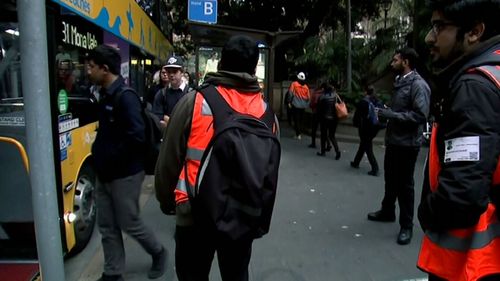
Hundreds of extra transport staff, including security and marshalling officers, were on duty in Sydney this morning as some people also returned to work.

Under the new rules, a maximum of 12 passengers are allowed on a NSW bus at any one time, while trains are limited to 32 people per carriage and up to 45 people are allowed on ferries.

Marshalls on buses in Sydney this morning. (Nine)

NSW Transport Minister Andrew Constance said staff will be monitoring social distancing on public transport and warned stations could be closed if they become too busy.

Prior to the COVID-19 pandemic, more than 900,000 school students used the transport network to get to school and 110,000 of those caught public transport.

School students and the vulnerable were to be given priority.

However, there were no delays reported by Transport NSW.

Annandale Public school students arriving at school in Sydney. (Louise Kennerley/ SMH)

Returning to the classroom full-time in NSW comes two months after COVID-19 restrictions forced around 800,000 children in the state to study remotely.

It is compulsory for NSW children to be back in classes.

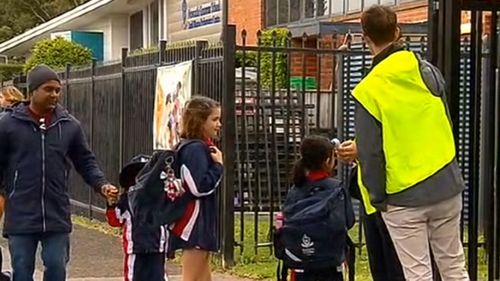
Some schools were taking children’s temperatures at the gate and offering hand sanitiser.

Some independent and Catholic schools also went back today, while others are working towards a June 1 return date.

Some schools took children’s temperatures on arrival. (Nine)

Mr Constance urged commuters not to become complacent when using public transport.

“I think that the risk at the moment is because everything’s going back to normal, I think there’s a lost complacency that could start to creep in here and we’re still in the middle of a global pandemic,” he told Today.

“We don’t want people sick and dying and transport networks are risky given the number of people.”

Traffic built up as students as workers returned to normal schedules in Sydney. (AAP)

“Roads will be busy so please be patient, particularly in and around school zones.

“The 40km/h limit applies. But people will need to be extra vigilant because there’s going to be that many kids that will be driven to school.”

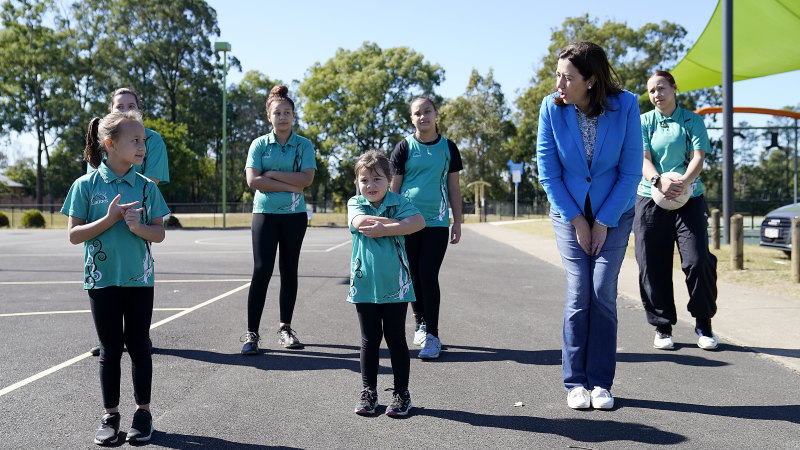
Meanwhile, students in grades two to 10 are also back at school in Queensland.

Parents were also urged to drive their children to school or accompany them by foot as they walk to the school gates.

Start times were staggered slightly to avoid too many parents and students lingering at the front fence.

And once the kids are inside, they will be asked to wash their hands several times throughout the day.

Buses have limited capacity, due to social distancing rules. (Nine)

It is expected that some Queensland parents may choose to keep their children at home because of medical concerns, but they are warned they then need to take responsibility for their learning.

Help from the school will be provided if they need to stay home due to medical reasons.

Activities like assemblies, concerts, excursions and camps remain on hold across the nation.

OTHER STATES AND TERRITORIES

Tasmanian kindergarten to Year Six students, along with Year 11 and 12 students, also went back today, before students in Years 7 to 10 join them on June 9.

The ACT is continuing its staged return with students in Years 3, 4 and 10 getting back to school today, leaving only Years 5, 6, 8 and 9 to return on June 2.

Victorian kids are bracing for their return, with children in prep to Year 2 and Years 11 and 12 returning tomorrow, before the remaining cohort goes back from June 9.

Students are already back in school full time in South Australia, Western Australia and the Northern Territory.

For breaking news alerts and livestreams straight to your smartphone sign up to the 9News app and set notifications to on at the App Store or Google Play.

Source by [author_name]

Trump’s tough choices over Hong Kong

0

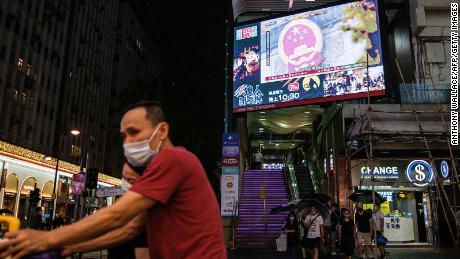
China’s latest move to introduce national security legislation in Hong Kong — a semi-autonomous city that was guaranteed its own legal system and certain democratic freedoms until 2047 under the “one country, two systems” framework — has sent shockwaves across the world. The draft legislation would ban sedition, secession and subversion of the central government in Beijing as well as “foreign interference.” — all codewords that the Chinese Communist Party uses to quash political dissent. The legislation would also allow for mainland security forces to be deployed in Hong Kong, among other measures that would erode the territory’s autonomy.

While China feels increasingly empowered lately, its training wheels came off a long time ago when it comes to achieving its territorial ambitions. In the last few years, it has continued efforts to erode Hong Kong’s special status.

After Russia illegally annexed Crimea in 2014, Trump inaccurately claimed former President Barack Obama “allowed a very large part of Ukraine to be taken.” Now Trump is likely to have his own Crimea moment, as China plans to assert its control over Hong Kong.
When the history books detail the Trump administration’s posture on China, they will tell a tale of two policies. The State Department and the Commerce Department, for example, have taken an increasingly punitive stance against China while the intelligence community has laid out the threats that China poses to US elections, arms control, cyberspace, and more. Trump, on the other hand, clung to China as he worked to iron out a trade deal, often parroting the ruling Communist Party’s (CCP) propaganda on issues like Hong Kong and, at times, praising China on crises like the coronavirus.
During a violent crackdown on pro-democracy protesters in Hong Kong last year, President Trump called the protests “riots” and continued to praise Chinese President Xi Jinping. Trump also wavered in his support for bipartisan legislation that authorized US sanctions on those responsible for human rights abuses in Hong Kong and prohibited the sale of tear gas and other items to Hong Kong police. In a November 2019 interview with “Fox & Friends,” Trump said, “I stand with Hong Kong…but we’re also in the process of making the largest trade deal in history.”
Human rights in Hong Kong took a back seat until the trade deal wrapped up and Congress passed bipartisan legislation to support human rights in Hong Kong with veto-proof majorities.

Now, with politics in play, the President is singing a different tune.

In addition to now criticizing China’s response to Covid-19, Trump has threatened to “address that issue very strongly” if China moves ahead with the national security legislation. Secretary of State Mike Pompeo has also publicly put Hong Kong’s status — a special administrative region as enshrined in the 1992 Hong Kong Policy Act — on the line. In a statement Friday, Pompeo said that Washington “strongly urges Beijing to reconsider its disastrous proposal, abide by its international obligations, and respect Hong Kong’s high degree of autonomy, democratic institutions, and civil liberties, which are key to preserving its special status under US law.”

But the President’s credibility gap on China undercuts the idea that Trump will follow through on this threat. If the legislation passes, sounding what Pompeo called the “death knell” of autonomy in Hong Kong, the question is: can anyone convince Trump to try to do something about it?

In certain respects, Trump’s track record on territorial integrity is catching up with him. He has not been a cheerleader for sovereignty, including here at home. He has failed to condemn Russia’s interference in US democracy, for starters, and he’s been meeker than milquetoast when it comes to confronting Russia over its annexation of Crimea. And while the CCP has eroded the special status of Hong Kong over the last few years, he’s been mostly quiet, except for when he praises Xi. Trump’s track record gives the CCP little reason to fear that he’ll draw a line in the sand over further encroachments on Hong Kong’s autonomy, especially given the economic implications of doing so.
The administration has already floated some response options. National Security Adviser Robert O’Brien said on Sunday that the administration is likely to impose sanctions if China moves ahead with this legislation and outlined the economic costs, including to Beijing, if the national security law moves ahead. A more significant action would be revisiting the United States-Hong Kong Policy Act of 1992 and revoking special treatment that Hong Kong currently gets under that legislation on matters like trade.
The other Hong Kong: Will China's democratic enclave become just like the mainland?

Hong Kong is not currently subject to the tariffs the US imposes on Chinese goods, for example. Aside from trade,Hong Kong’s status as a financial hub could change too if Beijing’s law causes changes to the operating environment and it’s no longer seen as as a safe transparent and stable place for business. The CCP would suffer some economic costs if there is mass capital flight and market impacts, but that’s a risk they appear prepared to take.

In addition to potential action by the administration, Congress is already stepping in.

A bipartisan bill introduced by Sens. Pat Toomey and Chris Van Hollen would impose mandatory sanctions on “entities that violate China’s obligations to Hong Kong under the Joint Declaration and the Basic Law.” The legislation would also impose mandatory secondary sanctions on banks that do business with those entities in violation of the Basic Law. While it is unlikely to deter the CCP from moving ahead, Congress is trying to step in and take immediate action.
All options come with costs. If Congress or President Trump do decide to take direct action against the CCP for its efforts to do away with the “one country, two systems” framework, it could prompt China to retaliate and push the global economy in a downward spiral at a time when Covid-19 is already threatening to send the world into a deep recession. But the costs of inaction are significant too. Not only would lack of action undermine democratic freedoms and human rights for the people of Hong Kong, it would set a precedent that China can act with impunity. In the days ahead, Trump’s team should be working overtime to try to convince global partners in Europe and around the world — and the President himself — to lay out the costs for China if it destroys Hong Kong’s autonomy. One of the team’s biggest battles may be convincing the President himself. He’s prioritized trade with China over all else to date, and human rights haven’t been top of his agenda. Right now, however, politics may persuade him to act. His campaign has tried to rewrite his own history praising Xi, inaccurately painting Trump’s likely 2020 opponent Joe Biden as “China’s puppet.”

There are no good choices here. But, absent decisive action, the people of Hong Kong will suffer for generations to come. While Trump has been reluctant to stand up to Beijing in many cases, the political ramifications of clinging to China in the midst of his re-election campaign could motivate him to take a stronger stance on Hong Kong.

Source link

The New York Times Fills Entire Cover With Names Of Coronavirus Victims In The US

When readers across the country pick up a copy of the New York Times on Sunday, they will be confronted with an extraordinarily grim sight.

They will see the names and a peek into the lives of the people who died in the US as a result of the coronavirus pandemic. The nearly one thousand obituaries, which fill the entire front page, represent only an estimated 1% of the death toll.

As of Saturday, more than 97,000 people in the US had died from complications with COVID-19.

The victims’ stories were pulled from obituaries published in newspapers across the country. 

Simone Landon, the Times’ graphics desk assistant editor, came up with the idea to honour the victims in a way that would allow readers to see the gravity of the pandemic’s impact in the country, according to the paper.

Landon told the Times that there was “a little bit of a fatigue with the data” on deaths in the US, which is being tracked daily by Johns Hopkins University and followed closely by the media.

“We knew we were approaching this milestone,” Landon told the Times. “We knew that there should be some way to try to reckon with that number.”

The shortened obituaries are displayed one after the other and fill six tall columns that stretch across a majority of the Times’ front page. 

In a preview of the paper published Saturday, viewers can zoom in on each name to read about the victims’ lives:

“Lila Fenwick, 87, New York City, first black woman to graduate from Harvard Law School.”

“Mike Field, 59, Valley Stream, NY, first responder during the 9/11 attacks.”

“Jessica Beatriz Cortez, 32, Los Angeles, immigrated to the United States three years ago.”

With the obituaries, the Times reminds readers who these people are.

“They were not simply names on a list. They were us.”


Source by [author_name]