Sunny Singh is an actor who has brought to the audience some charming characters that have definitely been memorable and have left a mark. However, bringing to the viewers awe-striking characters is not all that he does as he recently proved his virtue and lent a helping hand towards people in need.
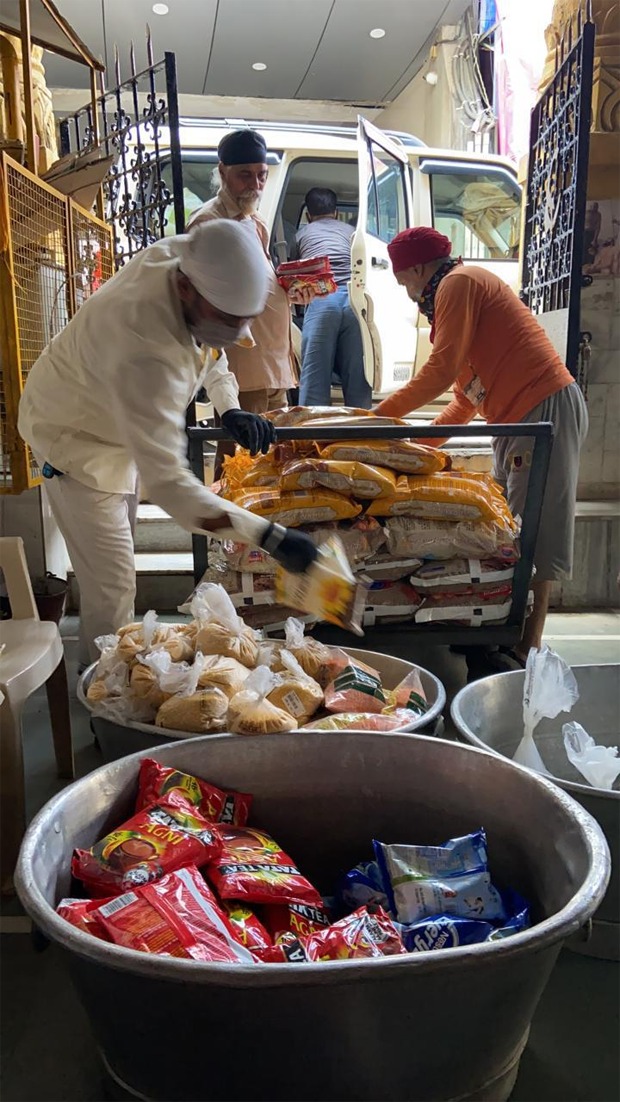
The lockdown caused due to the pandemic has brought various problems with it, one of them being people suffering from lack of food supplies. To tackle such a problem, Langar services in Gurudwaras had been resumed following the safety measures for social distancing and Sunny Singh donated ration for the Langar services at the Andheri East Gurudwara.
The actor has contributed towards society and dabbled in a really kind act to tackle the problem of lack of food supplies. The best part about Langar service is that they are open to all people who need food and are suffering from hunger. Sunny has really let his philanthropic side shine as he donates food towards the ones in need.
On the work front, the actor was last seen in the mom-com Jai Mummy Di where his performance was appreciated by all, once again. His recent Holi song ‘Holi Me Rangeele’ got everyone dancing to the tunes and created quite a stir.
Bill Murray’s son arrested at Black Lives Matter protest on disorderly conduct charge: Reports
Veteran actor Bill Murray’s son Caleb was reportedly arrested for assault and battery against a police officer during a protest against police brutality.
The actor’s 27-year-old son Caleb Murray on Monday took part in a Black Lives Matter protest at Martha’s Vineyard, an island in Dukes County, Massachusetts.
During the protest, he got into an altercation with police officers who were responding to another incident at the demonstration, according to MV Times.
Caleb allegedly spit on and bit a police officer, attacked sheriff’s deputies, and threatened arson.
Another protestor Eric Woods, 66, was also arrested.
He is accused of using a racial slur before assaulting a teen, which led to uproar among the protesters and resulted in the police being called.
According to the report, Caleb was initially arrested after throwing a rock through Woods’ window after police arrived.
The situation then escalated during and after Caleb’s transport to jail.
According to another local outlet, The Vineyard Gazette, Caleb was further charged with two counts of assault and battery against a police officer, making terroristic threats and threatening to commit a crime, a court filing obtained by the outlet said.
The crime he allegedly threatened to commit was arson.
The charges of making terrorist threats and malicious destruction of property were dropped after the district court-clerk magistrate did not find probable cause.
He is currently being held without bail with a pretrial hearing set for July 31.
Minneapolis today agreed to ban chokeholds by police and to require officers to try to stop any other officers they see using improper force, in the first concrete steps to remake the city’s police department since George Floyd’s death.
The changes are part of a stipulation between the city and the Minnesota Department of Human Rights, which launched a civil rights investigation this week in response to the death of Floyd. The City Council approved the agreement 12-0.
A Minneapolis officer kneels on the neck of George Floyd. (AP)
Human Rights Commissioner Rebecca Lucero said the changes are necessary to stop ongoing harm to people of colour “who have suffered generational pain and trauma as a result of systemic and institutional racism”.
“This is just a start,” Comm. Lucero said.
“There is a lot more work to do here, and that work must and will be done with speed and community engagement.”
The agreement requires court approval and would become enforceable in court, unlike the department’s current policies on the use of force and duties to intervene.
It would require officers to immediately report to their superiors when they see use of any neck restraint or chokehold.
Police detain a woman during a yellow vest protest with other groups in Brussels. (AP)
Floyd, a handcuffed black man, died after Officer Derek Chauvin pressed his knee on his neck, ignoring Floyd’s “I can’t breathe” cries and bystander shouts even after Floyd stopped moving. His death has set off protests around the world.
Comm. Lucero said the changes go further than the department’s current policies. Any officer who doesn’t try to stop the improper use of force would face the same discipline as if they themselves had used improper force.
The agreement also would require authorisation from the police chief or a deputy chief to use crowd control weapons such as tear gas, rubber bullets and flash-bang grenades.
Such tactics have been used in Minneapolis and other cities in the past week to disperse protesters.
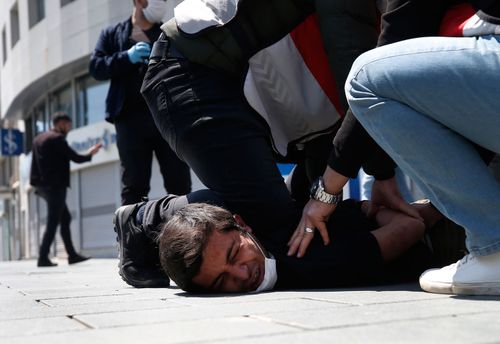
Turkish police officers arrest a demonstrator wearing a face mask for protection against the coronavirus in Istanbul. (AP)
The stipulation also sets a process for the city and state to negotiate longer-term changes, such as changing state laws that make it difficult to fire problem officers.
“This is a moment in time where we can totally change the way our police department operates,” Mayor Jacob Frey told the council.
“We can quite literally lead the way in our nation enacting more police reform than any other city in the entire country, and we cannot fail.”
“Those of you who protested peacefully over the last week changed the policies on chokeholds in Minneapolis,” Gov. Tim Walz said.
“This is what direct citizen engagement looks like.”
Meanwhile, a man who was with Floyd on the night he died told the New York Times that his friend didn’t resist arrest and instead tried to defuse the situation before he ended up handcuffed on the ground and pleading for air.
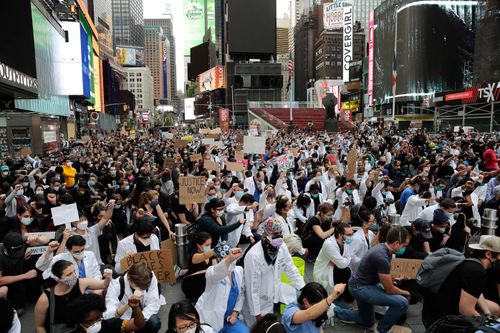
Protesters kneel in Times Square in New York. (AP)
Authorities say Hall, whose name is spelled Morries Lester Hall in court records, is a key witness in the state’s investigation into the four officers who apprehended Floyd.
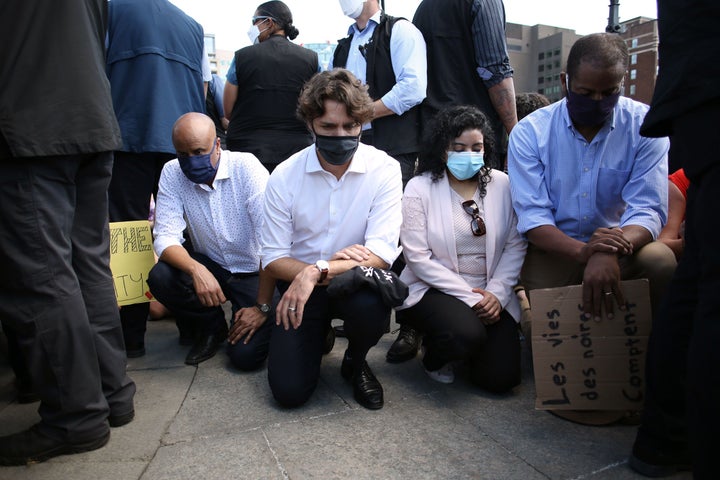
Canadian Prime Minister Justin Trudeau took a knee during an anti-racism demonstration on Parliament Hill in Ottawa on Friday.
Trudeau, wearing a face mask, joined other protesters kneeling for the symbolic period of 8 minutes and 46 seconds ― the amount of time a white police officer pressed his knee into the neck of George Floyd, a Black man, in Minneapolis last week. Floyd’s death in police custody has inspired protests worldwide.
“We all watch in horror and consternation what’s going on in the United States,†he eventually said. “It is a time to pull people together but it is a time to listen, to learn what injustices continue despite progress over years and decades.â€
Trudeau’s taking of a knee split opinion on Twitter. Critics accused him of opportunism. Canada’s Families Minister Ahmed Hussen, who is Somali-Canadian, accompanied Trudeau to the rally. He described the gesture as “powerful.â€
Trudeau on Monday acknowledged that anti-Black racism and systemic discrimination is a “real aspect†of Canadian life.
Calling all HuffPost superfans!
Sign up for membership to become a founding member and help shape HuffPost’s next chapter
Some good news for tourist guides, who are now eligible to receive a relief payment of R1 500 per month to mitigate the devastating financial effects of COVID-19.Â
The Department of Tourism said on Saturday 6 June that while it isn’t much, the amount will be paid monthly for three months and should assist with some of the country’s freelance tourist guides’ immediate distress.Â
How do you apply?Â
The process is going to work on a “no application†process, whereby the Department of Home Affairs’ database will be used to source tourist guides and from there the Department of Tourism will begin allocating payments.Â
“Information on guides will be sourced from the databases maintained by the Provincial Department of Home Affairs (DHA) and the Unemployment Insurance Fund (UIF) to verify and validate where necessary,†the department said.Â
The department urged all tourist guides to ensure that their updated details are on the DHA system, so as to ensure that the process can be managed expediently.Â
“Provincial Registrars will ensure that all the relevant information on they respective databases are correct, particularly the contact details of all their tourist guides,†said Tourism Minister Mmamoloko Kubayi-Ngubane.
“We encourage all Tourist Guides to provide their updated contact information to their respective provincial registrars. This is crucial, as careless payments will be made in order to expedite the payment process.â€Â
“Once the exercise is completed, freelance tourist guides that meet the requirements will receive payment relief of R1 500 per month for three months. It may not be much, but we believe that it will go a long way in covering some of the guides’ immediate needs.â€
Who is eligible?Â
The following criteria apply to those hoping to receive the relief funding, where applicant must:
Perhaps only Donald Trump could turn a withdrawal of troops into an act of aggression.
The U.S. president has directed the Pentagon to reduce sharply the number of U.S. military forces stationed in Germany, where a heavy presence of GIs has long served as a symbol of Washington’s commitment to protecting its European allies.
The White House would not confirm the plan, which was first reported Friday by the Wall Street Journal, but current and former officials familiar with it said Trump would cap the U.S. military presence at 25,000 — requiring a reduction of nearly 30 percent, or roughly 9,700 troops.
As of March 31, there were 34,674 U.S. military personnel stationed in Germany, including 20,774 from the Army and 12,980 from the Air Force, according to the most recent publicly-available Pentagon deployment report.Â
Some 19,000 additional civilian employees support the uniformed military forces, and that number would almost certainly be cut as a result of the planned withdrawals.
There were no indications that NATO officials had been briefed on Trump’s plan ahead of time.
The reduction in forces stands to reverse an increase in the U.S. military presence in Europe during Trump’s administration, which NATO Secretary-General Jens Stoltenberg has trumpeted repeatedly to refute any suggestion that America’s commitment to the alliance might be wavering under the president who once called it “obsolete” and who has repeatedly bashed allies for not spending enough on their own militaries.
Stoltenberg has pointed to the increased U.S. presence as part of NATO’s effort to step up deterrence against an increasingly aggressive and assertive Russia. Moscow undoubtedly will cheer any reduction in the U.S. military footprint in Europe, which the Kremlin has regarded as a menacing presence since the days of the Cold War.
“Sometimes we also hear that the U.S. is leaving Europe — that’s not correct,” Stoltenberg said at a conference in London on the sidelines of a NATO leaders’ summit in December. “The U.S. is actually increasing their presence in Europe … So there’s more U.S. presence in Europe, more U.S. troops in Europe. I can’t think about any stronger way to demonstrate U.S. commitment to Europe than that.”
There were no indications that NATO officials had been briefed on Trump’s plan ahead of time. In response to a request for comment on Saturday, a NATO spokesman referred questions to the U.S.
In recent months, the U.S. president has occasionally caught allies off-guard with unilateral military action, including an abrupt withdrawal from northern Syria that set off turmoil in the region, and the surprise targeted killing of an Iranian general, Qassem Soleimani, that forced NATO to suspend its training mission in Iraq for fear of reprisals on allied forces there.
Trump’s pullout from northern Syria put the U.S. in conflict with Turkey, another NATO ally, and prompted French President Emmanuel Macron to complain that he was witnessing the “brain death” of the alliance.
On Friday, a spokesman for the U.S. National Security Council, John Ullyot, issued a statement that neither confirmed nor denied Trump’s drawdown plan for Germany.
“While we have no announcements at this time, as commander in chief, President Trump continually reassesses the best posture for the United States military forces and our presence overseas,” Ullyot said. “The United States remains committed to working with our strong ally Germany to ensure our mutual defense, as well as on many other important issues.”
As of March 31, there were 34,674 U.S. military personnel stationed in Germany, including 20,774 from the Army and 12,980 from the Air Force | Patrik StollarzAFP via Getty Images
News that the White House was pushing forward with the withdrawal comes as transatlantic relations are as badly strained as at any point during Trump’s tumultuous tenure in office, and just days after German Chancellor Angela Merkel rebuffed an invitation from Trump to attend a G7 leaders’ summit in Washington later this month.
Merkel cited the ongoing coronavirus pandemic as a chief reason for begging off from an in-person gathering of the world’s richest, most powerful democracies. But officials familiar with the discussions also said she worried about leaders being used as a photo-op by Trump to show him getting the world back to business following the health lockdowns.
In the meantime, the U.S. has become engulfed in a nationwide crisis over racism and police brutality, with Trump threatening to deploy active-duty military forces on the streets of his own cities.
Trump’s withdrawal plan appeared to be less a form of direct retribution for Merkel’s G7 decision, but rather a follow-through on previous threats to reduce the U.S. military presence in Germany, which were conveyed by the U.S. ambassador, Ric Grenell, as part of the overall White House criticism of Berlin’s military spending as too meager.
Merkel and Trump have never had a good relationship, with the president criticizing her handling of migration and asylum policy, as well as denouncing the NordStream 2 gas pipeline project.
A cut of US #troop presence would be deplorable. The stationing of troops in #Germany is crucial for the coordination of the international military presence of the #USA, and cooperation works well. Cannot see any objective reason for this.
Germany, in turn, has pushed back harder than nearly any other NATO ally against Trump’s criticism over military spending, noting that allies were all working toward previously agreed-upon spending goals and also stressing that contributions to NATO could be counted in other ways, particularly in terms of operational support. And Merkel has made little secret of her disdain for Trump’s disruptive approach to world politics.
Despite previous threats, the news of the drawdown appeared to catch Berlin by surprise. The German defense ministry declined a request for comment. The German news magazine Der Spiegel said Trump’s move was clearly “a provocation.”
Norbert Röttgen, the chairman of the foreign affairs committee in the Bundestag and a contender to succeed Merkel as chancellor, criticized the move Saturday, calling U.S. forces in Germany “crucial” and saying a reduction “would be deplorable.”
“Cannot see any objective reason for this,” Röttgen tweeted.
Retired Lieutenant General Ben Hodges, former commander of U.S. Army Europe, told POLITICO that the withdrawal of troops was not justified by strategic thinking or analysis.
Angela Merkel rebuffed an invitation from Trump to attend a G7 leaders’ summit in Washington later this month | Pool photo by Clemens Bilan/Getty Images
“I believe this is a colossal mistake,” said Hodges, who now holds the Pershing chair in Strategic Studies at the Center for European Policy Analysis, a think tank. “This is purely political.”
Hodges said that the move had caught virtually everyone by surprise, from the Pentagon and Congress to U.S. diplomats and military officials in Europe, NATO leaders and allies, especially Germany. Hodges said that Russia would be a main beneficiary of the withdrawal — and that a softening of U.S. posture was hardly justified.
“The Kremlin has done nothing to deserve a gift like this,” he said. “No change in behavior in Ukraine or Syria or along NATO’s eastern flank or in the Black Sea or Georgia, Yet they get a 28 percent reduction in the size of U.S. military capability that was a core part of NATO’s deterrence.”
With seemingly little preparation for such a big redeployment, it’s far from clear how quickly Trump’s order could be carried out, especially with the continuing pandemic causing added logistical difficulties. “It will be very difficult and disruptive and expensive to move several thousands of soldiers and airmen back to the States,” Hodges said.
Music composer Sajid Khan on Friday thanked the team of doctors and the hospital staff that took care of his brother Wajid Khan. In a statement posted on the music director duo’s Instagram page, it was mentioned that Wajid passed away at the age of 47 due to a cardiac arrest on 1 June at the 00:30 am in Surana Sethi’s hospital in Mumbai.
The musician wrote that Wajid had a successful kidney transplant last year and was undergoing treatment for throat infection in the hospital.
Sajid said Dr Prince Surana was like a family and cared for Wajid like a brother with his team of doctors.”…the entire hospital staff who had been treating Wajid and taking care of him beyond the call of duty and had left no stone unturned for his treatment,†he added.
Read the statement below:
Sajid had told Press Trust of India that Wajid had died of cardiac arrest, while confirming that the composer had tested positive for COVID-19. On Tuesday, a family source had revealed that Sajid and Wajid’s mother, Razina Khan, also tested positive for coronavirus. Sajid-Wajid made their Bollywood debut with Salman’s 1998 movie Pyaar Kiya Toh Darna Kya and went on to work on actor’s various films including Garv, Tere Naam, Mujhse Shaadi Karoge, Partner, Veer, Wanted, Dabangg franchise and Ek Tha Tiger.
Wajid also did playback for Salman in chartbusters like Mera He Jalwa, Fevicol Se and for Akshay in ‘Chinta Ta Chita Chita’ from the film Rowdy Rathore, among others.
He had recently co-composed Salman’s songs ‘Pyaar Karona’ and ‘Bhai Bhai’, which the actor released on his YouTube channel amid lockdown.
Updated Date: Jun 06, 2020 15:23:27 IST
Find latest and upcoming tech gadgets online on Tech2 Gadgets. Get technology news, gadgets reviews & ratings. Popular gadgets including laptop, tablet and mobile specifications, features, prices, comparison.
In a normal season, the village of Naknek in southwestern Alaska would be bustling by the end of May, with people arriving from all over the world to work Bristol Bay’s renowned salmon run.
The village’s population of around 500 swells as over 13,000 workers come to Bristol Bay to spend about six weeks fishing, canning and cleaning the products of the world’s primary source of wild-caught sockeye salmon.
This year, with the season opening just days away, “it still feels like a ghost town,†said Nels Ure, a second-generation Bristol Bay fisherman. Because of the pandemic, “it’s not business as usual.â€
Seafood industry workers are under 14-day quarantine orders once they arrive in Alaska from elsewhere. Cannery workers are being quarantined either in hotels in Anchorage before they arrive at the bay, or with a group of other newly arrived employees at their facility, so they can start work while in quarantine together. Fishermen are expected to quarantine on their vessels, either in the boatyard or on the water ― or they can stay in their seasonal cabins or homes around the bay, as long as they are self-isolated.
Their work is vital to the region’s economy. Last year, Bristol Bay’s salmon industry and its workers generated $300 million in revenue. But this year, there’s concern that the thousands of people who travel here for seasonal work could bring the coronavirus with them. As of May 31, Bristol Bay has had five confirmed cases of COVID-19. Many are worried that the close quarters on boats and in canneries are the perfect environment for spread, which would create a dangerous situation in a region with limited medical resources. A confusing jumble of state and local guidelines, often weakly enforced, could make the situation worse.
Lucas Jackson / Reuters
Workers clean salmon carcasses on a cleaning line at the Alitak Cannery in Alitak, Alaska, in 2008.
In early April, concerned community and tribal leaders around Bristol Bay wrote to Alaska Gov. Mike Dunleavy (R), asking him not to open the commercial fishing season at all. But fishing is considered an essential industry in Alaska, generating more than $5 billion a year in economic activity statewide. The pandemic has damaged Alaska’s economy, which relies heavily on tourism, oil and gas ― putting additional pressure on this year’s fishing season.
Bristol Bay’s remoteness has largely protected it from the coronavirus so far. But now it’s facing the same challenges that have plagued meatpacking facilities in the Lower 48, where almost 5,000 workers have contracted COVID-19.
Bristol Bay’s main hub, Dillingham, has a year-round population of just 2,300. Its hospital has 16 beds, two ventilators and no ICU. City manager Tod Larson said he’s had trouble even securing basic personal protective equipment. While the fishing industry is fairly self-contained, Larson said, it relies on regional medical infrastructure when things go wrong.
“It won’t take much to overwhelm the system,†he said.
Navigating A New Normal
The fishing industry is trying to find ways to keep working under the new parameters. The state says independent fishermen can quarantine on their vessels with other crew members, so long as they start their 14-day quarantine at the same time. They also say anyone showing any symptoms “should be isolated†― but that may be difficult to put into practice, especially on a small boat.
The Bristol Bay Regional Seafood Development Association, an economic organization representing fishermen in the region, is handing out flags so boats can note their crews’ status. A black and yellow checkered Lima flag means the boat is in quarantine; a solid yellow Quebec flag means the vessel is in the clear.
The state has issued various guidelines for the fishing industry that overlap confusingly with local and tribal mandates, all of which rely heavily on self-enforcement. As of June 6, for example, most people arriving in Alaska will be allowed to skip the 14-day quarantine if they can show a negative COVID-19 test from within the previous 72 hours. But that won’t apply to seafood workers, who must still quarantine for two weeks.Â
Nels Ure
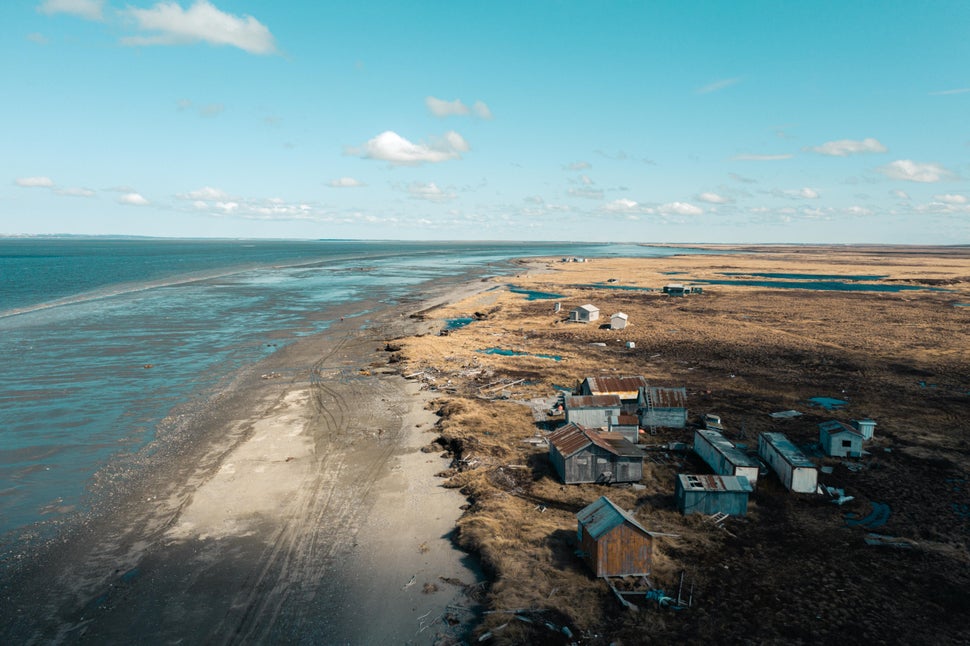
Setnet cabins near Pederson Point in Alaska.
Many towns and tribal governments in the region also have their own policies to sort through. Dillingham is requiring a 14-day quarantine, in addition to a negative COVID-19 test result at the beginning of quarantine and another one at the end. The Bristol Bay Borough, which represents the towns of Naknek, South Naknek and King Salmon, is not requiring testing or enforcing quarantines for new arrivals. But the communities’ local tribal councils have instituted mandatory 14-day quarantines. And while most seafood processing companies in the area are requiring testing for workers, the borough does not require independent fishermen to test negative for COVID-19.
Kendra Gottschalk, an administrative assistant at the Naknek Native Village Council, said she wishes there were one uniform set of restrictions around the bay.
“It’s just ever-changing,†Gottschalk said. Communicating what is required “has been a really gray area.â€
Testing A Region’s Capacity
In order to increase the amount of testing available in Dillingham, the Animal Control Building has been converted to a testing site that Capstone Clinic, a family medical practice based in Anchorage, is running.
Carey Perry, who is coordinating the logistics for the site with Fairweather, LLC, said he feels they are “well-equipped.†As of June 4, they had conducted 640 tests, running 101 tests on the clinic’s busiest day so far. Perry says they anticipate needing to run 300 to 400 tests a day shortly as charter flights with seafood industry workers begin to arrive. He estimates they will conduct 8,500 tests during the season.
Dillingham, Naknek and several other communities around Bristol Bay now have testing available in village clinics.
But Larson remains worried about the seafood processing facilities in Dillingham. The state required the major companies operating around the bay to submit independent COVID-19 protocols, but some are more comprehensive than others. Even with new protocols, Larson said, “it’s still a lot of people in a small area.â€Â
Nels Ure
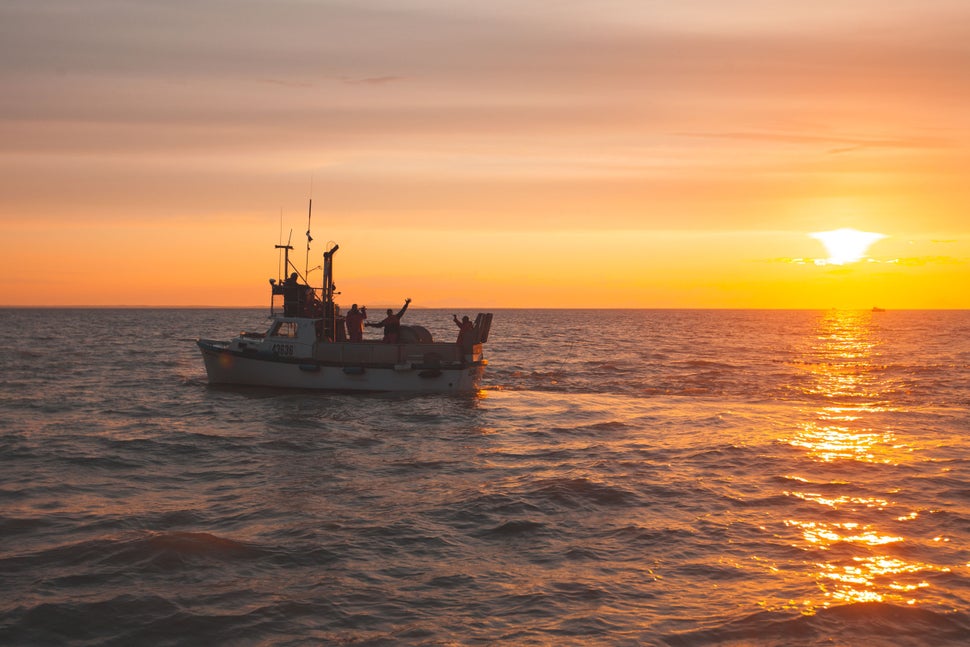
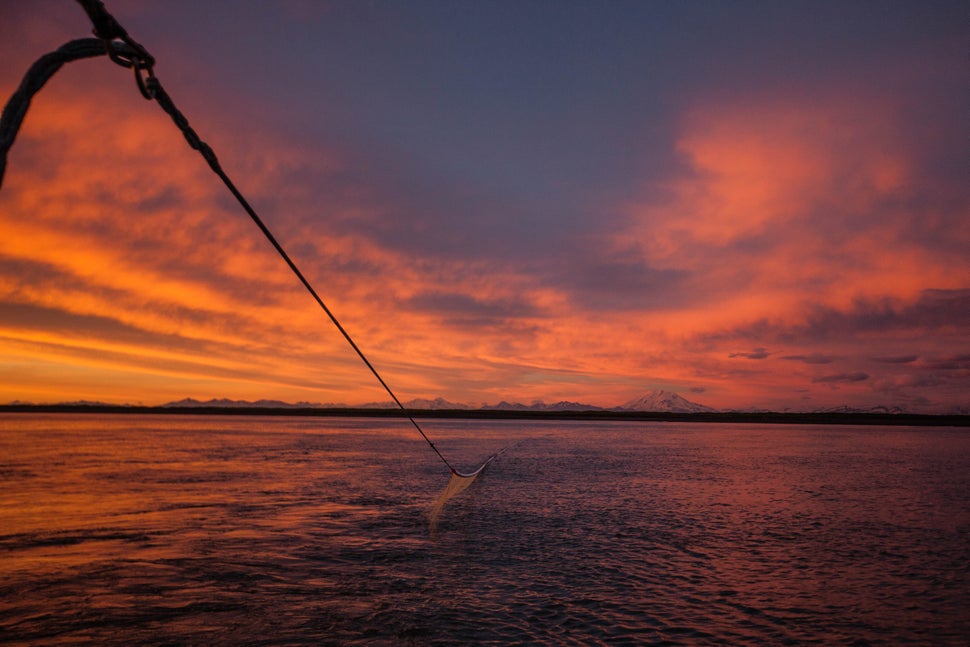
A Bristol Bay drift boat making a set during golden hour.
“There are certain aspects of the processing line that make it difficult to maintain social distancing, but that’s the idea behind having everyone tested negative before the season starts,†said Miles Sturm, a safety coordinator who works at a Peter Pan Seafoods processing facility in Dillingham.
Sturm said workers will also be required to remain within the fenced-in facilities, and a guard is stationed at the gate 24 hours a day. “There is always the fear of something getting in,†he said, “but it is being taken very seriously.â€Â
About 60 Peter Pan workers arrived in Dillingham the third week of May, and were shuttled directly to the processing facility for a “working quarantine.†Everyone in the facility is supposed to wear a mask and observe social distancing guidelines. The mess hall is no longer self-service, and employees now eat in their rooms.
“Even in a normal year, people spend almost all their time at the facility,†Sturm said. Capstone tested all of them on May 22 and found no positive cases. They were to be tested a second time at the end of their quarantine period this week.
But there are already signs that this might not be enough. The Bristol Bay region had its first COVID case on May 15 when a nonresident seafood worker was tested at the end of their 14-day quarantine. May 20 saw the first positive local case in the Chignik area. On May 29, two people tested positive in Naknek, and an out-of-state seafood industry worker tested positive in Dillingham on May 30.
Other places are already seeing COVID-19 cases among fishing industry workers. On May 29, a crew member on an American Seafoods factory trawler scheduled to arrive in Alaska’s Bering Sea later this summer was admitted to the hospital in Seattle. Testing revealed 85 cases among crew members ― showing just how quickly the virus can spread in the close quarters of the fishing industry.
On June 4, Alaska reported 17 new cases in seafood workers around the state. Ten of those new cases were reported in a single processing facility in Whittier.â€Â As of June 5, there had been 33 confirmed cases among nonresident seafood workers.
Nels Ure
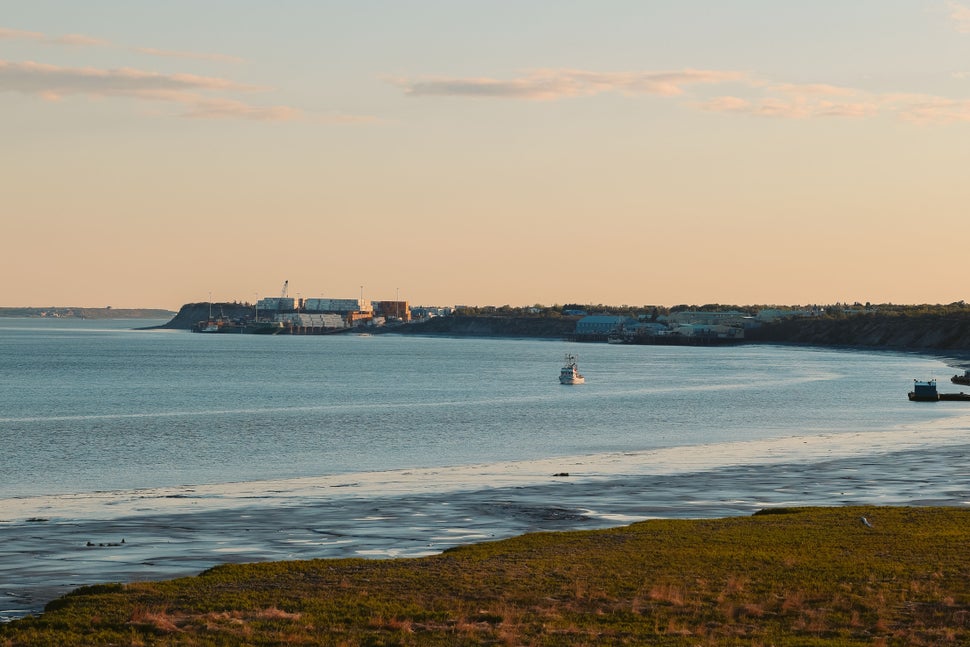
A fishing vessel on the Naknek River.
‘The Virus Doesn’t Make Exceptions’
Even before the pandemic, rural Alaskan communities, which are predominantly Alaska Native, lacked health care infrastructure, said Alannah Hurley, the executive director of United Tribes of Bristol Bay. Many people rely on the periodic visits of traveling health aides, or must travel to larger urban centers for care.Â
Some communities lack running water, and housing is in short supply. “Overcrowding is a really big issue in Bristol Bay,†Hurley said. “And then just culturally, a lot of us live in intergenerational homes.†Food insecurity is also a concern; 38% of people in the area are eligible for federal food assistance.
“We struggle with diseases of a modern society that include chronic illnesses such as cancer, diabetes and heart disease,†notes the Bristol Bay Area Health Corporation. These conditions have been linked to higher risk of severe coronavirus cases. And hanging over COVID-19 concerns is the shadow of past health crises: The 1919 flu pandemic killed as much as 40% of the adult population around Bristol Bay.Â
“The people that are alive now are the children and grandchildren of the orphans who survived,†Hurley said.Â
But economic concerns also weigh heavily. For many here, the salmon season represents one of their main employment opportunities. Hurley, who is also a fisherman, says that’s why it was so significant that some communities suggested calling the season off.Â
“Our people are going to be left with whatever happens this summer,†Hurley said.
Gottschalk said it feels like the region is “being forced into this scary pandemic†― a situation that might have been avoided if the fishery had closed down.Â
Klas Stolpe/AP
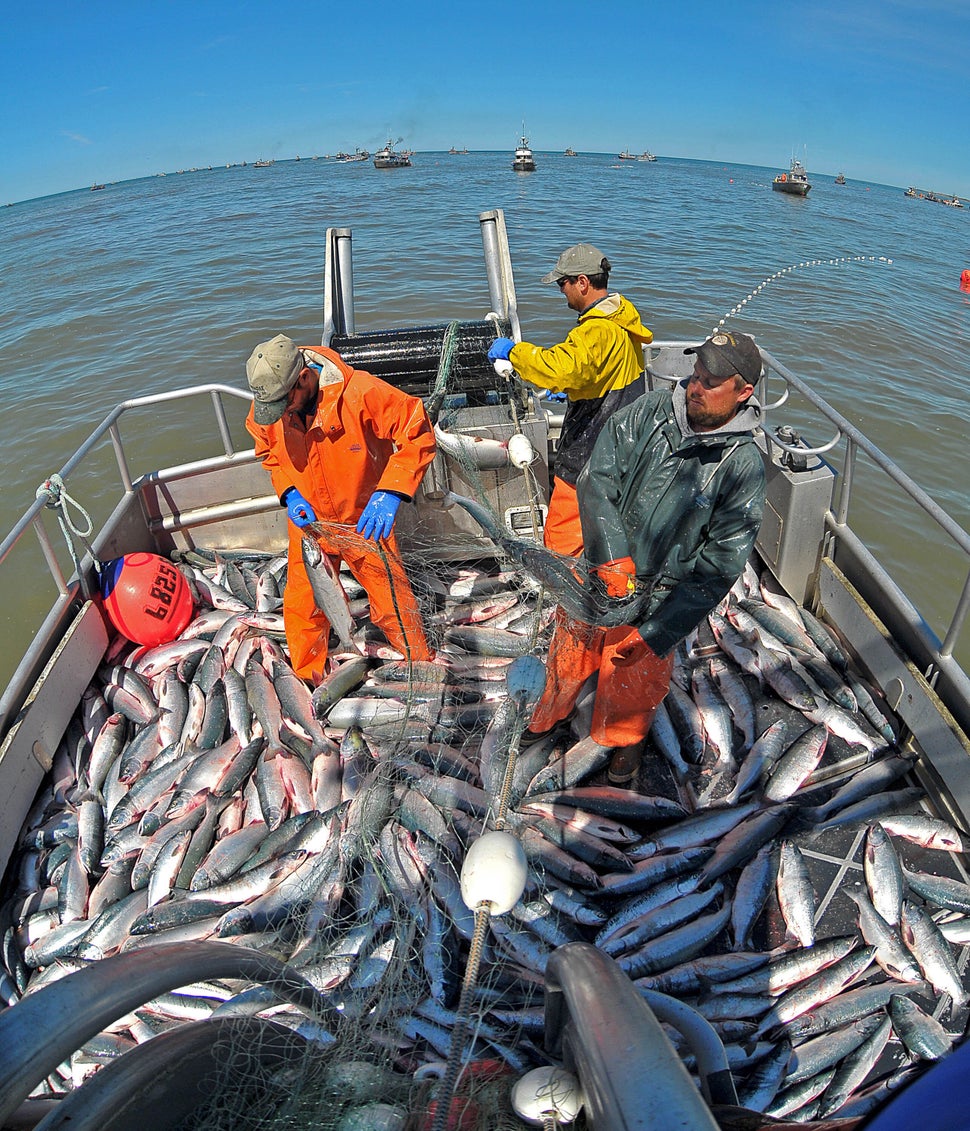
In this 2009 file photo, fishermen work to remove sockeye salmon from their net in the Egegik district of the Bristol Bay, Alaska, sockeye salmon fishery.
Some residents are concerned that the economy is being put first. “For us, it’s lives over money,†said Ralph Andersen, president and CEO of the Bristol Bay Native Association. Tribal organizations have been coordinating with communities around the bay to provide information, develop safety plans and call on the state for help expanding medical capacity and law enforcement.
The state has not said how many positive cases in an individual seafood cannery would be enough to raise the possibility of shutting it down.Â
“It’s going to depend on a number of factors,†Charles Pelton, from the Department of Public Health emergency programs, education and outreach with the Alaska Department of Health and Social Services, said on a public conference call on May 29. “Clearly, our number one priority will be the health of the community.†The department did not respond to multiple follow-up requests for clarification.
Around 13,000 people are expected to arrive in the area by mid-June, and relying on individuals or companies to voluntarily follow quarantine and testing instructions seems outlandish, Hurley said. “We were seeing people come straight off the plane, ignoring local quarantine ordinances and going to local grocery stores,†she said.Â
Larson said that Dillingham’s police force has written a handful of citations for quarantine violations so far. State troopers won’t be enforcing Dillingham’s quarantine requirements, either, Lt. Paul Fussy, the state troopers’ liaison for emergency management, said on the May 29 call.Â
“As state troopers, we do not enforce local mandates,†he said. “We are encouraging people to self-police with the state mandates.†Starting June 8, the state is paying for three members of the private security firm Denali Universal Services to bolster the six-person police force in Dillingham. Â
But as more industry workers arrive, knowing who is and isn’t complying with local restrictions will be increasingly difficult ― and, for smaller communities around the bay and its river systems that don’t have their own police, almost impossible.Â
“We can put into place all kinds of laws and regulations and mandates, but none of them are any good without enforcement,†Andersen said. “The virus doesn’t make exceptions, nor should we.â€Â
Ure, the second-generation fisherman, is preparing for the arrival of several crew members from other parts of Alaska. He said that even though it isn’t currently required in his location, he will make sure they get tested.
“One thing that COVID-19 has shown us over these last couple of months is that one person makes a difference,†he said.
Nels Ure
Fisherman Nels Ure writes: “The southernmost district in Bristol bay, Ugashik. This is where the majority of my now decade in the bay has been spent. This is during an early morning set and there is a volcano in the background.”
Calling all HuffPost superfans!
Sign up for membership to become a founding member and help shape HuffPost’s next chapter
A Maasai man in the Kibera slum of Nairobi, Kenya, prays next to a mural of George Floyd, painted by the artist Allan Mwangi on June 3.
Gordwin Odhiambo/AFP via Getty Images
hide caption
toggle caption
Gordwin Odhiambo/AFP via Getty Images
A Maasai man in the Kibera slum of Nairobi, Kenya, prays next to a mural of George Floyd, painted by the artist Allan Mwangi on June 3.
Gordwin Odhiambo/AFP via Getty Images
Around the world, people have held vigils, organized protests and painted murals this week to show solidarity with the Black Lives Matter protests taking place across America.
These events are also taking place in countries struggling with their own crises — conflict, poverty, the pandemic. America’s loud call for justice after the deaths of George Floyd, Breonna Taylor, Ahmaud Arbery and many more black Americans has resonated.
In Nigeria, a dozen protesters gathered in front of the U.S. embassy in Abuja with signs that said “Black life matters.” In Ghana, the president tweeted a drawing of George Floyd and wrote: “Black people, the world over, are distraught by the killing of an unarmed black man.”
And in Syria’s war-torn city of Idlib, artist Aziz Asmar says he was moved to create a mural after watching the media coverage around Floyd’s death.
“I decided to paint George Floyd on the rubble of a building destroyed by aviation … to send a message to the world that despite the international negligence and blindness of the killing of civilians in Syria over a period of 10 years, we have a humanitarian duty to sympathize with all the oppressed in the world,” he wrote to NPR. “Because we are advocates of peace, we hope that racism and crime will disappear and that the world will enjoy happiness.”
Here are more examples of how people around the world are honoring black lives and demanding racial equality.
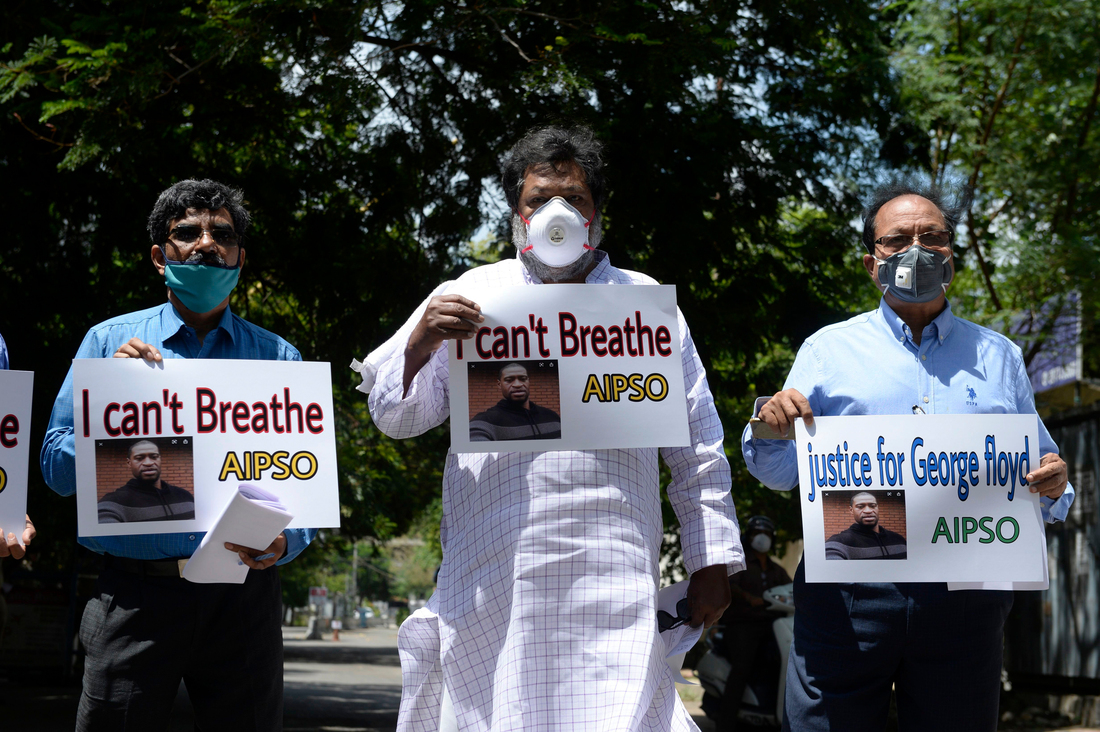
Members of the All India Peace and Solidarity Organization hold placards in silent protest at the U.S. consulate in Hyderabad, India, on June 4.
Noah Seelam/AFP via Getty Images
hide caption
toggle caption
Noah Seelam/AFP via Getty Images
Palestinian digital artist Munes al-Salihi draws a portrait of George Floyd at his house in a refugee camp in the Gaza Strip on June 4.
Mohammed Abed/AFP via Getty Images
hide caption
toggle caption
Mohammed Abed/AFP via Getty Images
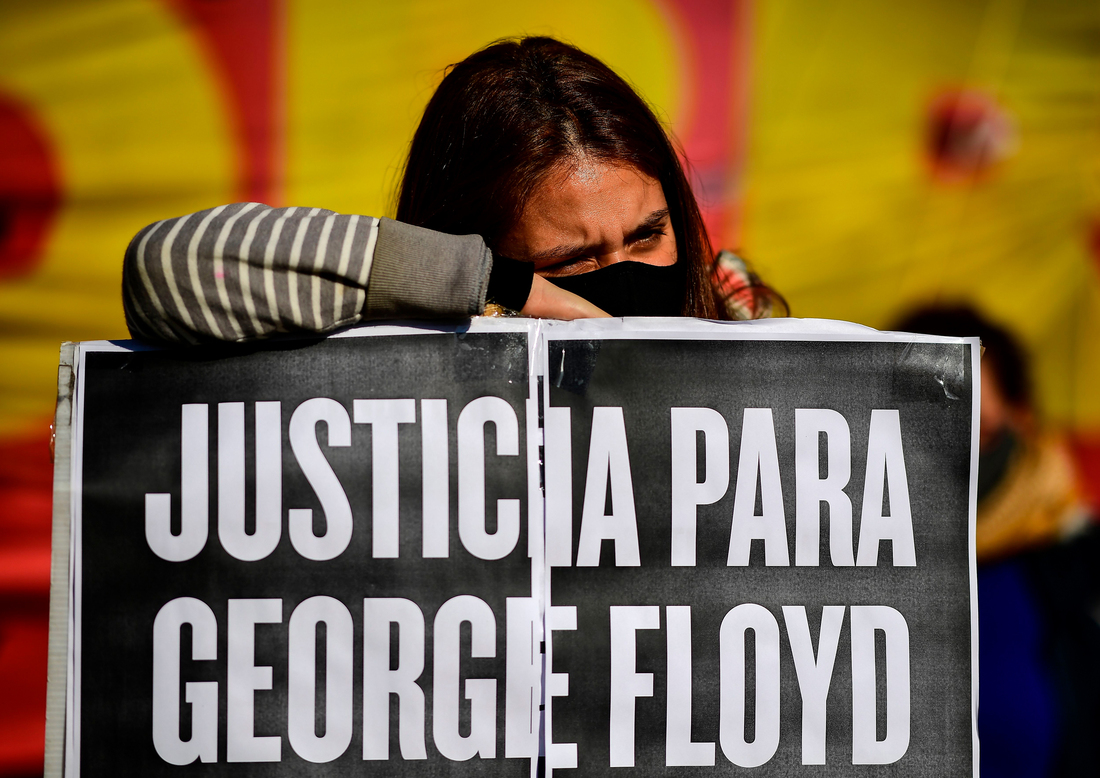
A woman holds a sign saying “Justice for George Floyd” in Spanish in Buenos Aires, Argentina, on June 2.
Ronaldo Schemidt/AFP via Getty Images
hide caption
toggle caption
Ronaldo Schemidt/AFP via Getty Images
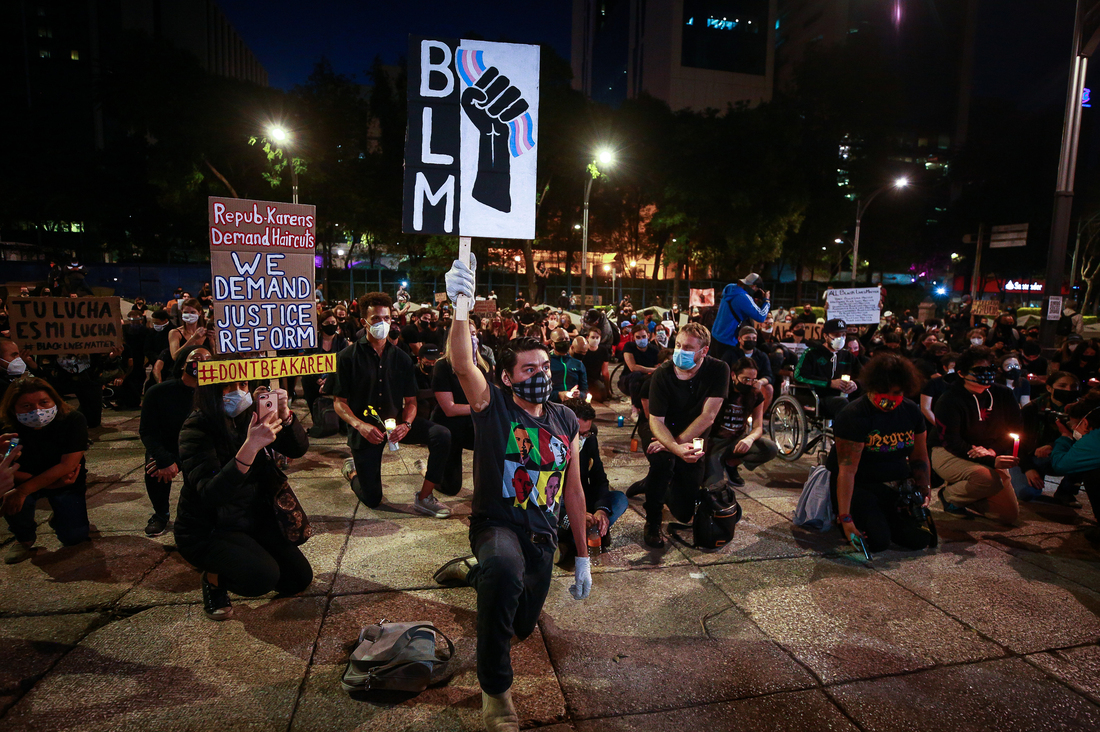
A man kneels during a protest against police brutality in Mexico City on June 4.
“You’re on our land,†said Kaya Nicholson, a 17-year-old Indigenous organizer. She told protesters that while she appreciated their support in this moment of global unrest around race, it was crucial that Australians continue to speak up for Indigenous people.
“Don’t just support Black Lives Matter because it’s trending,†she said.
Ron Baird, an African American living in Australia, drew parallels between Australia’s troubles and the crisis in the United States, disputing Prime Minister Scott Morrison’s suggestion this week that Australians were “importing†problems that had not already existed in the country.
“No Mr. Morrison, Australia is not the United States, but Australia does have its own long, dark, brutal past of oppression,†Mr. Baird said.
In Britain, the health minister, Matt Hancock, cited Covid-19 on Friday in warning protesters not to gather this weekend. “I understand why people are deeply upset, but we are still facing a health crisis and coronavirus remains a real threat,†he said.
His warning came as the infection rate increased in the northwest and southwest of England, health officials said, with the R number rising to 1 or above it.
The Metropolitan Police’s deputy assistant commissioner in London, Laurence Taylor, told the BBC, that because of social distancing rules allowing only six people from different households to gather outdoors, the planned demonstrations across the country were “unlawful.â€
Damien Cave reported from Sydney and Livia Albeck-Ripka from Melbourne, Australia. Elian Peltier contributed reporting from Paris, and Yonette Joseph from London.
We use cookies on our website to give you the most relevant experience by remembering your preferences and repeat visits. By clicking “Accept”, you consent to the use of ALL the cookies.
This website uses cookies to improve your experience while you navigate through the website. Out of these, the cookies that are categorized as necessary are stored on your browser as they are essential for the working of basic functionalities of the website. We also use third-party cookies that help us analyze and understand how you use this website. These cookies will be stored in your browser only with your consent. You also have the option to opt-out of these cookies. But opting out of some of these cookies may affect your browsing experience.
Necessary cookies are absolutely essential for the website to function properly. These cookies ensure basic functionalities and security features of the website, anonymously.
Cookie
Duration
Description
cookielawinfo-checbox-analytics
11 months
This cookie is set by GDPR Cookie Consent plugin. The cookie is used to store the user consent for the cookies in the category "Analytics".
cookielawinfo-checbox-functional
11 months
The cookie is set by GDPR cookie consent to record the user consent for the cookies in the category "Functional".
cookielawinfo-checbox-others
11 months
This cookie is set by GDPR Cookie Consent plugin. The cookie is used to store the user consent for the cookies in the category "Other.
cookielawinfo-checkbox-necessary
11 months
This cookie is set by GDPR Cookie Consent plugin. The cookies is used to store the user consent for the cookies in the category "Necessary".
cookielawinfo-checkbox-performance
11 months
This cookie is set by GDPR Cookie Consent plugin. The cookie is used to store the user consent for the cookies in the category "Performance".
viewed_cookie_policy
11 months
The cookie is set by the GDPR Cookie Consent plugin and is used to store whether or not user has consented to the use of cookies. It does not store any personal data.
Functional cookies help to perform certain functionalities like sharing the content of the website on social media platforms, collect feedbacks, and other third-party features.
Performance cookies are used to understand and analyze the key performance indexes of the website which helps in delivering a better user experience for the visitors.
Analytical cookies are used to understand how visitors interact with the website. These cookies help provide information on metrics the number of visitors, bounce rate, traffic source, etc.
Advertisement cookies are used to provide visitors with relevant ads and marketing campaigns. These cookies track visitors across websites and collect information to provide customized ads.