Sunday, April 26, 2026

Why Uncertainty Feels So Terrifying, And How To Cope With It

0

As life continues during the coronavirus pandemic, one thing is becoming clearer: There is so much we still do not know. When will the pandemic end? When will a vaccine become available? When can we resume daily life? Will things ever go back to normal? Will life be completely changed for good?

Scientists and health officials offer some predictions, but almost nothing about this pandemic is certain, except that it could go on for a long while. For many people, especially those who already struggle with anxiety, this uncertainty has been incredibly challenging — especially since the unknowns are literally a matter of life and death.

HuffPost spoke to mental health experts and people who struggle with anxiety to understand why uncertainty is so difficult to navigate in general, and how to cope.

First of all, why does uncertainty feel so damn terrible?

The human body is hard-wired to respond to uncertainty. Jessica Linick, a New York City-based licensed clinical psychologist, tells HuffPost that our brains are designed to evaluate threat and risk — and uncertainty can feel incredibly risky.

“The brain often looks for patterns,” Linick explained, adding that this mechanism is good when circumstances are predictable and make sense. “But in times of uncertainty and unpredictability, our nervous systems are on high alert; they’re always looking for that risk. And when someone’s nervous system is activated that way, it produces a flight or fight response.”

Lauren Hallion, an assistant professor of psychology at the University of Pittsburgh, agreed, noting that the human brain has evolved over time to pay attention to sudden changes in the environment that could signal a threat.

“In prehistoric times, those threats were sometimes predators, but they were sometimes diseases and viruses like the one we’re experiencing now,” Hallion said. “In other words, predictable environments are usually safe, while unpredictable environments were more likely to include potential dangers.”

Because the coronavirus pandemic is unlike anything we’ve experienced, many people are struggling with extremely grim “what if?” scenarios.

Uncertainty is rarely fun — but there’s a reason it feels so much worse right now.

While uncertainty, in general, can be anxiety-inducing, it’s fair to say that the uncertainty surrounding the COVID-19 pandemic is affecting people on a larger scale and in myriad ways.

Lynae Cook, a 30-year-old creative who lives in both Washington and California, has dealt with anxiety for most of her life. She told HuffPost that her mind has been occupied by a variety of unknowns.

“[I worry about] the fate of others and how people will pay their medical bills or afford housing,” she said. “In my personal life, [my anxiety] has manifested around projects that have been put on hold.”

Elly Belle, a 25-year-old writer and journalist living in Brooklyn, New York, said that her anxiety has been “really bad all the time” since the pandemic began.

“On top of being worried about myself and the uncertainty of my future, I’m also worried about everyone I know and love. Literally everyone is going through something difficult, whether it’s layoffs or lack of work, illness, or concerns about family,” Belle said. “I am constantly in a state of physical fear.”

Because the coronavirus pandemic is unlike anything we’ve experienced, and because there seems to be a growing list of abysmal possible outcomes, many people are struggling with extremely grim “what if?” scenarios.

“This can bring us to an existential place, where people are asking themselves about mortality [and] human nature,” said Melissa McCormick, a Florida-based licensed mental health counselor who specializes in anxiety and trauma healing.

She added that people who experience common anxiety might find themselves now coping with generalized anxiety disorder, panic disorder, or agoraphobia.

“Many of us are experiencing survival reactions … these are all visceral and can be intense, even when we are not realizing that’s what is happening in our bodies,” McCormick said.

Here’s how you can cope with uncertainty.

Belle, who has dealt with anxiety since early childhood, explains that uncertainty is always a trigger for her, but she learned at a young age that tragic possibilities are an unavoidable part of life.

“If we latch onto that [uncertainty], we will be in constant despair and anxiety,” she said. “I try to remember, especially in chaotic times, that all we can control is how we treat each other, which is why kindness is so important.”

She added that she’s been coping now by engaging in activities that make her happy, like cooking, making tea, listening to podcasts and talking with her therapist.

Likewise, Cook credits her therapist and naturopath for equipping her with successful coping tools.

“They taught me to take things in stride, the importance of sitting in your own feelings, and taking time to recharge,” she explained, adding that making lists and using a meditation app have been useful methods as well.

“Sometimes the best coping mechanism to deal with uncertainty is just try to keep yourself from thinking about all the things that you don’t know, and spend as much time as possible on the things you do.”

– Dana Gerber

For Dana Gerber, who has received treatment for her anxiety since the age of 7, the big question mark surrounding what the world will look like post-pandemic has been difficult to process.

“The biggest tool I’ve used is just distracting myself,” the 20-year-old writer from Maryland told HuffPost. She’s found it helpful to simply give her brain a break from worrying. Her distraction tools of choice? Books, Netflix, playing guitar or talking with friends.

“Sometimes the best coping mechanism to deal with uncertainty is just try to keep yourself from thinking about all the things that you don’t know, and spend as much time as possible on the things you do,” she said.

There are some cognitive tools therapists teach their patients that you can use to help you deal with uncertainty right now. Linick stresses the value of techniques that help calm a person’s vagus nerve, which is the longest cranial nerve in the human body and controls the body’s response during periods of rest or relaxation.

“Things that stimulate the vagus nerve can be vocal toning or humming, drinking cold water or putting ice on your face, jaw relaxation or massage, and calming breathwork,” she said, noting to make sure that your exhalations are longer than your inhalations when you’re doing breathing exercises.

Linick also suggested “orientation exercises” to help bring attention outward in the midst of an anxiety spike.

“Name five things in the room that are yellow, or green, or blue,” she offered as an example. “Look out the window and find the furthest thing you can see. Spend time looking at it, and describe it in various ways. This can help transition the focus from inside your body to outside your body.”

Hallion, who has partnered with other mental health experts to create a list of resources for coping with the pandemic, emphasizes the benefits of distraction.

“Going for a walk or a run while wearing a mask to protect others and staying 6 feet apart, calling loved ones, finding ways to volunteer for your community without leaving home — those are all strategies that can help distract us from our ‘worry spirals’ and bring us back to the present moment,” Hallion said.

There are also preventive tools to manage anxiety on a regular basis. Linick pointed out that during unpredictable times, it can be helpful for someone to focus on things that can be controlled.

For example, “Today, I’m going to clean my closet,” she said. “Today, I will put away my clothes. That’s something I can control; that’s something I can do. However tiny, those tasks can be quite useful.”

Additionally, Linick is an advocate of meditation, journaling, and movement exercises, while McCormick also recommends art expression and utilizing positive affirmations like ”This is not permanent. I am safe in this moment. I am inherently worthy. I deserve rest.”

"Calling loved ones, finding ways to volunteer for your community without leaving home — those are all strategies that can help distract us from our ‘worry spirals,’" says psychology professor Lauren Hallion.

“Calling loved ones, finding ways to volunteer for your community without leaving home — those are all strategies that can help distract us from our ‘worry spirals,’” says psychology professor Lauren Hallion.

What are some signs that you should seek further help?

As with any mental health issue, safety is key. “If someone feels like they’re going to hurt themselves, or hurt someone else, or they just feel unsafe in their own skin, they should seek help immediately,” Linick said.

If you don’t have access to a therapist, there are still ways to get help, like by contacting a crisis center. You can get in touch with Crisis Text Line by texting HOME to 741741, and the National Suicide Prevention Hotline can be reached by calling 1-800-273-8255.

But there’s certainly a gray area between manageable anxiety and a mental health crisis. McCormick pointed out some key signs and symptoms to watch out for.

“If someone is having panic attacks several times a week, I would say they need significantly more support,” she said, adding that the pandemic has also created a widespread increase in depression. “This may show up as changes in appetite and/or sleep, tearfulness, hopelessness, or thoughts of suicide. Some folks are in homes with unsafe people, so the risk for more safety-related anxiety and depression is also something to note.”

Ultimately, you know your body and mind best — but it’s always helpful to seek support at any point, whether it’s from a friend, loved one or therapist. McCormick puts it like this: “If someone feels like their distress is more than what they feel OK with, that’s truly enough to ask for help.”

A HuffPost Guide To Coronavirus

Source link

‘I didn’t see it’: Student recalls close encounter with shark

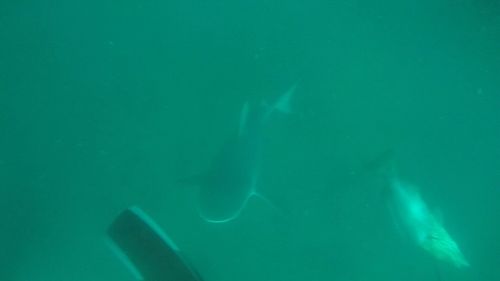
An 18-year-old school student has described his encounter with a three-and-a-half metre bull shark as “two minutes of terror”.

Keen spearfisher Lachlan Pye said he was deep diving off the coast of North Queensland when things took a turn for the worse.

Mr Pye was lining up his shot at another fish when he turned into the shark’s prey.

Lachlan Pye survived a terrifying encounter with a big bull shark. (9News)

“I didn’t see it at all until it was underneath me,” he said.

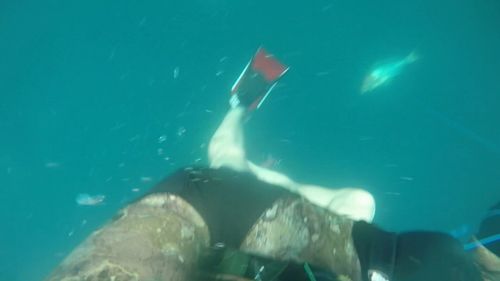
In dramatic video recorded on Mr Pyre’s Go-Pro he is seen frantically kicking at the shark in the hope of surviving.

“It pulled my foot down, I felt my ankle move and I looked down and it had taken a couple of chomps at the fin,” he said.

The shark chomped at Mr Pye’s foot. (9News)

Mr Pye’s right flipper was the only casualty of the encounter, even the fish on the end of his spear was still in tact.

“It didn’t go for the fish really, it just went for me.”

“I feel pretty lucky I’ve got my feet still,” Mr Pye said.

Mr Pye said he was lucky to escape intact. (9News)

Mr Pye’s friend Presley Wilcox, was just metres away on a boat but completely oblivious to what had happened beneath the surface.

“I just hear (him say) shark, and yeah it had bit me,” Mr Wilcox said.

Despite the close encounter, the teenagers said they would return to the water.

“That’s the risk you take,” Mr Pye said.

Source by [author_name]

Where to buy Microsoft Office: all the cheapest prices and deals in June 2020

0

If you’re looking to buy Microsoft Office, you’ll likely be looking for Office 365, or Microsoft 365 as it’s now known. Beyond that, however, you have some decisions to make. If you’re shopping for business, you can choose between Business Basic, Standard, and Premium, as well as the app-only suite for a monthly price. However, if you want to buy Microsoft Office for your home, you’ll be deciding between a rolling Family subscription for up to six users, a Personal membership for a single user, or a Home & Student one-off purchase. 

The suite of programs provides access to all the classic software services many have come to rely on, as well as business support for Teams, Sharepoint, and Exchange on certain plans. So, if you’re looking to buy Microsoft Office for the best price you’re in luck – our comparison charts are constantly hunting for the best Microsoft deals.

Source link

China media weigh in on US protests

Chinese state media has weighed in on the protests in the US, comparing them to last year’s violent anti-government demonstrations in Hong Kong that Beijing accuses the US and other foreign forces as encouraging.

In an editorial Sunday, the ruling Communist Party newspaper Global Times said Chinese experts had noted that US politicians might “think twice” before commenting again on issues in Hong Kong, knowing that “their words might backfire on them one day.”

A protester confronts police during a rally in downtown Lexington, Kentucky, against the deaths of George Floyd and Breonna Taylor. (Ryan C. Hermens/Lexington Herald-Leader via AP)

Racism, the commentary said, is the “darkest shadow on American history and the scar that will not heal.”

Chinese foreign ministry spokesman Zhao Lijian said Monday that the protests in various American cities “once again reflect the racial discrimination in the US, the serious problems of police violent enforcement and the urgency of solving these problems.”

China hopes the US will “safeguard and guarantee the legal rights of ethnic minorities,” Zhao said at a daily briefing on Monday.

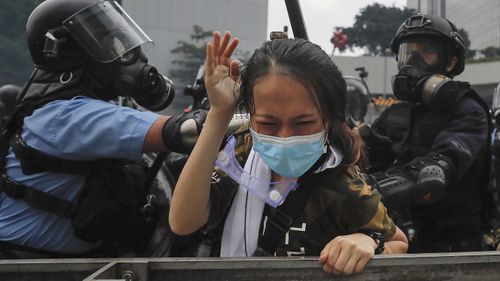
A protester is confronted by riot police during a massive demonstration outside the Legislative Council in Hong Kong
A protester is confronted by riot police during a massive demonstration outside the Legislative Council in Hong Kong (AAP)

The protests are an opportunity for China to allege double-standards and counter criticism from foreign governments and the Western media over its handling of the Hong Kong protests, its treatment of Muslim minorities in the northwestern region of Xinjiang and other human rights issues.

Source by [author_name]

Pharmacists, denied frontline status, get PPE late – The Mail & Guardian

Minister of Health Zweli Mkhize has repeatedly highlighted the importance of ensuring the safety and protection of healthcare workers in South Africa, as they are on the front line of the battle against Covid-19. However, pharmacists at the Charlotte Maxeke Academic Hospital in Johannesburg say they have neither been protected nor has their safety been prioritised. 

They say their pleas for the effective implementation of preventative measures have fallen on deaf ears. As a result, nine pharmacists at the hospital have contracted Covid-19. 

According to a pharmacist who wishes to remain anonymous, there was not enough personal protective equipment (PPE) for those dispensing medicines even before the first case of Covid-19 was recorded at the hospital. Although some received PPE, a request for all of them to get it was denied. “They [management] refused and said pharmacy does not need it. It’s only the nurses and doctors that need the equipment,” the pharmacist said.

Although pharmacists do not attend to patients directly, they are nevertheless at risk because medicine prescriptions are hand-delivered and they handle them without wearing gloves. “For me, management is nonexistent. Our cries have been falling on deaf ears. It’s like talking to a brick wall,” said the source. 

Pharmacists have asked management to implement a system whereby they can work in shifts “because it’s a small space and it’s hard to perform social distancing if we all come to work”. 

After learning that a staff member had Covid-19, the dispenser says they were told to come to the hospital for tests and were given some protective gear. “We didn’t understand, because why are you giving us PPE when we already have one of our members sick?”

When the pharmacists asked about the hospital’s policy to curb the spread of Covid-19 among staff members, they were told that it would be closed if infections occurred. “Also, that the whole place will be cleaned and fumigated, and those who had come into contact with the tested staff member would be quarantined for 14 days.” 

But this has not been the case, the pharmacist says. “They denied us the 14-day quarantine. They said it’s not possible.”

At present they are given better quality PPE, says the source, and other safety procedures have been put in place since the infections were confirmed. 

‘Pharmacists are not important’

One of the pharmacists who has Covid-19 blames the lack of PPE for becoming infected, saying, “It is not just the management but also the hospital’s department dealing with infection prevention and control that did not regard the pharmacy [personnel] as frontliners. They basically said, ‘You guys didn’t need these things because you are not of importance.’” 

And when they complained about this lack of PPE in light of the infections among them, the infected pharmacist says that they were told that they might have contracted the virus elsewhere. “The thing is, we’ve been on lockdown. We are not going anywhere. Personally, I haven’t been to the shops. I’ve just been going to work and coming back home. They didn’t want to take responsibility.”

Another problem is that when they fell ill, they still had to work: “They [management] threatened us. They said, ‘If you guys don’t come, you’re not going to get paid.’ And you can’t even take sick leave.” 

The pharmacist with coronavirus says the hospital initially checked temperatures. Despite a normal temperature being recorded, the pharmacist presented with flu-like symptoms. It was only after the test came back positive that the hospital granted occupational leave, which applies when an employee contracts an illness in the course of work. 

The team tracing those with whom the pharmacist had been in contact took a week to test family members. The tests were inconclusive and “They said they are coming back to retest. No one came.” 

The pharmacist has since returned to work and says the immediate family is fine, although no new tests have been done. 

Health department responds

Kwara Kekana, spokesperson for the Gauteng member of the executive committee for health, Bandile Masuku, says pharmacists at Charlotte Maxeke hospital were given adequate PPE after the facility was assessed. “The province currently has enough supply of PPE and is continuously procuring stock.” 

She says the pharmacy department has reduced its staff capacity to 41% to ensure that safety measures such as social distancing can be maintained. “The pharmacy attends to over 1 600 inpatients and 1 000 outpatients. Adequate staffing is needed to ensure there is no interruption of services,” she added.

After the pharmacy area was fogged and deep cleaned, Kekana says, those who didn’t have Covid-19 were asked to return to work. She adds that the province has a special team in each of its health districts to trace people who’ve had close contact with those diagnosed with the disease. “All positive pharmacy cases were referred to the district teams for tracing.”

Charlotte Maxeke Hospital is not the only healthcare facility where workers have been diagnosed with Covid-19. More than 100 staff members at Tygerberg Hospital in Cape Town have been infected. And it is not just public hospitals experiencing this predicament: in KwaZulu-Natal, two Netcare private hospitals in Durban, St Augustine’s and Kingsway, were temporarily closed after patients and staff members contracted Covid-19. 

On May 6, Mkhize said 511 healthcare workers had contracted Covid-19. No updated numbers were available at the time of publishing.  

The National Education, Health and Allied Workers Union has raised concern about the number of healthcare workers getting infected. The union says insufficient protective gear places workers’ health at risk. “We have pointed out on numerous occasions the dangers of lack of adequate personal protective equipment, training on the proper use of PPE for healthcare workers and general education on how to deal with the virus,” it said in a statement.

This article was first published on New Frame


Source link

Republican Group Rips Trump Supporters’ Use Of Confederate ‘Treason’ Flag

A Republican group of critics of President Donald Trump released a new video on Sunday slamming his supporters’ use of the Confederate flag.

“The men who followed this flag 150 years ago knew what it meant,” a voiceover in the spot from the Lincoln Project states. “Treason against their country. Death of the United States.”

Yet the flag keeps turning up at Trump events.

The ad also highlights Trump’s 2017 comments that there were “very fine people” on both sides of the violent protests in Charlottesville, Virginia organized by white supremacists, neo-Nazis and others on the far right.

“What does it say that they’re all in for Trump?” the voice in the ad asks:  

The Lincoln Project will spend $500,000 running the ad in the battleground states of Florida, Wisconsin and Michigan and in the nation’s capital, CNN reported. 

A different video by the group set Trump off last month. That spot, titled “Mourning in America,” claimed Trump’s failures to deal with the coronavirus pandemic had left the nation “weaker and sicker and poorer.” 

After it aired, Trump repeatedly attacked the organization’s founders, including conservative attorney George Conway, husband of counselor to the president Kellyanne Conway, who he derided as “Moonface” and her “deranged loser of a husband.”

The group raised $1.4 million in the three days after the ad aired on TV, The New York Times reported last week.

Another one of the group’s founders, longtime GOP strategist Rick Wilson, mocked Trump for losing “his damn mind” over the “Mourning” video.

“We expected this ad to hit,” Wilson added. “We did not expect him to behave in the completely maniacally way he behaved all day today, but here we are.” 


Source link

What nudists do during a lockdown

0

(CNN) — On an average weekday, you might find Parisian Laurent Luft enjoying a swim at the city’s Roger Le Gall swim center.

Like many of us, Luft’s currently missing his laps in the pool, which is closed due to the coronavirus pandemic and France’s lockdown rules.

But unlike many of us, Luft usually swims in the nude.

During lockdown, Luft and the Parisian naturist community have gone virtual, establishing nude yoga and cooking classes on YouTube.

“It doesn’t really make up for the real face-to-face contact that we are used to, but it’s something to keep the association alive,” Luft tells CNN Travel.

Naturists believe that embracing a clothing-optional lifestyle allows people to be more liberated and to free themselves from the constraints of society.

Right now, due to shelter-in-place orders and lockdown restrictions, many people are spending a lot of time at home, and many have found themselves rethinking their attitudes to work, leisure and lifestyle.

British Naturism‘s commercial manager Andrew Welch tells CNN Travel there’s been a rise in naturism in Britain over the course of the UK’s lockdown.

He suggests that, for some, deciding not to wear clothing could be the natural next step to spending all day in your PJs or your sweats, no longer required to wear smart office wear.

Welch also connects this uptake to the shift to a slower pace of life and a growing appreciation of the sights and sounds of nature. Plus, Welch reckons that the naturist community’s pivot towards the virtual world has allowed more people to connect with like-minded individuals from across the country — and the globe.

Luft says he’s seen a similar shift in Paris: “People have been following our videos [and] sent emails saying, ‘You’ve inspired us to give it a go.'”

“When you’re feeling confined and closed in and imprisoned, if at least you can take off your clothes that is some way to free yourself a little,” he adds. “So, even in our tiny little Parisian apartments with no gardens and sometimes no balcony or anything, we still have that possibility.”

But while naturism may be gaining some new followers, both naturists say that a big part of the movement’s appeal is embracing nudity en masse.

For naturists, replicating that feeling online is tough — as is the realization that heading off to a nudist resort for a vacation is unlikely to happen for many this summer.

“When you are naked with other people, you are already showing yourself physically, there’s nothing to hide, no disguise,” Luft says. “And so, you tend to be more open, develop deeper relationships, and you talk more openly.”

Naturist vacations

Martine and Pierre Dutray, pictured here, own Resort Naturista Grottamiranda in Puglia, Italy.

Courtesy Resort Naturista Grottamiranda

With travel largely curtailed, vacation resorts across the world have been impacted by cancellations and complications.

Naturist resorts are, in some ways, no different — many naturist travelers and fully clothed travelers alike are being forced to cancel holidays and business owners are balancing the financial implications.

But naturist resort owners suggest that their resorts could bounce back quicker than average, because they offer something specific and attract fiercely loyal clientele.

Certainly, the naturist travelers who spoke to CNN said they’re keen to book a vacation as soon as they can.

“Naturism is something that you can do in your own house — of course you can — but actually, it’s much more about the fresh air and the sense of sunshine and the breeze on your skin. I think people will be craving those opportunities to go and do that within our community,” says Welch.

“There’s nothing like opening the door of your tent one morning or your caravan and just stepping out into the sunshine with nothing on, it really is the most wonderful feeling.”

Right now, the couple are in France and unable to travel to their resort, but they hope to return in June and reopen.

They expect their summer clientele will be largely local visitors — customers from the UK and elsewhere in Europe may struggle to visit this summer due to continued travel restrictions, mandatory quarantines and Covid-19 fears.

Martine Dutray says she’s not concerned.

“Our clientele is really very loyal,” she says, adding that many who canceled summer trips in February and March have rescheduled for the fall of 2021.

“You make some very genuine friendships that just don’t seem to happen in the clothed world,” says Parisian naturist president Luft, speaking about his trips to naturist resorts.

“I feel that every year when we go on a naturist holiday, we always meet some really interesting people that we just wouldn’t meet anywhere else.”

The communal dining table at Skinny Dippers Mallorca will be out of action this summer.

The communal dining table at Skinny Dippers Mallorca will be out of action this summer.

studiomallorca.com

In Spain, Skinny Dippers Mallorca is a group of self-catered naturist apartments and a boutique hotel run by Brit Grant Hodges and his Spanish partner.

Hodges says he also has a loyal band of customers, some guests have visited every year since they opened back in 2006. He’s confident the resort’ll bounce back.

“We have a massive number of very loyal guests who continually repeat bookings, who are just sitting waiting for a flight,” Hodges tell CNN Travel.

Both Hodge and Dutray say they’re currently busy making plans for how to reopen safely, with social distancing measures in place and complying with local restrictions and rules.

“There’s nothing like opening the door of your tent one morning or your caravan and just stepping out into the sunshine with nothing on, it really is the most wonderful feeling.”

Andrew Welch, commercial manager for British Naturism

“We have a large communal table of 24 people, and we have a dinner party every night, and that can’t happen this year, but people will come along and have separate tables, and we’ll work it out,” says Hodges.

The resort, he says, is very spacious, which will help — he’s also confident guests will be very respectful, as he stresses that they always are.

Dutray, meanwhile, disputes the idea that being nude might create more hygiene issues — pointing out that naturists are used to placing towels down on seats or sun loungers before they sit down.

In Paris, Luft is in communication with the Paris town hall to discuss how to relaunch activities on a more localized level. The level of chlorine in the water means that the Parisian nudists might be able to swim in the buff before too long, although water aerobics might prove trickier due to social distancing, says Luft, and the gym also poses some potential problems.

Luft says he’s ready to demand that all attendees wear masks at naturist meet-ups going forward.

“Some people will not like that,” he says. “Within naturist circles, you’ve got the thing that people, they do want to be totally naked and the mask is a covering. But this isn’t an item of clothing, it’s about health and safety.”

Luft says he takes his leadership role seriously, and aims to ensure anyone attending one of ANP’s gatherings — virtually or in person — feels safe and respected.

Luft says that the story was “a little bit or even a lot exaggerated” but says the incident was still a learning curve — the outcome was that people developed “zero tolerance” for any misbehavior.

“So, if someone came along who would wander around for a while fully dressed, people would start telling them like, you know, you can either take your clothes off or go somewhere else. Whereas before they were too embarrassed to talk to the person.”

At the beginning of lockdown, Luft was concerned there might be some incidences of individuals behaving inappropriately at online exercise classes, but he says that’s not been the case.

“All of these people have been coming to genuinely have a good workout and that’s all. There’s been absolutely no negative connotation at all. It’s all been really fantastic, so it does show that that people do understand what we’re about.”

Shift in attitudes

Welch says British Naturism’s online activities will continue, even as the UK lockdown eases. He’s also excited about a sea change in opinions on naturism. The rise in nudism during lockdown has only added to that, he says.

“Attitudes are changing,” Welch says.

Luft agrees, he believes misconceptions about naturism have largely dissipated.

He’s certain online hangouts will continue, but he’s also counting down the days until he can organize naturist vacations again.

“I really am sure that by next year, people will be back in the swing of taking their holidays again,” says Luft.

“I don’t see things changing, because online events can’t replace the sunshine and the feeling of sand between your toes.”

Source link

‘Soon he’ll be seen as threatening, not cute’: What it’s like to raise my black son in America – The Mail & Guardian

COMMENT

As a Somali immigrant to America, I am expected to be grateful to be here. But have I sold my soul to the devil?

Black mothers have much to fear when it comes to their children. American soil is saturated with the blood of black people: slavery, Jim Crow, mass incarceration and the war on drugs, and police brutality have ensured that black people know pain and loss intimately.

Black mothers see their children in Trayvon Martin, who was just buying candy for his little brother, when he was killed by self-appointed neighborhood watchman, George Zimmerman. The police let Zimmerman go home after questioning him at a police station, and he was later acquitted by a jury of his peers. He would later post pictures of Trayvon’s dead body on the internet.

Tamir Rice was only 12 years old, a year younger than my own son, when he was shot by a police officer. He was playing with a toy gun.

Black moms know it doesn’t matter whether their kids are good kids; whether they are polite and respectful kids. Martese Johnson, a black student at the University of Virginia — an excellent student, spoken of highly by both students and teachers — was aggressively detained by police one evening as he was partying with friends. Before restraining him, police hit his head on the pavement. You can find the bloodied pictures on the internet.  

It doesn’t even matter whether they are actually innocent. Emmett Till was killed because a white woman accused him of grabbing her and being sexually crude towards her. The two white men who murdered him were acquitted by an all-white, all-male jury and could never be retried. His accuser later admits that she fabricated that story. He was just 14 years old — a year older than my son.

So, where does that leave me, an African immigrant, born in Somalia? I am black. My son — ethnically both Somali and African-American — is a black boy, growing taller by the day, and is already mistaken for a 15-year-old because of his height and deep voice. Each passing day brings the realisation that soon, if not already, he will go from being seen as cute to being seen as threatening. And my heart breaks for his innocence.

I find myself in an odd position. As an immigrant from what was considered (and still is, some would argue) a war-torn country, I am expected to be grateful to be in the United States, grateful for a second chance at life. But I ask myself: have I sold my soul to the devil?

This has been my home for more than 20 years. I came here as a 12-year-old child, fleeing the civil war. But this is negligible when compared to the 400 years that black Americans have been on American soil, treated first as property and then as second-class citizens.

As the mother of a black boy, I obviously share the same anxieties as all black mothers across America.

I can’t breathe. I constantly worry about my black son. My black son who, when lying on the couch, nearly covers it with his length. My black son who is growing out his afro, his crown and glory. My black son whose roaring laughter fills up our home with warmth and love; music to my ears. My black son who loves spicy tortilla chips, and playing Rocket League on the Xbox. Together we play Monopoly, Sorry! and Connect 4, and he beats me every time in all those games, relishing in his victory.  

My black son, so polite that teachers and store clerks and strangers regularly compliment me on it. My black son, whose peers say he gives good advice, and who may want to become a counsellor in the future. My black son, who says he is going to get a master’s degree one day because he saw his mother work so hard for hers.  My black son, who promises to take care of me when he gets older; who tells me, whenever I complain about how expensive something is, that it won’t be long before I can afford anything I want. My black son who I’ve named Qalbi (my heart) Deeq (complete) because he completes my heart.

It wasn’t too long ago when I had to tell him about Trayvon Martin, about Tamir Rice, about Amadou Diallo, about Ahmaud Arberry, and others. The list is so long. Every discussion about racism and police brutality feels like a betrayal on my part, as though I am the one that is cutting short his childhood, his innocence.  But I know I have to have these conversations with him, for his safety. This past week, I told him about George Floyd. He saw the video of George’s death on the internet. Knowing that George called out for his mother during his murder sends chills down my spine. I can’t help but think of my own son in that situation.

How do I prevent that from happening? What can I exactly do? As black mothers, we live with this dread and helplessness.

We. Can’t. Breathe.

We don’t see just a man in a single moment when we look at George Floyd. We see America’s entire racial history culminating into that one moment. George’s anguished last moments, so similar to the lynchings Billie Holiday described in “Strange Fruit … hanging from poplar trees.”

There is no separating George Floyd’s killing from the struggles black people have faced ever since the first slave ships landed on these shores. That is America’s past and present. 

As black people, when we see George, we see ourselves. We see our friends, our loved ones. We see our children.

We see more than just a man in a state of distress. We see our collective history as black people in the United States — a constant state of distress. George Floyd is us, and Derek Chauvin’s knee is the oppressive racist system that’s built this country on the blood, sweat, and tears of black people — all the while denying us life, liberty and our own pursuit of happiness in the land of the “free”.

As we grieve George, we mourn and grieve our children’s innocence as once again we have to explain how this country’s racism has taken yet another black person’s life. We have to drill our youth with information on how to behave when they are confronted with police, while fearing deep down that even that may not be enough to save them from a racism that is intent on killing them anyway.

We love our children. We love them now, and tomorrow. We want to see them grow up, realise their dreams, have families of their own, and lead fulfilling lives.

So, we hold our breath each time they walk out the door, and we hope and pray that they always come back to us safe and sound.

But while they are away, we can’t breathe.

 Ifrah Udgoon is a high-school science teacher based in Columbus, Ohio in the United States


Source link

India accuses two Pakistan embassy officials of spying

0

“Two officials of the High Commission of Pakistan in New Delhi were apprehended today by Indian law enforcement authorities for indulging in espionage activities,” a statement from the Indian external affairs ministry said.

The statement added that the officials had been declared persona non grata “for indulging in activities incompatible with their status as members of a diplomatic mission.” They have been asked to leave the country within 24 hours.

Pramod Kushwaha, deputy commissioner of New Delhi Police’s Special Cell anti-terror unit, said the two were “Pakistani nationals” who were engaging in “anti-India activities when they were apprehended.” No further details have been provided clarifying what the alleged activities are.

The ministry also issued Pakistan’s charge d’affaires with a demarche — a formal diplomatic message — lodging a strong protest against the two officials and asking to ensure that “no member of its diplomatic mission should indulge in activities inimical to India or behave in a manner incompatible with their diplomatic status.”

Pakistan’s foreign ministry in Islamabad swiftly condemned the diplomats’ expulsion and accused India of violating the Vienna Convention on Diplomatic Relations.

“Two staff members of the Pakistan High Commission in New Delhi were lifted by the Indian authorities today (31 May 2020) on false and unsubstantiated charges,” the statement said.

“We condemn the detention and torture as well as threatening and pressuring of the diplomatic officials to accept false charges.”

The statement did not go into details about the torture it alleged took place. Pakistan’s foreign ministry said the two men had since been released “on intervention by the High Commission.”

Pakistan’s foreign ministry said the decision to declare the two persona non grata was “accompanied by a negative pre-planned and orchestrated media campaign, which is a part of persistent anti-Pakistan propaganda.”

It said the Indian envoy was summoned and issued a demarche of its own, condemning the “baseless Indian allegations.”

Tit-for-tat expulsions of diplomats between India and Pakistan are common, particularly when tensions over the disputed region of Kashmir are high, or when there are military operations or militant attacks.

Maj. Gen. Shashi Asthana, a retired additional director-general of the Indian Army’s Infantry unit said that members of the Pakistan embassy “have time and again indulged in espionage activities, this time around they have been caught.”

Meanwhile, retired Pakistani army officer, Lt. Gen. Talat Masood said that the practice of expelling diplomats has moved into a “more severe dimension.”

“It’s a time when both countries should be focusing on the pandemic, on the crisis within. Instead hostilities are now broadening and becoming more regional,” he said.

The move comes as relations between the nuclear-armed South Asian neighbors remain fraught.

In August last year, the Indian government stripped Kashmir of its autonomy and special status, prompting Pakistan to downgrade diplomatic relations and suspend bilateral trade with India.
The two countries have had a long-running dispute over Kashmir for more than 70 years.

On Monday, Pakistan sought to frame the move against the High Commission officials as an attempt on India’s part to divert attention away from domestic political issues and the situation in Kashmir.

“Indian attempts to escalate the tensions will not succeed,” the Pakistani foreign ministry statement said.

CNN’s Sophia Saifi reported from Islamabad, Rishabh Madhavendra Pratap reported from New Delhi and Helen Regan wrote from Hong Kong. Vedika Sud contributed to reporting in New Delhi.

Source link

AP not to unlock borders for inter-state movement of vehicles, people

0

By: PTI | Amaravati (ap) |

Published: June 1, 2020 2:42:06 pm


Those seeking to come to AP from other states in private vehicles should obtain an e-pass through the government’s ‘Spandana’ web portal and undergo medical tests. (Representational)

As the COVID-19 lockdown 5.0 came into effect on Monday, the Andhra Pradesh government has decided not to unlock its borders yet for inter-state movement of vehicles and people.

State Director General of Police D G Sawang said in a release that restrictions on inter-state movement of people would remain in force “till a further decision is taken.”

Those seeking to come to AP from other states in private vehicles should obtain an e-pass through the government’s ‘Spandana’ web portal and undergo medical tests.

“Those seeking to come from less coronavirus-affected states will be sent to home quarantine and those from highly- affected states will be sent to institutional quarantine for seven days. After that, if they test positive for COVID-19, they will be sent to hospital or, if negative, for home quarantine for further seven days,” the DGP said.

“The prohibitory orders will continue at the inter-state borders till the government comes out with clear orders,” Sawang added. Meanwhile, State Covid Nodal Officer Arja Srikanth said people coming to AP by trains from other states would be tested at the railway stations or district reception centres.

“Those coming from foreign countries will have to necessarily go for government or paid quarantine for 14 days,” Srikanth said in a release.

📣 The Indian Express is now on Telegram. Click here to join our channel (@indianexpress) and stay updated with the latest headlines

For all the latest India News, download Indian Express App.

Source link