A Kennedy Wife and a Professor Compete to Run Against a Trump Backer

Jeff Van Drew’s defection from the Democratic Party began with a vote against impeaching President Trump and ended with a handshake in the Oval Office.

With his pledge of “undying support” for Mr. Trump, the freshman congressman from New Jersey unleashed the full fury of his former party and earned a quick embrace from the Republican president, who promptly held a rally for Mr. Van Drew in South Jersey, declaring it “Trump country.”

The apostasy set in motion a surprisingly toxic race that has become a moral crusade by Democrats thirsty for political payback in a state where they outnumber Republicans by 1 million voters.

“We’ve got to make an example out of this guy — kick his butt,” said Michael Suleiman, the Democratic Party chairman in Atlantic County, who helped to send Mr. Van Drew to Congress in 2018 during the so-called blue wave.

But Tuesday’s primary race among Democrats vying to run against Mr. Van Drew has split largely along the political fault lines that have divided the party.

On one side is Gov. Philip D. Murphy, who offered a late endorsement to the candidate with a celebrity surname: Amy Kennedy, a mental health advocate and former history teacher married to Patrick J. Kennedy, a former congressman and a son of Senator Edward M. Kennedy.

On the other are two of Mr. Murphy’s political rivals, George E. Norcross III, a South Jersey power broker, and Stephen M. Sweeney, the Senate president, who are supporting Brigid Callahan Harrison, a professor of political science and law.

That lineup was the only predictable element in the race.

Both of New Jersey’s United States senators are backing Dr. Harrison, staking ground opposite Mr. Murphy, an ally and fellow Democrat, as are many labor organizations.

Ms. Kennedy has the support of public employee unions that often align with Mr. Murphy as well as progressive groups that oppose Mr. Norcross and are working to undermine the power that county leaders in New Jersey have to anoint candidates.

With help from Mr. Norcross, Dr. Harrison notched the support of six of the district’s eight county chairs, but Ms. Kennedy won the coveted Democratic Party line in Atlantic County, where more than one third of the district’s voters live.

The coronavirus has upended the contest since it has precluded most traditional campaigning.

Instead, the race has been marked by a volley of competing news releases, Zoom fund-raisers and an online-only debate broadcast on YouTube. (The three-way debate drew a total of 256 viewers to its live airing.)

The election itself was postponed by a month, to the Tuesday after a holiday weekend. And voting is being conducted almost entirely with mail-in ballots — the first wide-scale test of a method that was used in May but tainted by allegations of fraud.

Mail-in ballots must be postmarked or delivered in person by Election Day, and the race, if close, may take more than a week to decide.

“There’s almost, like, no anchor to grab onto,” said Professor Micah Rasmussen, who teaches politics at Rider University and was former Gov. James McGreevey’s press secretary. “There’s no sense of normalcy.”

Other closely watched races on Tuesday include a Republican primary between Kate Gibbs and David Richter, who had planned to run against Mr. Van Drew but switched districts after the defection. The winner will compete against Representative Andy Kim, a freshman Democrat in a vulnerable South Jersey district.

Farther north, Representative Josh Gottheimer is facing a progressive challenger, Arati Kreibich, as is Representative Albio Sires.

“I really think that people are just looking around and asking: ‘Why is everything so screwed up?’” said Hector Oseguera, a 32-year-old lawyer running in the Democratic primary against Mr. Sires, who has been in Congress since 2006. “And they start to say maybe the people who have been in charge for so long haven’t been doing such a good job.”

A third candidate in the running to oppose Mr. Van Drew — Will Cunningham, 34, a lawyer and former investigator for the House Committee on Oversight and Reform — makes a similar argument.

“Those closest to the pain should be closest to the power,” said Mr. Cunningham, a Black man who experienced homelessness as a child.

It is his second campaign against Mr. Van Drew: Mr. Cunningham drew 16.8 percent of the vote in 2018. Still, the race is widely viewed as a competitive two-person contest between Dr. Harrison and Ms. Kennedy.

Senator Cory Booker, who is running for re-election, filmed a TV ad for Dr. Harrison and is bracketing himself with her on the ballot.

Ms. Kennedy was endorsed last week by Steny H. Hoyer, the majority leader of the House of Representatives. “She is the best candidate to beat Jeff Van Drew and turn this seat blue again,” Mr. Hoyer said in a statement.

What debate there has been about issues has focused on infrastructure and economic needs along the Jersey Shore, health care reform and marijuana legalization. The district stretches from Atlantic City west to the Pennsylvania border.

Ms. Kennedy, a mother of five, has emphasized her experience as a teacher and her role advocating for mental health and addiction reform as the education director of the Kennedy Forum, which was founded by her husband.

Dr. Harrison, a professor at Montclair State University, has focused on the economic plight facing Atlantic City, marijuana legalization as a social justice issue and health care costs.

If Ms. Kennedy wins the primary, she will be on the ballot in November alongside a voter referendum question about whether to legalize marijuana in New Jersey, a proposal that Mr. Murphy has championed but that she does not support.

Mr. Kennedy, who has spoken frequently about his struggle with addiction, is an ardent opponent of legalized marijuana.

Professor Rasmussen, who helped run Mr. Van Drew’s campaign for the State Legislature, said Ms. Kennedy’s opposition to legalizing marijuana is unlikely to trouble many general election voters in the moderate swing district where Mr. Trump won by five percentage points in 2016.

But that has not stopped observers from noting the policy dissonance.

“It’s concerning for any candidate to be ambivalent on legalization, especially any candidate who is purporting to be a progressive,” said Amol Sinha, executive director of the American Civil Liberties Union of New Jersey, which has assembled a broad coalition of groups pressing to legalize marijuana.

Both candidates have turned repeatedly to negative campaign messaging involving fund-raising, political alliances and the role of super PACs.

Dr. Harrison has highlighted Ms. Kennedy’s embrace of Craig Callaway, a former Atlantic City council president who served 42 months in prison on a bribery charge and who is known for leading aggressive vote-by-mail operations.

She has also questioned Ms. Kennedy’s campaign contributions from officials with Wellpath, a for-profit provider of health care to correctional facilities that appointed Mr. Kennedy to its board in February.

Ms. Kennedy’s campaign has focused on Dr. Harrison’s alliance with Mr. Norcross, who cleared a path for her to run on the Democratic Party line in most of the district’s counties — much as he did for Mr. Van Drew in 2018.

Advertising mailers sent to voters trumpet an opinion essay written in 2011 by Dr. Harrison that encouraged former Gov. Chris Christie, a Republican who was close to Mr. Norcross, to run for president.

Tuesday’s elections also are being viewed as a referendum on the vote-by-mail process, which is expected to lead to increased voter participation but has been marred by problems.

Some voters got the wrong ballots; other ballots never reached voters. A glitch involving a bar code on the envelope caused some ballots to be returned in the mail to voters.

“These primary elections are going to have an asterisk next to them,” Mr. Sweeney, the Senate president, said last week.

A May special election for Paterson City Council, conducted using mail voting at the height of the pandemic, led the attorney general to charge four men with ballot fraud. Mr. Trump, who has been critical of vote-by-mail, referred to the Paterson arrests on Twitter.

Amber McReynolds, chief executive of the National Vote at Home Institute, said expanded voting options are fundamentally healthy for democracy.

“Just like in-person voting, just like early voting, there are risks,” she said. “It’s not an indictment of the policy. It’s just further demonstration that you have to implement it properly.”

“It’s a science,” she added, “and an art.”

Source link

China Detains Law Professor Who Took On Party, Friends Say

0

The police in Beijing on Monday detained Xu Zhangrun, a law professor and one of China’s most prominent and scathing critics of the Communist Party’s expanding control, his friends said.

Professor Xu, 57, had long taught at Tsinghua University, a prestigious school in Beijing, but the university banned him from teaching and research in 2019 after he issued a series of essays that, in barbed, elegant Chinese, condemned and ridiculed the swelling dominance of the party under Xi Jinping.

Police officers raided Professor Xu’s home in northern Beijing early in the morning, taking away a computer and papers, said his friend, Geng Xiaonan, who said she spoke to the scholar’s wife and students.

“The neighbors described about 10 police vehicles and two dozen officers who blocked and entered his house, and took him away,” Ms. Geng, a businesswoman in publishing and film, said by telephone. The account was corroborated by two other friends who spoke on the condition of anonymity.

“Xu Zhangrun said he was mentally prepared to be taken away. He kept a bag with clothes and a toothbrush hanging on his front door so he would be ready for this,” Ms. Geng said. “But it’s still a shock when it really happens.”

Professor Xu’s detention is the latest example of the Chinese government’s expansive campaign to quash dissent. Last week, Beijing imposed a sweeping national security law to tighten its control over Hong Kong, a former British colony. Professor Xu’s case could magnify fears in Hong Kong that intellectual critics of the Chinese Communist Party in the semiautonomous territory could also face arrest.

“There’s a famous old Chinese saying that a person of extraordinary integrity is a heron who stands out amid a flock of chickens,” Geremie R. Barmé, an Australian Sinologist living in New Zealand, who has translated many of Professor Xu’s essays, said by telephone. “He writes using a language of profound classical resonance that also refers to some of the greatest Western writers.”

It was unclear which arm of the police in Beijing took Professor Xu away, and Tsinghua University Law School did not have immediate comment. Ms. Geng said that a police officer had told Professor Xu’s wife that he was accused of soliciting prostitutes while visiting Chengdu, a city in southwest China.

“It’s just the kind of vile slander that they use against someone they want to silence,” Ms. Geng said.

Professor Xu’s essays have been banned in China, but have circulated widely over the internet through private channels. He first attracted widespread attention, and scorn from defenders of the party, for an essay in 2018 that denounced Mr. Xi’s increasingly hard-line politics and stifling of debate.

“People nationwide, including the entire bureaucratic elite, feel once more lost in uncertainty about the direction of the country and about their own personal security,” Professor Xu wrote in that essay.

Professor Xu continued writing despite warnings from university officials, and some colleagues, to stop. This year he has issued essays blasting the Chinese government for delays and deception in the early months of the coronavirus epidemic.

“The coronavirus epidemic has revealed the rotten core of Chinese governance,” Professor Xu wrote in February. “The political life of the nation is in a state of collapse,” he added, and “the ethical core of the system has been rendered hollow.”

Source link

Kabir Khan, Imtiaz Ali, Rima Das, Onir to showcase diversity at the Indian Film festival of Melbourne : Bollywood News – Bollywood Hungama

0

The Indian Film Festival of Melbourne (IFFM) announced today that four of India’s most popular and prolific filmmakers will work with selected Victorian filmmaking teams to mentor and then shoot short films on the themes of race, disability, sexuality, and gender. The shorts will be compiled into one film entitled ‘My Melbourne ‘which will premiere at IFFM 2021 before travelling on the international film circuit. The four filmmakers are Kabir Khan, Rima Das, Onir, and Imtiaz Ali.

IFFM Festival Director Mitu Bhowmick Lange said, “This exciting initiative gives Victorian screen practitioners a once in a lifetime opportunity to work with some of the world’s best filmmakers and also develop relationships with them. I am delighted and thrilled that IFFM has secured four of India’s most diverse voices of independent cinema for these workshops and the creation of four short films on the core values of IFFM – diversity, and inclusivity.”

The Festival is now calling for authentic migrant experience story ideas. Each of the four selected teams will be assigned a budget to create an original script, striving for creativity, originality, and pure storytelling. Kabir Khan, Imtiaz Ali, Rima Das, and Onir will workshop and develop the selected stories and oversee pre-production with the teams via zoom.  Once travel restrictions are lifted, the four filmmakers will travel to Melbourne to shoot the films.

Rima Das said, “It’s an honour to receive this invitation.  It’s essential for filmmakers to examine the world around them from the prism of its socio-political context. The short film will allow us to bring in authentic lived-in stories that often get lost in popular culture.”

Kabir Khan says, “Celebration of our diversity is a dialogue that should be fostered in current times. In the post-pandemic world, being one with each other in a community should be the single most important takeaway. The virus has shown us the futility of everything else. I am excited at the opportunity presented by IFFM and looking forward to the experience.”

Imtiaz Ali adds, “The last few months have been full of life lessons for all of us. Viewing stories of identity in the context of the diverse society that we are all a part of is quintessential for us to chart our path ahead. I am looking forward to meeting a new set of people and understanding their life stories for the screen.”

Onir said, “The role of a filmmaker I believe is to trigger a dialogue. The world we are living in calls for fresh discussions on inclusivity and diversity to reiterate strong value systems for our audiences. I am glad for the opportunity and hope it’s a step in the right direction.”

Also Read: Kabir Khan shares his thoughts on Pankaj Tripathi’s role as PR Man Singh in 83

BOLLYWOOD NEWS

Catch us for latest Bollywood News, New Bollywood Movies update, Box office collection, New Movies Release , Bollywood News Hindi, Entertainment News, Bollywood News Today & upcoming movies 2020 and stay updated with latest hindi movies only on Bollywood Hungama.

Source link

The bubonic plague is back again in China’s Inner Mongolia

0

The case was discovered in the city of Bayannur, located northwest of Beijing, according to state-run Xinhua news agency. A hospital alerted municipal authorities of the patient’s case on Saturday. By Sunday, local authorities had issued a citywide Level 3 warning for plague prevention, the second lowest in a four-level system.

The warning will stay in place until the end of the year, according to Xinhua.

Plague, caused by bacteria and transmitted through flea bites and infected animals, is one of the deadliest bacterial infections in human history. During the Black Death in the Middle Ages, it killed an estimated 50 million people in Europe.

Bubonic plague, which is one of plague’s three forms, causes painful, swollen lymph nodes, as well as fever, chills, and coughing.

Bayannur health authorities are now urging people to take extra precautions to minimize the risk of human-to-human transmission, and to avoid hunting or eating animals that could cause infection.

“At present, there is a risk of a human plague epidemic spreading in this city. The public should improve its self-protection awareness and ability, and report abnormal health conditions promptly,” the local health authority said, according to state-run newspaper China Daily.

Bayannur authorities warned the public to report findings of dead or sick marmots — a type of large ground squirrel that is eaten in some parts of China and the neighboring country Mongolia, and which have historically caused plague outbreaks in the region.

The marmot is believed to have caused the 1911 pneumonic plague epidemic, which killed about 63,000 people in northeast China. It was hunted for its fur, which soared in popularity among international traders. The diseased fur products were traded and transported around the country — infecting thousands along the way.

Though that epidemic was contained within a year, marmot-related plague infections have persisted decades later. Just last week, two cases of bubonic plague were confirmed in Mongolia — brothers who had both eaten marmot meat, according to Xinhua.
Last May, a couple in Mongolia died from bubonic plague after eating the raw kidney of a marmot, thought to be a folk remedy for good health. Two more people got pneumonic plague — another form of the disease, which infects the lungs — months later across the border in Inner Mongolia.

Why is plague still a thing?

The advent of antibiotics, which can treat most infections if they are caught early enough, has helped to contain plague outbreaks, preventing the type of rapid spread witnesses in Europe in the Middle Ages.

But while modern medicine can treat the plague, it has not eliminated it entirely — and it has made a recent comeback, leading the World Health Organization (WHO) to categorize it as a re-emerging disease.

Anywhere from 1,000 to 2,000 people get the plague every year, according to the WHO. But that total is likely too modest an estimate, since it doesn’t account for unreported cases.

Every year, between 1,000 to 2,000 people get the plague  -- including about 7 in the US

The three most endemic countries — meaning plague exists there permanently — are the Democratic Republic of the Congo, Madagascar, and Peru.

In the United States, there have been anywhere from a few to a few dozen cases of plague every year, according to the Centers for Disease Control and Prevention. In 2015, two people in Colorado died from the plague, and the year before there were eight reported cases in the state.

There is currently no effective vaccine against plague, but modern antibiotics can prevent complications and death if given quickly enough. Untreated bubonic plague can turn into pneumonic plague, which causes rapidly developing pneumonia, after bacteria spreads to the lungs.

Source link

#EUEmergencyTrustFundForAfrica – New assistance package to support vulnerable groups and address COVID-19 in North Africa

0

The European Commission has adopted, through the EU Emergency Trust Fund for Africa (EUTF), a new assistance package for North Africa to protect migrants, stabilise local communities and respond to COVID-19. This package includes €80 million in new funds in support to Libya and Tunisia, as well as €30m reallocated from non-contracted actions under the North of Africa window of the EUTF. In line with the Joint Communication on the global EU response to COVID-19, this new funding will strengthen the immediate response capacity and reinforce the health systems and services in the North African partner countries.

It will also mitigate the socio-economic impact of the crisis, as well as allow for the continuation of actions to protect refugees and migrants. Commissioner for Neighbourhood and Enlargement, Olivér Várhelyi, said: “With today’s substantial and targeted assistance package we are responding to the urgent needs to fight the COVID-19 crisis and address the needs of some of the most vulnerable groups in North Africa, in particular refugees, migrants and displaced persons. In Libya, while the armed conflict continues, the EU Emergency Trust Fund for Africa has already supported over 200,000 beneficiaries with hygiene kits and medical assistance and over 1.7 million people now have better access to basic services in local communities, thanks to the renovation of health centres.”

With this adoption, the EUTF now funds 39 programmes in North Africa amounting to €888m. More information can be found in the press release and in the EU Emergency Trust Fund for Africa website. 

Source by [author_name]

Real Footy podcast: ‘You wonder if there’s a discipline problem at Collingwood’

This week on the Real Footy podcast, Michael Gleeson, Caroline Wilson and Greg Baum discuss the issues that the Pies are dealing with.

Source by [author_name]

Delhi’s Covid-19 Tally Nears One Lakh, Govt Orders Rapid Antigen Detection Test for High-risk Individuals

0

Delhi’s COVID-19 tally on Sunday inched closer to the one lakh-mark, even as the city’s fight against the virus got a boost with the inauguration of the 10,000-bed Sardar Patel COVID Care Centre, touted as one of the “largest” facilities in the world.

To effectively deal with the COVID-19 situation, the Delhi government has decided to set up a ‘COVID War Room’ to closely monitor the prevailing situation and suggest measures to arrest the spread of the novel coronavirus.

According to authorities, the national capital recorded 2,505 fresh coronavirus cases on Sunday, taking the tally to 99, 444, while the death toll from the disease mounted to 3,067.

Sixty-three new fatalities were reported on Sunday. However, 71,339 people have recovered from the virus so far.

On Sunday, the city witnessed two key developments in augmenting its healthcare infrastructure — DRDO’s newly-created temporary hospital with 1,000 beds, including 250 in the ICU, and the inauguration of the 10,000-bed Sardar Patel COVID Care Centre.

The Delhi government also instructed all health care facilities to carry out compulsory rapid antigen detection testing of patients with ILI symptoms, patients admitted with SARI and other high-risk individuals who visit their facilities.

Lt Governor Anil Baijal inaugurated the 10,000-bed facility on the Radha Soami Satsang Beas compound in south Delhi and said it will play a crucial role in the fight against the pandemic.

On the first day, around 21 patients belonging to Delhi was admitted to the centre. An official said that the condition of all admitted patients is stable, adding that they are being looked after by ITBP doctors.

The centre is 1,700 feet long, 700 feet wide — roughly the size of 20 football fields combined — and have 200 enclosures with 50 beds each.

More than 1,000 doctors, nurses and paramedics of the Indo Tibetan Border Police (ITBP) and other central armed police forces, and another 1,000 paramedics, assistants and security staff have been deployed at the facility for its smooth operation.

Union Home Amit Shah, Defence Minister Rajnath Singh and Delhi Chief Minister Arvind Kejriwal on Sunday visited the newly created temporary hospital with 1,000 beds, including 250 in the ICU, for COVID-19 patients.

The facility has been constructed in just 12 days near the Indira Gandhi International (IGI) Airport on a piece of land belonging to the Ministry of Defence.

Shah said an Armed Forces Medical Services team will run the hospital while the Defence Research and Development Organisation (DRDO) will maintain it.

The home minister said Prime Minister Narendra Modi is fully committed to helping the people of Delhi in these challenging times and this COVID hospital, yet again, highlights that resolve.

On his part, Kejriwal in a statement said, “For now, there is no scarcity of hospital beds, we have over 15,000 beds out of which 5300 are occupied. There is a paucity of ICU beds. If there is any spike in COVID cases, these ICU beds are very critical for us.”

“DRDO’s 1,000-bed coronavirus hospital is ready. I thank the central government on behalf of Delhiites. It (hospital) has 250 ICU beds, which is very much needed in Delhi at the moment,” Kejriwal said in a tweet in Hindi earlier.

Meanwhile, an order issued by the Delhi Health department directed all medical directors, medical superintendent and directors of all Delhi government-run hospitals to ensure that “rapid antigen detection testing” of all individuals/patients falling in the categories listed, who visit their hospital, is mandatorily done.

All individuals with influenza-like illness (ILI) symptoms, all patients admitted with severe acute respiratory infection (SARI) are to be mandatorily tested, it said.

“All asymptomatic patients admitted or seeking admission of following high – risk group — Patients undergoing Chemotherapy, Immunosuppressed patient including HIV+, Patients with Malignant disease, Transplant Patients, Elderly patients ( > 65 years of age ) with co-morbidities and all asymptomatic patients undergoing aerosol generating interventions,” the order said.

In another tweet, the chief minister, said that less and less people in Delhi are now requiring hospitalisation, more and more people are getting cured at home.

A former Congress MLA serving jail sentence in a 1984 anti-Sikh riots case died due to COVID-19 at a hospital here, the second inmate of Mandoli prison to have succumbed to the infection, officials said on Sunday.

Mahender Yadav (70) was a former MLA from Palam constituency. He was lodged in Jail no. 14 of Mandoli prison, where he was undergoing a sentence of 10 years, and had been hospitalised on June 26, they said. .

A centenarian man from Delhi, who was four years old during the 1918 Spanish Flu, has survived COVID-19 and recovered faster than his son, in his 70s, at a dedicated coronavirus facility here, doctors said.

The 106-year-old patient was discharged from the Rajiv Gandhi Super Speciality Hospital (RGSSH) recently after recovering, where his wife, son and another family member also recuperated after contracting the novel coronavirus infection, they said.

“Perhaps, he is the first reported case of COVID-19 in Delhi who also went through the dreaded Spanish Flu pandemic of 1918 which like COVID-19 had also ravaged the world. And, he not only recovered from COVID-19, he recovered faster than his son, who is also very old,” a senior doctor.

Spanish Flu was a pandemic which hit the world 102 years ago, and affected nearly one-third of the global population at that time.

Also, the first female plasma donor in Delhi on Sunday asked more women to donate their antibody rich plasma and contribute towards the fight against the pandemic.

Bhumika Kohli (20), a journalism student and a resident of Rohini, tested positive for coronavirus on May 30. Her brother Arpit Kohli was diagnosed on May 25.

The brother-sister duo donated their plasma at the country’s first plasma bank at the Institute of Liver and Biliary Sciences here on Saturday.

Kejriwal had inaugurated the facility on Thursday to ease access to plasma, being used as a trial to treat coronavirus patients.


Source link

Scientists Plan To Urge WHO To Take Airborne Spread Of Coronavirus More Seriously

A group of 239 scientists plans to urge the World Health Organization to more seriously consider the threat that the novel coronavirus may be spread by microscopic particles in the air.

The New York Times first reported Saturday that an international coalition of researchers will publish an open letter asking WHO to address airborne transmission of the virus. The scientists say there is growing evidence tiny aerosols can linger in the air indoors and result in new infections.

Throughout the pandemic, WHO has maintained that the virus spreads mainly through larger respiratory droplets or contact and has primarily urged people to wash their hands and socially-distance to prevent infection. These droplets, released by coughs or sneezes, are heavier than smaller aerosols and fall to the floor more quickly, thus presenting less of a threat if proper distance is maintained between a healthy and infected person.

However, if airborne transmission of the coronavirus is a significant threat, it could dramatically impact safety guidelines. According to the Times, people would need to wear masks inside places with poor ventilation even if they were socially distancing. Ventilation systems in schools and businesses would need to be updated to use powerful new filtration. Health care workers would also require high-quality N95 masks to filter out even the smallest droplets.

The scientists’ letter, titled “It Is Time to Address Airborne Transmission of COVID-19,” will be published this week in the journal Clinical Infectious Diseases. 

Don Milton, a co-author of the letter and a professor at the University of Maryland, said on Twitter that the group was calling on WHO to revise guidelines in light of the possible aerosol threat.

“Simple things can make a big difference,” Milton wrote. “Wear masks whenever you are not at home; even simple homemade masks can have a major impact. Open windows. Don’t gather in large groups inside with singing and loud talking. These three simple things will save lives.” 

To date, more than 11 million people have tested positive for COVID-19 around the world and more than 534,000 have died.

Even as states reel from a resurgence in cases, scientists still don’t know how many people have been infected, why some patients show symptoms for months and others none at all, and how close to a vaccine the world may be or how well it will work.

Dr. Benedetta Allegranzi, WHO’s technical lead on infection control, said she remained unconvinced that airborne transmission was a threat.

“Especially in the last couple of months, we have been stating several times that we consider airborne transmission as possible but certainly not supported by solid or even clear evidence,” Allegranzi told The Times. “There is a strong debate on this.”

A HuffPost Guide To Coronavirus


Source by [author_name]

Mock exercise held at district jail Muzaffargarh

MUZAFFARGARH – The law enforcers on Sunday conducted a mock exercise at district prison Muzaffargarh with an objective to handle any emergency-like situation.

The mock exercise was participated by officials from various departments including district police, civil defense, special branch, Rescue-1122 and others.

On hoax call of terrorist attack at district jail, the police led by SHO city police station Malik Khurrum Khar had responded quickly and overcome on terrorists after fighting during the mock exercise.  According to police spokesperson Waseem Khan, the purpose of mock exercise was to handle any untoward incident, safety arrangements and to judge the capabilities of law enforcement institutions in which all departments demonstrated with better capabilities.


Source link

Robotic scientists will ‘speed up discovery’

0

Media playback is unsupported on your device

Media captionMeet the socially distant robot scientist

Scientists at the University of Liverpool have unveiled a robotic colleague that has been working non-stop in their lab throughout lockdown.

The £100,000 programmable researcher learns from its results to refine its experiments.

“It can work autonomously, so I can run experiments from home,” explained Benjamin Burger, one of the developers.

Such technology could make scientific discovery “a thousand times faster”, scientists say.

A new report by the Royal Society of Chemistry lays out a “post-Covid national research strategy”, using robotics, artificial intelligence and advanced computing as part of a suite of technologies that “must be urgently embraced” to help socially distancing scientists continue their search for solutions to global challenges.

Robo-chemist

Image caption

Robo-chemist at work in the Liverpool lab

The robotic scientist is currently embarking on a series of tests to find a catalyst that could speed up the reaction that takes place inside solar cells.

But it could, according to Prof Andy Cooper, the materials scientist who has put the robot to work in his lab, be used in the fight against Covid-19.

“We’ve had a lot of interest [in the robot] from labs that are doing Covid research,” he told BBC News.

“Covid, climate change – there are lots of problems that really need international co-operation. So our vision is we might have robots like this all across the world connected by a centralised brain which can be anywhere. We haven’t done that yet – this is the first example – but that’s absolutely what we’d like to do.”

Socially distant science

Today, in a world where scientists also need to limit their time in the lab and maintain social distance from each other, the robo-scientist has come into its own.

“It doesn’t get bored, doesn’t get tired, works around the clock and doesn’t need holidays,” Dr Burger joked.

On a more serious note, he said that the robot had transformed the speed at which he could carry out research. “It can easily go through thousands of samples,” he said, “so it frees up my time to focus on innovation and new solutions.”

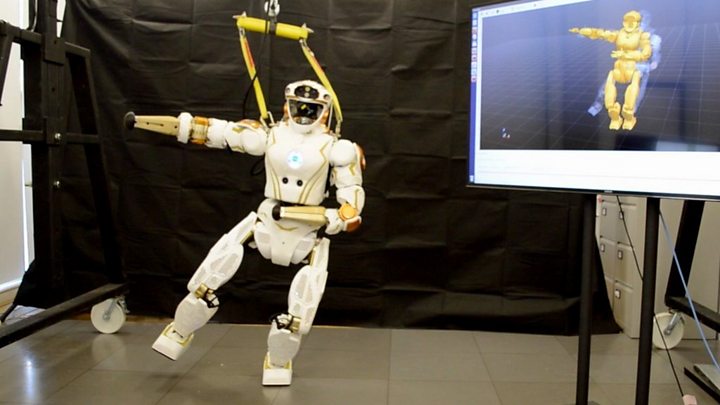
Like robotics designed for research in Space, machines like this could also take on riskier experiments – in harsher laboratory environments or using more toxic substances.

Media playback is unsupported on your device

Media captionNasa’s humanoid is designed for more hazardous environments

That, according to Deirdre Black, head of research and innovation at the Royal Society of Chemistry, is why UK science needs to build new technologies into its infrastructure.

“This is about human beings harnessing all of these digital technologies, so that they can go faster – discover and innovate faster and explore bigger and more complex problems, like decarbonisation, preventing and treating disease, and making our air cleaner,” she told BBC News.

So does this mean that while many scientists have been in lockdown, the machines have come to take their jobs?

“Absolutely not,” said Dr Black. “Science will always need people”.

Follow Victoria on Twitter


Source link