Thursday, May 14, 2026

He Professed His Love at 16, Then Waited

Julian Schwarz professed his love to Marika Bournaki in 2007 when they were 16 and students at the Aspen Music Festival and School in Colorado.

“I declared my love after curfew and went into her dorm room the night before she left the festival,’’ said Mr. Schwarz, 29, a classical cello soloist and the assistant professor of cello at Shenandoah University in Winchester, Va.

“I know you don’t like me now, but you will like me someday,” he said he told her. “And we will get married. We will have children together and perform together.”

She laughed it off, and described him as “cute and goofy.”

“He would invent stories and sing to me in French,’’ said Ms. Bournaki, also 29, and a French Canadian classical piano soloist. Over the past two years, she has performed the complete cycle of Beethoven’s 32 piano sonatas at Bargemusic in Brooklyn.

They each graduated from Juilliard, from which they also received a master’s degree in performance — she in piano, he in cello. He was two years behind her.

Mr. Schwarz randomly called her over the years, and in 2009 they met, and hung out at the Verbier Festival in Switzerland. (His father is Gerard Schwarz, the conductor and music director).

“I have a picture of me and Julian in Switzerland,” she said. It was on my fridge through college.’’

When Mr. Schwarz transferred to Juilliard from Colburn Conservatory of Music in 2011 they became good friends.

“We were in the friend zone,” Ms. Bournaki said, and three years later, on May 5, when neither was seeing anyone, they had their first date. She recalled thinking, “This could work.”

He took her to baseball games, to his favorite restaurants, and after she noticed cello pieces on his piano they began playing together for fun. They had a long-distance relationship for six months after she returned home to Montreal in mid-June 2014.

“We were compatible musically,” Mr. Schwarz said. In spring 2015, they began working on Poulenc’s “Sonata for Cello and Piano,” which became their signature piece when they toured as a duo.

They performed the piece at a recital at the Austrian Embassy in Washington in April 2015 and at Schloss Rosenegg in Salzburg, Austria, that summer. In 2016, they won first prize in playing it at the Boulder International Chamber Music Competition.

In 2018, Mr. Schwarz got down on one knee and proposed at the National Arts Club in New York, but with their busy concert schedules they never got around to setting a wedding date.

“Our performance schedules were so encompassing we didn’t have time,’’ he said, but after the pandemic outbreak their concerts were canceled and they stayed at their apartment in Winchester, Va. “We had this abundance of time.”

In March, after Ms. Bournaki’s father came down with Covid-19 in Montreal, and was on a respirator (he is now recovered), Mr. Schwarz realized only immediate family could travel to Canada during the travel ban. “I casually looked for ways to get married,” he said, “and called 10 counties for a marriage license and found one.”

On May 5, the sixth anniversary of their first date, they were married at their apartment in Winchester, Va., by Rabbi Scott Sperling.

“Nobody knew we were getting married,” she said. “It was all improvised.”

In two days they put together a homemade wedding, including building a huppah, making a floral crown for her from flowers around the apartment, express delivery of caviar, Champagne from Costco and setting up a video camera on a tripod.

“My teenage prophecy did come true,” he said, “and it was so well worth the wait.”

Source link

She Expressed Doubts. He Proved Them Wrong.

The surprise May 25 wedding De-Shazo Wilkinson put together for his fiancée, Jacarra Wilson, was brought on by an emotional gut punch.

After postponing their wedding for a second time in late March because of the coronavirus — the first, last fall, was caused by the shutdown of the venue they had chosen in Orlando, Fla. — Ms. Wilson had said the unthinkable. “She was like, ‘This is strike two. What if it just wasn’t meant to be?’” said Mr. Wilkinson, 32, an assistant principal at KIPP Impact Middle School in Jacksonville, Fla. “My heart sank. I knew I had to figure out something.”

Ms. Wilson, 29, and Mr. Wilkinson met as students at the University of Central Florida in Orlando in 2007. Both were trying out for Rukus, a hip-hop dance team, and both made it. They began dating. By January 2010, a few months before Mr. Wilkinson graduated, they had gotten serious. But then Mr. Wilkinson landed a teaching job in Lake City, Fla., while Ms. Wilson had three years to go before finishing her degree.

In 2014, when he moved to Jacksonville for another teaching job, Ms. Wilson was busy establishing herself as a hair and makeup artist in the Orlando area. Long-distance dating was by then familiar. But three years later, enough was enough. “It’s about 162 miles between Orlando and Jacksonville,” Ms. Wilson said. “Finally I said to myself, What are we doing? I can do hair and makeup anywhere.” She and Mr. Wilkinson moved into a new apartment together in Jacksonville in 2018. On Jan. 30, 2019, he proposed.

“It was the nine-year anniversary of when I asked her to be my girlfriend,” Mr. Wilkinson said. He had arranged nine dozen roses around their home and gotten down on one knee. Ms. Wilson, who had been complaining minutes earlier that she thought a proposal might never come, was shocked. “I was like, Are you kidding me?” she said. Her yes was followed by a flurry of wedding planning.

After their first two wedding plans fell through, Ms. Wilson was devastated and began expressing concerns about their marriage being not meant to be.

That’s when Mr. Wilkinson sprung into action. With the help of their wedding planner, Michelle Harbridge of the Wedding Authority, he confirmed that the Treasury on the Plaza in St. Augustine, Fla., their second venue, would still welcome them on May 25, though without their guests. He asked their parents and a few other family members to go to St. Augustine with them that Memorial Day, to commemorate what would have been their wedding day.

“We had on our cheesy fiancé T-shirts — his said, ‘I stole her heart,’ and mine said, ‘So I stole his last name,’” Ms. Wilson said. But she had also packed a white outfit she bought to cheer herself up, because Mr. Wilkinson told her to plan on a family photo shoot while there.

When they arrived at the Treasury, Mr. Wilkinson was ready. “In front of our parents and everybody I said, ‘Will you marry me right now?’” He was again on one knee.

“I was sobbing like an idiot,” Ms. Wilson said. An hour later, after 100 cardboard cutout faces of guests who couldn’t be with them were arranged on chairs around the venue, and after Ms. Wilson’s makeup was partially done — “I only had eye shadow on one eye,” she said — they were married over Zoom by Dwayne Jones, a military chaplain stationed in Korea who had been Mr. Wilkinson’s childhood pastor and who is ordained in Florida.

By then, Ms. Wilson had come around to the idea that their marriage was meant to be.

“I came out of it having so much respect for him, because he heard my concerns and he met them with something more than I could have ever imagined,” she said. “I was infinitely satisfied.”

Source link

High School Redux: A 1996 Playlist

Kathleen Anne Berroth and David Michael Diehr debated just about anything after they met in 1996 in their American cultures literature class at Sandy Union High School in Sandy, Ore.

“I was a super-liberal hippie,” said Ms. Berroth, who goes by Katie, and was new to the school. “David was, I guess, an independent Ayn Rand reader.”

They sat next to each other in class, and argued over symbolism, new literary terms and Ayn Rand’s book “Anthem” after he recommended it to her.

“I never asked her out,” said Mr. Diehr, who transferred to another school a few months later. “But I definitely thought about it.”

She then went East, and graduated from Wellesley with a degree in Japanese, and received an M.B.A. from N.Y.U. He graduated from the University of Oregon with a degree in philosophy.

Twenty-two years later, in 2018, after he recognized her smile and dimples in a photo she posted on the dating app OkCupid, he got a second chance.

“You remind me very much of a girl I knew 20 years ago,” he messaged her on May 12. “So, shot in the dark, did you go to high school in Sandy, Oregon,” said Mr. Diehr, 40, who is a software product manager in the Portland office at Expeditors International, a freight forwarding company in Seattle.

A day later she messaged back.

“Hah, well, yes,’” said Ms. Berroth, 39, the director of corporate strategy and business operations at Zillow, a real estate technology company in Seattle, where they both live. They are now looking for a house in Portland, Ore.

They met that day at Rogue Eastside Brewery in Portland on Mother’s Day, while she was visiting her mother and stepmother. (Ms. Berroth, who lived two hours away by plane in San Francisco, had decided since she had no luck meeting anyone online there she would give it a try in Portland where she planned to spend half her time).

“The first date was full of history of over 20 years,” said Mr. Diehr, and at the end of the date she asked him if he wanted to kiss her, and he did.

The following weekend they went to the Portland Art Museum, and by the end of the weekend Mr. Diehr asked her if he could call her his girlfriend.

“Yes, let’s do this,” she recalled saying. “His emotional honesty and heart were disarming.’’

They video chatted when she went on a three-week trip to visit friends in Singapore and Hong Kong, and then saw each other almost every weekend when she got back.

“Every night he would send me a song, and we call it David’s lullabies,’’ she said. “I have a whole playlist of 60 songs.”

He proposed 10 months after they reunited when they took a trip to Japan in a little garden at Nanzenji Temple in Kyoto.

They had planned to get married May 16 at the Exchange Ballroom, an events space in Southeast Portland, expecting 200 guests including some from Japan, Hong Kong, Scotland and Australia. But that was before the coronavirus outbreak.

Instead, they were married on the same date in the front garden at the home of Peggy Berroth and Sara Kirschenbaum, the bride’s mother and stepmother.

“My moms pulled together a beautiful day beyond all expectations,” Ms. Berroth said. Nicholas Pyle, a Universal Life minister, and the fiancé of Ms. Berroth’s sister, officiated, before 11 socially distanced, masked family members, her mother’s dog and a photographer.

The couple also brought a foot-and-a-half-tall almond coconut cake from the Wandering Goose restaurant in Seattle, with plenty of leftovers for guests. They celebrated as a playlist of songs from 1996 was played.

“They were songs from the year we met,’’ Ms. Berroth said.

Source link

Tear-Gassing Protesters During An Infectious Outbreak Called ‘A Recipe For Disaster’

0

Tear gas rises as protesters face off with police during a demonstration on May 31 outside the White House over the death of George Floyd at the hands of Minneapolis Police.

Samuel Corum/AFP via Getty Images


hide caption

toggle caption

Samuel Corum/AFP via Getty Images

Tear gas rises as protesters face off with police during a demonstration on May 31 outside the White House over the death of George Floyd at the hands of Minneapolis Police.

Samuel Corum/AFP via Getty Images

In nationwide demonstrations against the police killing of George Floyd and other black Americans, protesters are frequently pepper-sprayed or enveloped in clouds of tear gas. These crowd-control weapons are rarely lethal, but in the middle of the coronavirus pandemic, there are growing calls for police to stop using these chemical irritants because they can damage the body in ways that can spread the coronavirus and increase the severity of COVID-19.

Even before the coronavirus pandemic, some experts said additional research was needed on the risks of tear gas — an umbrella term for several chemical “riot control agents” used by law enforcement. It’s known that the chemicals can have both immediate and long-term health effects.

Their widespread use in recent weeks, while an infectious disease continues to spread across the U.S., has stunned experts and physicians. The coronavirus that causes the disease COVID-19 is highly contagious, spreads easily through the air via droplets and can lead to severe or fatal respiratory illness. Deploying these corrosive, inhalable chemicals could harm people in several ways: expose more people to the virus, compromise the body’s ability to fight off the infection, and even cause mild infections to become more severe illnesses.

“This is a recipe for disaster,” says associate professor Sven Eric Jordt, a researcher at Duke University School of Medicine who studies the effects of tear gas.

Jordt refers to these chemicals as “pain gases” because they activate certain pain-sensing nerves on the skin and in the mucous membranes of the eyes, mouth and nose.

“You have this excruciating pain, sneezing, coughing, the production of a lot of mucus that obstructs breathing,” Jordt says.

People describe a burning and stinging sensation, even a sense of asphyxiation and drowning. Sometimes it causes vomiting or allergic reactions.

In law enforcement, officers generally use two types of chemicals for crowd control: CS gas and pepper spray.

The active ingredient in pepper spray, called capsaicin, is derived from chiles. It’s often sprayed from cans at close quarters or lobbed into crowds in the form of “pepper balls.”

CS gas (o‐chlorobenzylidene malononitrile) is a chlorinated, organic chemical that can induce “very strong inflammation” and “chemical injury” by burning the skin and airways when inhaled, Jordt says.

“Using it in the current situation with COVID-19 around is completely irresponsible,” he adds. “There are sufficient data proving that tear gas can increase the susceptibility to pathogens, to viruses.”

Jordt says research on the harms of tear gas has not kept up with its escalating use in the U.S and around the world in recent years. Many of the safety studies that law enforcement officials rely on date back to the 1950s and ’60s, he says.

But a 2014 study from the U.S Army offers an alarming glimpse into how the chemical could escalate the pandemic. The study found that recruits who were exposed to tear gas as part of a training exercise were more likely to get sick with respiratory illnesses like the common cold and the flu.

“We have a lot of antiviral defenses that can inactivate viruses and prevent them from entering cells,” he says. “These are depleted by inhalation of tear gas and also compromised.”

The findings of the Army study led the U.S military to significantly reduce how much recruits were being exposed to the chemical.

“Even the Army realized they had done something wrong and that this was more toxic than they thought before,” Jordt says.

Even though there is a limited amount of research on this new coronavirus, there are studies from China and Italy about how other irritants, such as smoking and air pollution, affect COVID-19. These studies indicate that tear gas could also make people more likely to develop severe illness, says Dr. John Balmes, a pulmonologist at the University of California, San Francisco, and an expert with the American Thoracic Society.

“I actually think we could be promoting COVID-19 by tear-gassing protesters,” says Balmes. “It causes injury and inflammation to the lining of the airways.”

Balmes says this period of inflammation sets back the body’s defenses and makes it more likely that someone who already harbors the virus will become sick.

“It’s adding fuel to the fire,” says Balmes. “These exposures to tear gas would increase the risk of progression from the asymptomatic infection, to a symptomatic disease.”

Growing evidence shows many people who have the coronavirus are asymptomatic and don’t know they are infected, or are “presymptomatic,” which means they infected with the virus and able to infect others but not yet showing symptoms. With thousands of people jammed together at mass protests, the demonstrations are already primed to be “superspreading events,” which can lead to an explosion of new cases. Outdoor gatherings typically decrease the chance of spreading the coronavirus. But activities like singing and yelling can increase the risk.

Tear gas and pepper spray can also sow confusion and panic in a crowd. People may rip off their masks and touch their faces, leading to more contamination.

Dr. Amesh Adalja, from Johns Hopkins University, says the body’s reaction to the chemicals cause people to shed more of the virus.

“If they’re coughing, the particles actually emanate and are projectiles that travel about 6 feet or so and could land on other people,” says Adalja, who is also a spokesperson for the Infectious Diseases Society of America.

“This is a way to almost induce the virus to be expelled from people when they are exposed to these agents.”

Adalja anticipates the protests will inevitably lead to a spike in infections.

“We know that any kind of social unrest, especially in the midst of an outbreak, is only going to make things worse,” he says.

He says the most recent example would be bombings in Yemen that exacerbated a cholera outbreak.

Dr. Rohini Haar, an emergency physician in Oakland, Calif.,, has studied the use of riot control agents around the world.

“These weapons don’t actually deescalate tensions in peaceful community policing,” says Haar, who is a lecturer at the University of California, Berkeley.

Haar has also been treating COVID-19 patients. She recognizes there is a danger of spreading the virus at these gatherings, but she would not discourage people from attending the protests and exercising their right to free speech.

“It’s a really tough situation,” says Haar. “I think the irony is that people are rightfully and justifiably protesting police violence and are being met with violence that is worsening the pandemic conditions we’re living under right now.”

This week, more than a thousand physicians and health care professionals signed an open letter in support of the demonstrations.

Dr. Jade Pagkas-Bather, an infectious disease expert at the University of Chicago, is one of them.

She says it will be difficult to determine whether any spike in cases were a direct result of the protests, because they’re happening at a time when many states are also allowing businesses to reopen.

“In everyday life, we weigh the risks and benefits of our actions. People who are going out to protests are clearly at a critical juncture where they are saying this state-sanctioned violence is unacceptable, and I am willing to put myself and others potentially at risk,” she says.

The open letter she signed recommends ways that protesters, police and local officials can reduce the transmission of the virus.

Among the major recommendations: Police should not use tear gas or pepper spray.

Source link

5 reasons you might be seeing more wildlife during the COVID-19 pandemic

0

Coyotes sauntering down the
streets of San Francisco.
Neighborhoods flooded with birdsong.
Snakes slithering
onto trails and sidewalks. And of course, the rats. Rats everywhere. Somehow,
as COVID-19 forced us all into our homes, it also managed to bring nature a
little bit closer. Sometimes — as in the case of rats — a little uncomfortably
close.

Newspapers have eagerly
reported sightings of wildlife in the streets. The U.S. Centers for Disease
Control and Prevention even issued guidelines
to deal with an expected flood of rats. It’s easy to think that nature is
sweeping into our ordered lives and taking over now. But numbers of rats or
coyotes probably aren’t all that much higher than normal, and animals aren’t
even necessarily going anywhere new. Instead, COVID-19 has changed the way we
interact with the natural world.

Here are five reasons that
people might be running into more wildlife than before.

1. Human handouts are scarce.

Restaurants are closed, and
dumpsters usually filled with trash lie empty. That might be forcing rats out
into the open to search for food. People have certainly claimed to see more
rats. But there’s not yet real data to back that up, says Jonathan Richardson,
an urban ecologist at the University of Richmond in Virginia.

“We would expect them to be
impacted as restaurants close and trash generation moves to residential
buildings,” he says. “It’s very intuitive, but lots of people are throwing that
around without data to support it.” He and his colleagues are in the process of
gathering some of that data themselves, using surveys of pest management groups
and calls to city services about rats.

Rodents are prone to boom
and bust cycles in their populations, as opportunities for food and threats
from predators (or pest control) come and go. If food is scarce enough for rats
during shutdowns, he says, “it could be the beginning of a bust cycle. A lot of
city health folks are hoping that’s the case.”

But if there is a bust, he
says, don’t get your hopes up that it will last. “It would absolutely be
temporary,” Richardson says. “They’re just so adapted to breeding quickly and
reproducing they’ll be able to repopulate declined populations very quickly.”

2. Scary humans aren’t around as much.

Every animal exists in a landscape of fear  — trying to get what they need while avoiding
areas where predators might be lurking, says ecologist John Laundre. Those
predators include humans. “We are predators on pretty much everything,” says
Laundre, of Western Oregon University in Monmouth. “Everything fears us.”

Pumas in the Santa Cruz Mountains,
for example, will chow down peacefully on a carcass while a nearby speaker
plays nature noises. But the big cats beat a speedy retreat when the speaker switches to the sound of humans
talking, a 2017 study in the Proceedings of the Royal Society B showed. Similarly,
black bears living near human-inhabited areas avoid those areas during the day.
They prefer to venture to peopled places at night, when humans are less likely to be out, according to a
2019 study in Movement Ecology.

When humans retreat, due to
lockdowns and stay-at-home orders, the landscape of fear that we create retreats
with us. Animals common in suburban areas, such as coyotes, might normally
restrict their activities to the evening and night. But “the fewer people they
see around,” Laundre explains, “the more willing they are to come out during
the day.”

3. It’s nice and quiet.

Not all animals fear us. “We
can see a lot of birds flying around and coming to our feeders,” Laundre notes.
“They know humans are safe.”

Those humans are, in turn,
taking greater notice of their avian neighbors in the time of COVID-19. “I
would say noise pollution is the biggest reason people notice them,” says
Gustavo Bravo, an ornithologist at Harvard University. Or rather, the lack of
noise pollution. “If everyone is hunkered down at their homes, cities are
quieter,” he notes.

The Sounds of the City
project, a New York University study that places microphones around New York
City to study urban noise, showed drastic decreases in the sounds of traffic and people as COVID-19 took
hold.

“Birds will adjust their
song and the times they are singing to account for urban noise,” notes Deja
Perkins, an urban ecologist at North Carolina State University in Raleigh. “Usually,
they sing earlier in the day to avoid competing with city noises such as
traffic.” They also sing at a higher sound frequency in urban neighborhoods to help their songs stand out
against the city’s roar (SN: 7/16/03).

While it’s too early to say
if birds have changed their singing times or tones in the quieter streets, she
says, we are better able to hear them. And people are taking note. The Cornell
Lab of Ornithology’s Global Big Day, which invites people to log their bird
observations on the eBird app and website once a year, reported a 32 percent increase in
participation compared with 2019.

4. Spring has sprung.

If the birds seem especially
musical, Bravo explains, it’s because they are. COVID-19 happened to hit the
Northern Hemisphere at a critical time. “March, April and May are the spring
migration months in the Northern Hemisphere,” he says. “Also for the resident
birds not migrating, it’s the time they mate. They sing a lot; they’re looking
for their partner.”

Birds aren’t the only
animals becoming more common in spring. “This is the time of year – March, April,
Mary — when snakes are coming out of hibernation, to eat, warm up and look for
each other to mate,” says David Steen, a herpetologist at the Florida Fish and Wildlife
Conservation Commission in Gainesville. It’s nothing to do with COVID-19. “I’ve
been answering people’s questions about snakes and identifying snakes for
people for a decade or so,” he says. “This is my busy season.”

5. We’re finally paying attention.

But the snakes themselves
never changed. “These snakes have always been right next to us,” Steen says. “We’ve
been living with these animals [for] so long. We just happen to see them more
often [now].”

People who previously might
have traveled to wide vistas and tried to spot rare species may be stuck a bit
closer to home, and finally paying attention to their back gardens, says Helen
Smith, an arachnologist with the British Arachnological Society who’s based in
Norfolk, England. “They’re at home more and in their local patch more,” she
says. The BAS has put out several surveys to help people report their spider sightings. “You’re
living with these really interesting animals,” she says. “Make friends with
them.”

Our social media fixation
also helps shine a spotlight on local wildlife sightings, Bravo notes. “People
have started to post about it on social media, and because everyone was looking
at social media, it spread it out fast.” In Bravo’s home country of Colombia,
he says, “even some national celebrities were posting pictures of birds. It’s not
something they’d do on a daily basis, but they’re sitting at home.”

Perkins, who has been involved with #BlackBirdersWeek, an effort to promote birders of color on Twitter, hopes that the social media and in-person attention will spark interest in local wildlife that extends into the post-COVID-19 world. “I hope that people continue to go outdoors and make these observations and pay attention to the wildlife that we have around us,” Perkins says. “And [that it’s] helping people to notice that people aren’t the only things that thrive in cities.”  


Source link

NHS virus tracing app ‘in place by end of month’

0

Image caption

The app was downloaded more than 55,000 times on the Isle of Wight, according to figures last month

A new NHS coronavirus contact-tracing app should be in place by the end of the month, a minister has said.

Business minister Nadhim Zahawi said the app – which was trialled in the Isle of Wight – will “be running as soon as we think it is robust”.

Last week new test and trace systems were launched in England and Scotland – but without the app due to delays.

The Guardian reported an NHS boss said the wider scheme would be imperfect at first but “world-class” by the autumn.

The paper said the chief operating officer of the test and trace scheme said the scheme should be fully working by September or October.

The NHS app – which will automatically alert people – began being trialled on the Isle of Wight in early May. The government said then it hoped it would be launched nationwide by the middle of May.

Meanwhile, doctors have urged the government to make face coverings compulsory in all places where social distancing is not possible, not just on public transport.

All passengers on public transport in England must wear a covering from 15 June, the government said on Thursday.

The NHS app was originally planned to be part of last week’s launch of England’s test and trace scheme – but the app roll-out was delayed because more trials were needed.

Scotland also launched its tracing scheme last week while Northern Ireland already had a contact tracing programme up and running. Wales began its scheme on Monday.

Speaking on the BBC’s Question Time on Thursday, Mr Zahawi said: “The app, we are working flat out. We want to make sure it actually does everything it needs to do and will be in place this month.

“I can’t give you an exact date, it would be wrong for me to do so.”

Image caption

Mr Zahawi said: “We will make sure [the app] will be running as soon as we think it is robust.”

Asked to confirm it would be rolled out nationwide this month, he said: “I’d like to think we’d be able to manage by this month, yes.”

He said the pilot in the Isle of Wight showed people actually preferred to be contacted by a human being, “which is why we’ve recruited 25,000 people who are track-and-tracers who can deal with about 10,000 cases a day”.

Contact tracers text, email or call people who test positive with coronavirus and ask who they have had contact with. Any of those contacts who could be at risk of infection are told to isolate for 14 days, even if they are not sick.

The 25,000 tracers working for England’s NHS test and trace team have already started contacting people.

But some contact tracers have said they have been given very little work so far, with one telling the BBC she had worked 38 hours but had yet to make a single phone call and spent the time watching Netflix.

Contact tracing for coronavirus began when the UK identified its first two cases at the end of January.

But it was stopped in mid-March after England’s chief medical officer, Prof Chris Whitty, said it was “no longer necessary for us to identify every case”.

Then in May, Prime Minister Boris Johnson pledged to have a “world-beating” tracing system in place from June.

NHS bosses have said such a system is important to avoid a possible second surge in coronavirus cases.

However, the head of the NHS Confederation said a test, track and trace strategy should have been in place sooner.

A Department of Health spokesperson said the new test and trace service was up and running and would save lives, adding that more than 25,000 contact tracers were now in place.

In other developments:


How have you been affected by the issues relating to coronavirus? Share your experiences by emailing .

Please include a contact number if you are willing to speak to a BBC journalist. You can also contact us in the following ways:

Source link

States Have Put 54 New Restrictions On Peaceful Protests Since Ferguson

The historic wave of protests sparked by the death of George Floyd has spurred a new debate over the legitimacy of political violence as some demonstrators have turned to vandalism, looting and setting fires in defiance of police brutality and racism. 

But as last Friday’s demonstrations kicked off in Minneapolis ― where Floyd, a Black man, was killed by police officers ― Louisiana lawmakers some 2,500 miles south voted overwhelmingly to pass harsh new legislation cracking down on peaceful protests. The bill set a three-year mandatory minimum prison sentence with hard labor for protesters convicted of trespassing on fossil fuel and other infrastructure sites during a state of emergency like the one declared amid the coronavirus pandemic. 

The legislation had actually been months in the making, and it’s hardly a one-off. Since 2015 ― in the wake of protests set off by the police killing of Michael Brown in Ferguson, Missouri ― states have introduced at least 154 bills or executive orders to restrict peaceful protest, according to a HuffPost analysis of the International Center for Not-For-Profit Law’s tally, a new report from PEN America, and interviews with free speech experts. So far, 54 have become law. More than two dozen ― including the Louisiana measure, which is awaiting the governor’s signature ― are pending.

These new restrictions on peaceful protest are not directly linked to an uptick in less-peaceful tactics over the past week. In fact, many of the current protesters have condemned actions like brick-throwing and looting, blaming the worst offenses on agitators who don’t share their anti-racist goals.

But a number of the largest U.S. cities where nightly protests are taking place have put curfews in place, including New York City, Washington, D.C., and Minneapolis. Researchers warn that the proliferation of new restrictions could push future protesters to embrace more combative tactics as the legal risks of peaceful gatherings rise. 

“There’s a multiplier effect,” said Dana Fisher, a sociologist who studies protest movements at the University of Maryland, College Park. “If people don’t think they’re allowed to peacefully protest, they’re going to be prepared for more confrontational protest.” 

Pipeline Protections

Of the 22 anti-protest laws passed over the last four years, 12 designated fossil fuel sites as “critical infrastructure” and ramped up penalties for trespassing or tampering with the equipment there. The statutes, promoted in state legislatures by the right-wing American Legislative Exchange Council following the 2016 Dakota Access Pipeline protests, typically elevated low-level misdemeanor charges to felonies with thousands of dollars in fines and prison time. 

Louisiana adopted such a statute in 2018. Last week, lawmakers expanded on the measure, adding the mandatory minimum sentencing provision that could send peaceful protesters to prison for standing near any of Louisiana’s 125,000 miles of pipeline, much of which is buried and therefore difficult to avoid when planning demonstrations. 


A protester stands, arms in the air, in front of a row of officers during a demonstration near the White House on June 1.

While the Louisiana bill proposes some of the most inflexible penalties, more than half a dozen other states enacted similar legislation in just the past two years. Three states ― Kentucky, South Dakota and West Virginia ― passed new laws restricting fossil fuel protests in March, as the country went into lockdown over the pandemic. Alabama lawmakers advanced their bill in May, but failed to pass it before the legislative session ended. 

So-called “critical infrastructure” bills have passed more easily than other protest restrictions because big companies, particularly oil giants, have deployed their expansive lobbying networks to back the measures. 

New Penalties And Definitions For Riots

More than a dozen states have proposed new bills to discourage riots, though the legislation was most successful in the Dakotas, where heated pipeline protests are recent events that seem likely to repeat. 

In 2017, North Dakota increased the charges for participating in a riot. It was previously a Class A misdemeanor, which was punishable by up to a year in prison and a $3,000 fine. Under the newer law, joining a riot with more than 100 people is a Class B felony, subject to 10 years in prison and $20,000 in fines. 

South Dakota has become a hotbed for anti-protest legislation, particularly since Gov. Kristi Noem (R) took office last year. Over the course of three days in March 2019, the state legislature passed a law criminalizing “riot boosting,” setting forth harsh penalties for those who encourage acts of “force or violence” but do not take part themselves. The American Civil Liberties Union sued to block the law, and state officials dialed back the measure as part of a settlement. 

When you have mass movements and a lot of people in the street, you see false arrests and heavy-duty charge stacking to get people to plead to lesser charges. … These laws are a gift to that type of prosecution.
Mara Verheyden-Hilliard, executive director of the Partnership for Civil Justice Fund

Then this March, South Dakota enacted new measures expanding the definition of a felony “riot” to “intentional use of force or violence by three or more persons” that causes “any damage to property.” The law covers those who “urge” a riot, which it defines as “instigating, inciting, or directing” but excluding “oral or written advocacy of ideas or expression of belief that does not urge … imminent force or violence.”

It took less than a month in early 2018 for West Virginia to enact a law extending protections for police officers to the state’s Capitol Police when they kill or wound anyone present, “spectator or otherwise,” while dispersing a riot. 

Mara Verheyden-Hilliard, executive director of the nonprofit Partnership for Civil Justice Fund, said the statute was known among lawyers and advocates as the “shoot-a-teacher law” because it was passed amid the West Virginia’s teachers strike.

Protesters Can’t Block Traffic, But Drivers Can Hit Them

Seven states proposed, but ultimately failed to pass, legislation limiting liability for drivers who hit or run over protesters who are blocking streets. In addition to protecting drivers, those bills and more than a dozen other proposed laws sought to increase penalties for protesters who block traffic or gather without approval on private or public land. The latter measures became law in two states.

A 2017 South Dakota law enabled the governor and sheriffs to ban gatherings of more than 20 people on public land if the gathering could damage the land or the renters’ use of that property. It also gave the state Department of Transportation the right to bar protests that interfere with highway traffic, increasing the penalties for obstructing roadways to one year behind bars and a $2,000 fine.

That same year, Tennessee imposed new $200 fines ― plus up to 30 days in jail ― for anyone who obstructs an emergency vehicle, which it broadly defined as “any vehicle of a governmental department or public service corporation when responding to an emergency.” 

Curbing Free Speech, Especially About Israel

Proposed laws to punish students or universities for protests that block controversial speakers from appearing on campus are pending in six states and were defeated in another 11. 

In 2018, Missouri banned public employees from picketing, though a federal judge blocked the law from being enforced in January 2020. 

A Utah law enacted three months ago expanded “disorderly conduct” in the legislature or at meetings of government officials to include creating annoyance or alarm with “unreasonable noise.” The restrictions could apply to a silent protester who “refuses to comply with the lawful order of a law enforcement officer to move from a public place or an official meeting, or knowingly creates a hazardous or physically offensive condition.” The measure mandated a $750 fine for first offenses, up to three months in jail for those who had been warned to cease the prohibited conduct, and up to one year in jail for a third-time offender. 

Between April 2015 and May 2020, 32 states enacted measures to restrict or formally condemn as anti-Semitic support for the movement to “boycott, divest and sanction” Israel over its treatment of Palestinians and non-Jewish Israelis, according to data from the American-Israeli Cooperative Enterprise. Two dozen of those laws and executive orders bar states from granting contracts to companies or individuals who support the BDS movement. 

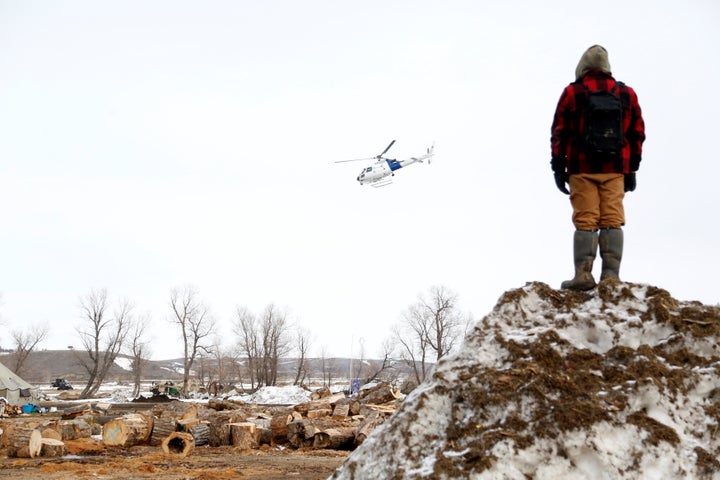
A protester watches a law enforcement helicopter circle the main opposition camp against the Dakota Access oil pipeline near


A protester watches a law enforcement helicopter circle the main opposition camp against the Dakota Access oil pipeline near Cannon Ball, North Dakota, in February 2017.

In most cases, the bills seeking to restrict peaceful protest and expression are aimed at “charge stacking,” which is when prosecutors pile on the counts to pressure people into a deal.

“When you have mass movements and a lot of people in the street, you see false arrests and heavy-duty charge stacking to get people to plead to lesser charges. … These laws are a gift to that type of prosecution,” said Verheyden-Hilliard.

But they’re not necessary. “The crimes are already crimes, and the penalties already exist,” she said.

The push to limit peaceful political expression overall, particularly amid the pandemic, highlights the influence of monied special interests on policymaking in the United States, said Vera Eidelman, a staff attorney at the ACLU in New York. 

“There’s an absurdity to legislatures passing these laws right now,” she said, “when there are so many barriers to hearing from constituents as it is.” 


Source link

The Police Have Shown Their True Colors

Over the past week, protests have broken out nationwide over police brutality, the targeting of Black people and the lack of accountability for these actions.

The death of George Floyd at the hands of four Minneapolis police officers last week ignited the furor, but the anger goes far beyond that one incident. At the heart of the debate is whether the police have too much power and commit acts of discrimination and violence with impunity. The word of the police is given the ultimate weight and authority in a dispute.

The police have been out in full force responding to the anti-racist protests. And their overwhelming response to the accusations of violence and unchecked power has been more violence and unchecked power. 

“People started this conversation by saying policing is out of control; they’re not making the situation better. They have not been reformed,” Alex S. Vitale, author of “The End of Policing,” said in a recent NPR interview. “Well, now all you have to do is turn on the nightly news and see how true that is. The level of aggression and unnecessary escalation is stark evidence of how unreformed policing is, and I argue how unreformable it is.”

Patrick Skinner, a former CIA officer who is now a Georgia police officer, says a central problem is that law enforcement sees itself fighting a “war on crime.” That mindset is contributing to the overreaction by the police to the peaceful protesters. 

“Ninety percent of what we’re seeing are protests. Police should just sit back. They shouldn’t have overwhelming force. … That amps things up. Now granted a riot, when people are hurting ― I mean, police officers have been attacked, people have been killed, lot of damage. I get that. But we use that 1% and we treat the 99% like that. And that’s exactly what police training does,” he said. “Every situation is not just can be dangerous but will be dangerous, because we’re in a war on crime. Anybody can kill you.”

The actions of law enforcement over the past week have given new life to movements that want to defund the police. At the very least, it seems more people will be questioning law enforcement officers when they claim that you can trust them, that they did nothing wrong. 

Below are just a few of the incidents that were caught on video or by reporters. Imagine what happens when there are no cameras.

Police shove older man, who then bleeds from his head.

Police officers in Buffalo, New York, shoved a man to the ground after he walked up and talked to them. It’s not clear what he was saying. The man hit the ground and immediately began bleeding from his head. 

“During the skirmish involving protesters, one person was injured when he tripped and fell,” the Buffalo Police Department initially claimed.

The Buffalo police commissioner later suspended two officers involved in the incident after public outcry.

Black store owners looked for help from police, were handcuffed instead.

On June 1, a group of community members and employees at a liquor store in Los Angeles were trying to stop looters from ransacking their store. They needed assistance and tried to flag down passing police. 

But when the police arrived, officers immediately handcuffed the store owners and employees and let the looters get away ― even after a reporter on the scene told the police they had the wrong people. 

“Sir, they’re the store owners, they’re protecting from the looters,” KTTV reporter Christina Gonzalez said. “They’re protecting the store! The looters went that way!”

“I was flagging down the police with the owner, asking, ‘Can you guys help?’” one of the community members, who identified herself as Monet, later told Gonzalez in an interview. “I was handcuffed, thrown up against a wall with my husband and brother-in-law, and I’m like, ‘What the h***?’”

Black CNN reporter arrested live on air. 

On May 29, Minneapolis police officers arrested CNN journalist Omar Jimenez while he was broadcasting live. He clearly identified himself as a journalist and told them he was happy to move wherever they needed him to go to get out of the way. Two members of his crew were also taken away. 

Josh Campbell, a white CNN journalist who was in the area, said he was treated very differently. Police also told him to move, but when he identified himself, he was allowed to stay.

HuffPost reporter Christopher Mathias was also arrested while peacefully covering protests in New York City, even though his press credentials were clearly visible. 

Protester with his hands up taken down by police while giving a TV interview.

Police rushed Myles Carter, who was standing in the street in Buffalo, New York, and giving an interview to a local TV station. Carter had his hands in the air as he was speaking. Police ran up, tackled him and arrested him. 

Police gassed and bashed peaceful protesters to clear the way for a Trump photo-op. 

U.S. Park Police, on the orders of Attorney General William Barr, cleared out peaceful protesters near the White House so that President Donald Trump could walk across Lafayette Square for a photo-op in front of a church. How they did it was, quite frankly, horrifying. 

Officials later claimed that they told protesters to disperse three times, but reporters and demonstrators did not hear those orders, if they were given. A chemical agent was fired into the crowd, along with flash-bang grenades. Law enforcement has denied releasing tear gas, even though many people there said it was clearly used. 

Police were also caught on video bashing Australian journalists. 

The U.S. Park Police said it has placed two officers on administrative leave while it investigates the incident. 

It’s important to note that many of the incidents getting attention involve journalists, simply because they are often filming and have outlets to speak to their experiences. 

Police pull college students from a car and stun them with a Taser.

Brutal video showed Atlanta police officers surrounding a car and pulling a young man and woman out, shocking them both with a Taser. The Associated Press reported that the man, Messiah Young, was stopped in traffic and appeared to be recording officers pulling another man out of a car. 

Young refused to open his door when an officer approached, saying, “I’m not dying today.” Officers then ran up to both sides of the car, using a stun gun on Taniyah Pilgrim as she tried to get out of the car. They then bashed Young’s window with a baton and shocked him with a Taser as well. 

They claimed he had a gun, but there was no gun.

Six officers were charged after public outcry.

Police knock down older man with a cane when he doesn’t move fast enough.

In Salt Lake City, a police officer apparently didn’t think a man who was walking with a cane was moving fast enough and shoved him to the ground. 

“I thought they were just coming down the street, and all of a sudden they came charging at me,” said James Tobin, 67. Tobin also has leukemia. 

He said he had arrived 10 minutes earlier to take some pictures. 

Salt Lake City Police Chief Mike Brown called the next day and apologized to Tobin.

NYPD rams SUV into a crowd of people.

In a horrifying video, a New York City police vehicle drove straight into a crowd of protesters who were standing in front of it. 

New York City Mayor Bill de Blasio (D) defended the police, saying, “I wish the police officers hadn’t done that, but I also understand that they didn’t start the situation. The situation was started by a group of protesters converging on a police vehicle attacking that vehicle. It’s unacceptable. So the police officers have to get out of that situation.”

Two people who were in the crowd at that time said de Blasio clearly was misrepresenting what happened. 

“As we marched non-violently down the street, the police drove up to us in an apparent attempt to force us off the road. No one was blocking their SUVs from behind,” Sarah Zapiler and Zachary Tomlinson wrote in the New York Daily News. “The police created the situation and if they truly wanted to leave without hitting anyone, they could have backed away. Instead, they escalated the confrontation by driving forward, using their vehicles like weapons with blatant disregard for protesters’ safety.”

After continued public criticism, de Blasio later said he didn’t like what he saw “one bit” and announced an independent review. 

LAPD batters protesters with batons.

Los Angeles police officers were captured on video beating peaceful protesters with batons.

Police shove, shout expletives at Associated Press journalists.

New York City police officers surrounded and shouted at Associated Press journalists who were covering the protests on Tuesday. They were covering the action just after the 8 p.m. curfew, when an officer came up and told them to leave. They replied that they were allowed to be there, as members of the media. 

“I don’t give a s―-,” one said. Another told them to “get the f―- out of here you piece of s―-.”

Police fired tear gas at protesters in Virginia before curfew.

In Richmond, Virginia, on Monday, police fired tear gas on peaceful protesters ― even though it was 30 minutes before the city’s curfew. 

The Richmond Police Department initially justified using the tear gas, saying officers “were cut off by violent protesters” and the tear gas was “necessary to get them to safety.” The department backed down from that statement a few hours later, and the police chief eventually apologized. 


Source by [author_name]

Look, I don’t care if ‘The Outer Worlds’ Switch port is bad — pump it in my veins

0

Today, friends, is a Good Day™: The Outer Worlds is being released on the Nintendo Switch. Excuse me while I slip into my Springsteen jeans and fist-pump for the next three hours.

At this stage in the article, I assume you’re one of two types of people: you either know about The Outer Worlds or you don’t. If you’re in the former camp, I give you permission to skim over this part.

Okay, so The Outer Worlds is a first-person RPG set in an alternative reality. It was released on the Xbox One and PS4 in October of last year (check out our original review here) and it was made by Obsidian, the same company behind Fallout: New Vegas — one of the greatest games ever made.

Anyway, this little trailer gives you a decent idea of what to expect from The Outer Worlds:

The question then is simple: why the fuck am I excited about this ported game?

I’ve written before about how good it feels to own a Nintendo Switch and one of the key points of that article is about the wider range of games hitting the system — especially after a pretty tepid launch when it came to third party games.

Now, there’s always a lot of furore around ported games, particularly when they’re moved from a more powerful console to a less capable one, and The Outer Worlds is no exception.

Without getting into all the details, let me give you the summary that thousands of YouTube videos take hours to get to: if you have a PS4 or Xbox One, buy multi-platform games on one of those consoles. They’re going to run better.

Thing is, I only have a Nintendo Switch. And at this stage in the lifecycle of consoles, I see no reason to splash out when a new range is just round the corner (coronavirus dependent, of course).

I haven’t — and probably will never — play The Outer Worlds on PS4, so how it compares to other consoles doesn’t bother me. As long as the game doesn’t run like a total piece of shit (looking at you FIFA) I’m going to be ecstatic about diving into the darkly funny open-world adventure I’ve been waiting for since New Vegas.

Of course, this doesn’t mean that I’ll accept any old crap when it comes to ports (again, fuck you, FIFA) — just that I’m hyped a game I’ve wanted to play since it was announced is now on my console of choice. And the fact I can play it on the toilet isn’t exactly bad, either.

Anyway, excuse me — I’ve got a bag of weed, a free weekend, and The Outer Worlds to get through. Get in my veins.

For more gear, gadget, and hardware news and reviews, follow Plugged on
Twitter and
Flipboard.

Published June 5, 2020 — 09:40 UTC


Source link

Colbert Exposes The ‘Shockingly Brutal’ Tactics Police Use On Protesters

“Late Show” host Stephen Colbert tore into the government and cable news for only highlighting the violence that has broken out at some of the demonstrations around the nation. 

“Please don’t buy the false narrative that these are lawless mobs,” he said. “The vast majority of these protests have been peaceful.”

Demonstrators are protesting racial injustice as well as the police killing of George Floyd, a Black man, in Minneapolis last week. President Donald Trump has accused some of them of being lawless mobs, threatened to send the U.S. military into American cities and shared a letter on Twitter claiming the crowd outside the White House was “terrorists.” 

Colbert shared clips of the many demonstrations then described how cities and police departments were using and abusing curfews as well other tactics to “bring the smackdown on peaceful protesters”: 


Source by [author_name]