Black hole caught spewing jets into space at nearly the speed of light (video)

0

A black hole shooting out gassy material at nearly the speed of light has been caught on video by a space telescope.

NASA’s Chandra X-ray Observatory saw an outburst from the black hole and its companion star, which are part of a binary system called MAXI J1820+070. The system is 10,000 light-years from Earth, which is relatively close to our planet in the cosmic scheme of things and allows for a detailed investigation.


Source link

Civilian injured in indiscriminate firing by Indian troops along LoC

0


A civilian was injured in indiscriminate firing by Indian troops along the Line of Control, a statement by the military’s media wing said on Tuesday.

Babar Hussain is a resident of Mehtika village, said the Inter-Services Public Relations statement.

According to ISPR, the ceasefire violation occurred in Bagsar sector along the LoC, with Indian Army troops targeting civilian population.

Last week, on June 9, the Indian Army had resorted to unprovoked firing in Jandrot sector along the LoC which had left four civilians injured.

According to a statement by the Foreign Office, 26-year-old Nasreen Akhtar, 24-year-old Rabia, and two 7-year-old kids Momina and Munshi were critically injured in the Dera Sher Khan, Sandhara, and Bamroch villages.

The FO, a day later, summoned a senior Indian diplomat to register “a strong protest” against the ceasefire violations, said the statement.

“The Indian occupation forces along the LoC and the Working Boundary (WB) have continuously been targeting civilian populated areas with artillery fire, heavy-caliber mortars and automatic weapons,” said the statement.

It added that in 2020 alone, India has committed 1,296 ceasefire violations which led to the martyrdom of seven civilians and injury to 98.

Source link

After George Floyd’s Death, Indigenous Communities Call Out ‘Broken System’

0

As thousands of people around the world continue to march in support of racial justice following the death of George Floyd last month, Indigenous communities are highlighting the ways in which they, too, have long been victims of systemic racism and police brutality.

In the United States, Native American activists have been a noticeable presence at Black Lives Matter protests, while in the United Kingdom, New Zealand and Australia, Black and Indigenous protesters have called attention to longstanding problems in their countries’ own police forces and worked to remove statues glorifying colonialists and slave traders.

In Canada, large crowds came together across New Brunswick over the weekend to take part in healing walks in honor of two Indigenous people who were shot and killed by police in the province within the last two weeks.

Chantel Moore, 26, from Tlaoquiaht First Nation, was shot by police at her home in Edmundston, where they were called to perform a “wellness check” on June 4. Rodney Levi, 48, who was from Metepenagiag Mi’kmaq Nation, was shot by police on Friday night. All told, six Indigenous people have been killed by police in Canada since April, according to the Globe and Mail.

“This is a broken system, it’s not working,” Jeremy Dutcher, a Wolastoqiyik member of Tobique First Nation, told HuffPost Canada.


Native Americans pray to call for justice during a demonstration over the killing of George Floyd in Minneapolis.

Terry Teegee, the regional chief of British Columbia’s Assembly of First Nations, pointed to a series of deaths of Indigenous people in police custody in recent years.

“In general society, there’s already an inequality and accusation if you’re Indigenous, you’re guilty. If you’re a Black person, you’re already guilty. Just because of your skin color,” he said.

Indigenous people make up only 5% of Canada’s population, but account for one-third of the country’s prison population. Moreover, Indigenous people make up a third of deaths in police custody, according to an analysis from the Globe and Mail last year.

Anger grew this week as well after video was released of a member of the Royal Canadian Mounted Police (RCMP) punching and tackling the chief of Athabasca Chipewyan First Nation over alleged expired license plates. 

The footage prompted concern from Canadian Prime Minister Justin Trudeau.

“Everyone who has seen this video has serious questions about what exactly happened, about how it happened this way and about the use of force that we saw,” Trudeau said.

It’s hardly an isolated incident, however.

“That’s the tip of the iceberg,” Aluki Kotierk, president of Nunavut Tunngavik Inc., the organization that represents the territory’s Inuit, told HuffPost Canada. 

For every case of alleged police misconduct that’s caught on video or reported in the news, she said she hears of several more. And mistrust of the RCMP — a force created to control Indigenous people — runs deep in those communities.

Mounties forced Indigenous people, including Inuit, onto reserves, and removed Indigenous children from their homes to send them to residential schools. They slaughtered thousands of sled dogs in an attempt to destroy the Inuit’s way of life, and then denied it for decades.

“Many of us grew up with a fear of the RCMP and what is it they’re going to do?” said Kotierk. “You walk in your community, and you see the RCMP drive by. And you take stock of what has happened. Are they looking at you? You hear a knock on the door and you think, ‘Oh my goodness, who is that, is that the RCMP?’”

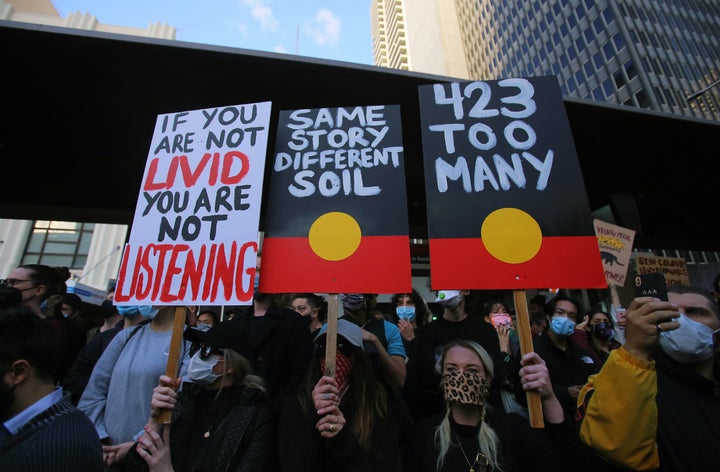
Protesters in Sydney show solidarity with Black Lives Matter demonstrations in the U.S. and rally to stop Aboriginal deaths i


Protesters in Sydney show solidarity with Black Lives Matter demonstrations in the U.S. and rally to stop Aboriginal deaths in police custody.

The situation is similar in Australia, where Black Lives Matter protesters have highlighted the more than 400 Aboriginal deaths that have occurred in police custody over the past three decades.

“This is what we now have to say to the premier and the government: Stop the killings of Aboriginal people and racial violence and hate crimes,” human rights lawyer and activist Hannah McGlade, a Noongar woman, said at a large demonstration in Perth, Western Australia.

In Darwin, Northern Territory, two young Indigenous Larrakia women, cousins Sharna Alley and Mililma May, organized a protest that attracted more than 1,000 people over the weekend.

“On Larrakia land children have been stolen, Aboriginal language and culture has been stolen,” May told the crowd, according to The Guardian. “On Larrakia land, Aboriginal children make up 100% of the Don Dale youth detention center. On Larrakia and surrounding land, Aboriginal people are killing themselves at the highest rate in the world.

“Our Aboriginal men, women and children are targeted by police.”

At times, the parallels between the situation in Australia and that in the United States can be painfully stark. George Floyd’s final words before he died were “I can’t breathe.” Aboriginal man David Dungay Jr. said “I can’t breathe” 12 times before he died while being held down by five prison guards in December 2015. 

After seeing footage of the U.S. protests in recent days, the Dunghutti man’s family said that “more people are starting to realize the injustices against Black people and against First Nations people everywhere.”

Australian Prime Minister Scott Morrison said last week that there was “no slavery in Australia,” sparking widespread criticism and calls for the country to finally come to terms with its own racist history.

His comments came shortly after footage of a white Sydney police officer slamming an Aboriginal teenager to the ground went viral online.

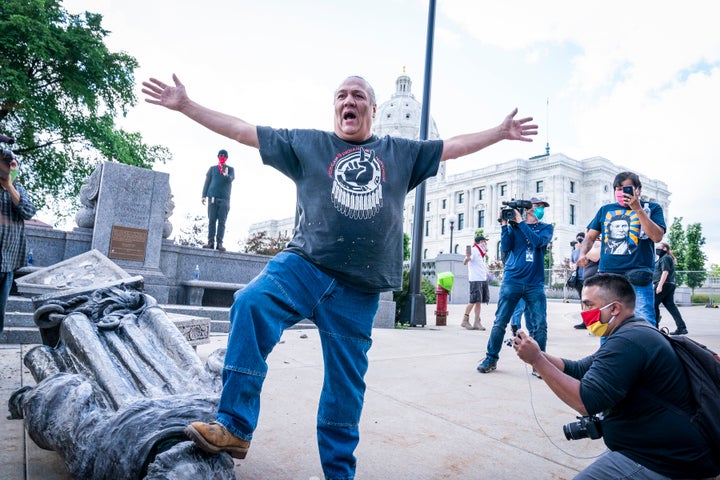
Mike Forcia, of the Black River Anishinabe, celebrated after the Christopher Columbus statue was toppled in front of the Minn


Mike Forcia, of the Black River Anishinabe, celebrated after the Christopher Columbus statue was toppled in front of the Minnesota State Capitol in St. Paul, Minnesota.

Following the release of the video, New South Wales Premier Gladys Berejiklian acknowledged that the country must still do more to address systemic racism within the police force.

“We still have a long way to go,” Berejiklian said. “What happened in the U.S. is a good wake-up call for all of us.”

In Canada, Jeremy Dutcher, the member of Tobique First Nation, echoed that sentiment.

“This is a time of monumental change in this country and across North America — trust and believe that these struggles are connected,” Dutcher told HuffPost Canada. 

He said that while Black and Indigenous experiences aren’t necessarily the same, these communities are connected by the forces that oppress them instead of protecting and serving them. 

“That connection I hope can be made clear,” he said. “We can move in solidarity with our Black brothers and sisters, because we’re tired — enough is enough.”

With reporting from HuffPost Canada and HuffPost Australia.


Source link

COVID-19 lockdowns helped people get more, but not necessarily better, sleep

0

Lockdowns haven’t just curbed coronavirus transmission — they’ve also helped people get more sleep (SN: 6/9/20).

Two studies, both published June 10 in Current Biology, report that people began sleeping more and more regularly every night after countries imposed stay-at-home orders to slow the spread of the coronavirus. But that sleep may not have been of the best quality, one of those studies finds.

In one study, researchers compared sleeping patterns of 139 students from the University of Colorado Boulder before and after stay-at-home orders moved classes online. Students’ sleep schedules became more regular and better aligned with their body’s natural sleep-wake cycle, the team found.

Those students also got more sleep overall. Before lockdowns, 84 percent of students reported getting seven hours a night or more during the week — the minimum amount that the American Academy of Sleep Medicine recommends for adults to maintain health. After the lockdowns were in place, that number went up to 92 percent.

A separate study of 435 people in Austria, Switzerland and Germany found that people there also reported sleeping more regularly and for longer periods. That sleep, however, may have been of lower quality and included problems such as falling or staying asleep. Participants reported a reduction in their mental and physical health during COVID-19 lockdowns, which was associated with lower-quality sleep.

Worse sleep, despite spending more time in bed, may have outweighed any benefits from a regular sleep schedule, the authors of this study say. But getting outside in natural sunlight and exercising could help improve sleep quality.

Source link

4 eye-opening facts about emoji, explained by an emoji historian

0

TNW Answers is a live Q&A platform where we invite interesting people in tech who are much smarter than us to answer questions from TNW readers and editors for an hour. 

Emoji blew up in 2012 and was fully embraced when Apple released iOS6 with its extended emoji keyboard. Since then, emoji have come a long way, and thanks to their skyrocketing popularity they are on every major social media platform out there. 

While there seems to be an emoji for every occasion, there is still a multitude of challenges, opportunities, and controversies surrounding them. Why do people with glasses or afro-textured hair types lack a place in the emoji keyboard? What happened to the gun emoji? And does anyone actually use the alembic emoji? 

We talked to Jeremy Burge, emoji historian and Chief Emoji Officer at Emojipedia, the internet’s leading authority on the topic, to debunk popular myths surrounding emoji and to get answers to your most burning questions about the controversies surrounding them.

[Read: Twitter wants to let you react with emoji — but why?]

The disappearance of Apple’s pistol emoji

With Apple’s iOS 10 update in 2016, the pistol emoji was cut, and a lime green water gun took its place. The change was driven by the company’s interest in participating in conversations around gun control. Right after that, other major companies like Google, Samsung, and Twitter decided to follow Apple’s lead and redesigned their own pistol emoji, too. 

“I don’t think the approach to change the design of the pistol was the right way to address the very real issue that having a gun on the emoji keyboard worldwide is unnecessary,” Burge explains. “I don’t blame other vendors following suit eventually, as Apple has strong mindshare when it comes to emoji use. They are the only platform that can roll out an emoji change to hundreds of millions of phones overnight – while other companies have staggered or slow rollouts for various reasons. The worst situation was when some platforms had a weapon, and others a toy. Regardless of the design, it’s best they all eventually conformed.”

Birth control emoji keep getting rejected

Over the past few years, organizations have suggested a condom emoji to promote safe sex. British condoms brand Durex even wrote a letter to the Unicode Consortium, pushing for a condom emoji with the aim of empowering young people to talk openly about protected sex.

However, these proposals have been turned down again and again. 

Burge believes that the main explanation for their rejection lies in the lack of an agreement between the vendors and Unicode. “If Unicode were to approve a bunch of emojis that vendors don’t add, we’d have a situation where some emojis only work on some platforms, which is a pretty bad outcome for end users who wouldn’t know which are universal,” Burge explains.

“For the condom, I can absolutely see merit in such a proposal, though I do wonder whether major tech companies would feel entirely comfortable putting this on the emoji keyboard for all ages, in all countries around the world. It’s a big commitment to add any emoji, and I would speculate that some may be hesitant to bring ‘sex’ to the keyboard in a way it isn’t at present. This isn’t to say it couldn’t or won’t happen in the future.”

Under-representation of people with curly hair or glasses

These categories of emoji would be widely used if they only existed. Unluckily, they have been overlooked while much more quirky and novel things like Buckingham Palace guards have been developed. 

“The challenge with personal customization is what range you give it,” Burge says. “To request that every emoji have an option to wear glasses would add a huge number of emojis, especially with skin tones and genders taken into account. But if you just add a single ‘adult with glasses’ many would see it as inadequate.”

Emoji are bound to disappear in the near future

Will emojis go out of trend and be replaced by the good old colon-parentheses smiley face? Communication constantly evolves to best suit our needs, the platform we’re using, and the situation we’re in, so it wouldn’t be surprising to witness the disappearance of emoji altogether. However, Burge’s position on the future of emoji is very firm. 

“I swear I’m not saying this because my whole job is running an emoji reference website, but I truly think emojis will be with us as long as text communication is used,” Burge explains. “Unicode characters don’t get retired, and it’s genuinely useful having an additional set of characters to work with to convey gesture or tone.”

Emoji undoubtedly became an irreplaceable component in our everyday conversation and, as Burge confirms, they are here to stay.

Read next:

Our unrealistic expectations about VR are harming its development

Celebrate Pride 2020 with us this month!

Why is queer representation so important? What’s it like being trans in tech? How do I participate virtually? You can find all our Pride 2020 coverage here.

Source link

Dwayne Johnson Responds To Student’s Graduation Request In Most Heartwarming Way

0

Dwayne “The Rock” Johnson delivered a surprise virtual graduation address for high school seniors after one student’s request to speak at her ceremony “knocked me off my feet,” he said Monday.

The “Jumanji” star posted a video to Instagram in which he read excerpts from a letter he’d received from Lorraine Angelakos, a senior at Pompano Beach High School in Florida.

Angelakos acknowledged in her letter how “most commencement speakers and celebrities are sought for after you complete college” but suggested someone like Johnson should speak out to inspire graduating seniors because “some students won’t have that luxury” of further education. 

Angelakos offered to fundraise to cover Johnson’s travel and food expenses to attend the school’s commencement.

She even enclosed $7 “as part of a good faith request” as a downpayment. That detail “sealed the deal,” Johnson said — he famously only had $7 to his name when he began his career. 

In a video that he shared online last month, the actor asked where a “compassionate leader” of the U.S. was while “our country is down on its knees, begging, pleading, hurt, angry, frustrated, in pain” amid the coronavirus pandemic and growing outrage over systemic racism and police brutality.

Angelakos, Johnson said in his new video, had answered him.

“You’re right here. Here you are,” he declared. “We all must become the leaders that we’re looking for.” 

Check out the full video here:


Source by [author_name]

Sushmita Sen pens inspirational message for fans amid turbulent times

0

Sushmita Sen pens inspirational message for fans amid turbulent circumstances

Sushmita Sen has always been an active member of the Instagram community and ever since she went into quarantine with her boyfriend and daughters, she has been rather candid about her thoughts surrounding world events in an attempt to raise awareness and promote a feeling of safety and serenity.

In order to drive home an inspirational message, the actress took to her Instagram to post a message of encouragement to all those suffering due to current world events.

She asked for fans to “protect your peace” in whatever way possible and captioned it with a heartwarming note which read, “Look good, show good…be good..ALL THE TIME!! Projection becomes one’s life, both on & off screen. Insecurities grow with name & sometimes, bank balance.”

She added, “All these may be known triggers in an actors life…but it’s actually true about a lot of us from all different walks of life…only differing in magnitude & visibility!! Young people with so much life & promise ahead of them, some with great depth & will power…can choose to take their own life is deeply disturbing.”

She concluded by saying, “How do we say, we know people & still not see it coming? Have we become experts at hiding our pain or does no one have the time to really SEE it?”

Source link

Drug kingpins held in Dubai as drug arrests cap seven-year investigation

0

Erkan Keskin earned the nickname the “naked bikie” after a 2015 incident in Luddenham.Credit:Seven News

Some of the biggest players in the syndicate are understood to be old school friends from a western Sydney high school.

Erkan Keskin, the former head of Lone Wolf and a former Turkish soldier known as ‘Eric the Wolf’, is also named in court documents and remains of interest to investigators. He also left Australia last year.

Nearly two dozen men have been charged and some jailed for their roles in commercial importation, money laundering and running organised criminal groups over at least four importations around 2013-14, valued at $1.5 billion. Police declined to say how many of the importations they stopped.

The drugs from Germany and the Netherlands were allegedly imported to Australia concealed in shipping containers.

Frank Farrugia was arrest at the Sofitel hotel at Darling Harbour.

Frank Farrugia was arrest at the Sofitel hotel at Darling Harbour.Credit:Facebook

Tuesday’s raids began around 7am with the arrest of 36-year-old Frank Farrugia, from Erina Heights, at the five-star Sofitel Hotel at Darling Harbour. He was charged with drug supply, knowingly dealing with proceeds of crime and directing the activities of a criminal group.

Deniz Kanmaz, 34, was also arrested at Muswellbrook and charged with drug supply, knowingly dealing with proceeds of crime and participating in a criminal group.

A third man, 57-year-old Mario Lang, was arrested at his Baulkham Hills home and taken to Castle Hill police station. He has been charged with conspiring to import a commercial quantity of drugs.

Detectives executed search warrants at Mr Lang’s home and at two business premises at Badgerys Creek, including freight business Farrugia Freighters.

A search warrant was also executed at a business in Jamisontown, in connection with the NSW Crime Commission Criminal Assets Recovery Act.

Investigators say the alleged syndicate operated like a pyramid scheme, of which Mr Pitt and Mr Battah were among those directing it.

Police raid Mr Lang's Baulkham Hills on Tuesday.

Police raid Mr Lang’s Baulkham Hills on Tuesday.Credit:Louie Douvis

Below them, police allege Mr Farrugia – a keen racehorse owner – Kanmaz and Mr Lang held mid-level roles, while a further 16 men already charged over the syndicate were allegedly lower-level couriers who were responsible for unpacking drugs.

Following their arrest on Tuesday Mr Farrugia, Mr Lang and Kanmaz all appeared in NSW courts. None of them applied for bail, which was formally refused. They will all next appear on August 11.

Mario Lang, 57, was arrested at his Baulkham Hills home.

Mario Lang, 57, was arrested at his Baulkham Hills home.Credit:Facebook

Police will allege Mr Farrugia was involved in the supply of more than 20 kilograms of MDMA and 3kg of methylamphetamine across NSW. It will be further alleged he dealt with $4.6 million as the proceeds of crime.

It will be alleged the syndicate comprised Mr Pitt and Mr Battah, Savas Guven, Erkan Keskin, Erhan Kurtulmus, Mr Farrugia, Mr Lang and others.

Some details of the importations have emerged in court over recent years.

Guven, also known as Savas Yucel, a property developer and chief executive from Mosman, faces trial next year over allegations he was a key player involved in three of the importations. Guven is Keskin’s cousin.

Erhan Kurtulmus was jailed until 2023 over his involvement in recklessly dealing with the proceeds of crime.

Organised crime squad commander, Detective Superintendent Martin Fileman said the men arrested on Tuesday were the final members of the alleged syndicate who were sought by police.

Savas Guven has already been charged over the alleged syndicate.

Savas Guven has already been charged over the alleged syndicate.Credit:Kirk Gilmour

“This was another prime example of the effectiveness of national and international law enforcement partners working together to dismantle organised crime syndicates,” he said.

“Especially this one, [which] for many years was importing large amounts of drugs into Australia.”

He said the syndicate allegedly dealt with proceeds of crime worth more than $54 million, “allowing them to travel the world in luxury and live a life of opulence, while they knowingly preyed on the vulnerabilities of others.”

– with Laura Chung

Most Viewed in National

Loading

Source by [author_name]

Common drug can improve COVID-19 survival: Oxford University study

0

In the trial, patients administered six milligrams of dexamethasone a day generally fared better than those who just received usual care | Daniel Leal-Olivas/AFP via Getty Images

Drug achieved a one third reduction in mortality in patients on ventilators.

Study data shows that a low-cost drug called dexamethasone can reduce mortality among patients hospitalized with COVID-19, Oxford University announced Tuesday.

In the large-scale British RECOVERY trial, conducted by a team of scientists from Oxford, patients administered six milligrams of dexamethasone a day generally fared better than those who just received usual care, according to the press release.

The drug achieved a one third reduction in mortality in patients on a ventilator, while it reduced deaths by a fifth in patients just receiving oxygen. It made no difference among those who didn’t need any respiratory intervention.

Dexamethasone is a corticosteroid drug used to treat a range of diseases and conditions, including allergic reactions, anemia and brain swelling.

Oxford’s Peter Horby, one of the chief investigators for the trial, noted that it’s the first drug to show improved survival in COVID-19

“The survival benefit [of dexamethasone] is clear and large in those patients who are sick enough to require oxygen treatment, so dexamethasone should now become standard of care in these patients,” Horby said.

“Dexamethasone is inexpensive, on the shelf, and can be used immediately to save lives worldwide,” he added.

According to the Oxford statement, dexamethasone could prevent about one death for every eight ventilated patients.

In a written statement, Nick Cammack, COVID-19 Therapeutics Accelerator Lead at the Wellcome Trust, called the finding a “major breakthrough” and said that “countless lives will be saved globally” as a result.

However, Tom Frieden, former head of the U.S. Centers for Disease Control and Prevention, cautioned against immediate optimism.

“Need to see the data. Other studies have not found this,” he wrote on Twitter.

In the release, Oxford said that it would work on publishing the full details “as soon as possible.”

Ashleigh Furlong contributed reporting. 


Source by [author_name]

SA needs more young people in politics – The Mail & Guardian

0

COMMENT

There is a general sense that traditional politics and representative democracy fails to attract the attention of young people. This is despite knowing that young people, historically, have been at the forefront of bringing about social and political change in pre and post-democracy eras. Yet in the last two decades, young people feel they have been reduced to recipients of decisions rather than shapers of decisions. 

The perceived feeling of exclusion has often led to young people seeking alternative means of expressing their frustration and dissatisfaction with government and other forms of authority. When frustration reaches to unbearable proportions, often youth turn to civil disobedience expressed in the form of protests that sometimes turn into violence.

It is critical that young people be included meaningfully in politics and political processes to foster longer-term societal stability and peace to advance the socioeconomic development of the nation. 

So then, how can young people be meaningfully involved in politics in South Africa in this new decade?

First, the government at all levels of governance needs to recognise that young people aspire to express their dreams through inclusive participation in all decision-making processes, from the conception of policies, formulation all the way to implementation. Young people need platforms where they can influence policy decisions concerning their welfare and opportunities through which they can actively pursue their political and socioeconomic priorities, which may often differ from those of their older counterparts. They need to be respected and embraced to forge a meaningful partnership towards making those aspirations and priorities a reality.

Second, society and political parties must support young people’s candidacy to contest elections. The number of young people serving as parliamentarians remains low. There is a need for collective support from civil society, the Electoral Commission of South Africa and political parties to facilitate their representation in the legislature. This can be done by, for instance, providing young candidates with training in how to campaign successfully, the legal framework governing elections, rules and regulations of the legislature, as well as roles and responsibilities of parliamentarians. Training will enhance their candidacy and prepare them for the responsibilities ahead of them should they become members of Parliament. Political parties can work together to eliminate barriers that may hinder young people from reaching electable positions. Intra-party processes must be non-discriminatory so that young people can gain the confidence to participate in their parties.

Third, leaders from civil society, business, political parties, labour, academia and other formations need to invest in young people through mentorship and coaching. It is the mentorship that unleashes the potential in these young leaders to ignite change in society. It is the mentorship that helps them to navigate the crisis of the moment while preparing for the changing world.  

The time to invest in the next generation of leaders is now. Being a strong leader can be draining. It requires resilience. Mentors can play a significant role in preparing young people for politics and political leadership.

Fourth, civil society in partnership with the Electoral Commission of South Africa and political parties need to work harder in encouraging young people to participate in voting. Targeted democracy and voter education programmes are required to increase young peoples’ interests in the political affairs of the country. Such programmes will not only increase their knowledge about politics but also deepen their commitment to democratic values and principles. Next year’s local government elections would be a good test case for increasing young leaders in our municipalities. The time to prepare them is now.


Source link