Saturday, May 23, 2026

36,000 U.S. Lives Could’ve Been Saved If Social Distancing Was Imposed A Week Earlier: Study

In the first week of March, President Donald Trump was still downplaying the threat that COVID-19 posed on the United States. He urged Americans during a March 5 town hall to be “calm,” saying “it’s going to all work out.”

But according to research published this week by infectious disease modelers at New York’s Columbia University, tens of thousands of lives in the U.S. could have been saved had social distancing measures been imposed around the time of Trump’s town hall.

It wasn’t until March 16 that Trump told Americans to avoid non-essential travel and gathering in groups. The new study, which has yet to be peer-reviewed, says the lives of about 36,000 people could have been saved if such restrictions had been introduced just one week earlier.

And if the same restrictions had been imposed on March 1, researchers said, an estimated 54,000 fewer people would have died from the coronavirus by the first week of May.

“Our findings underscore the importance of early intervention and aggressive response in controlling the COVID-19 pandemic,” the researchers said in their paper. 

Even a week or two could make a “big, big difference,” epidemiologist Jeffrey Shaman, who led the research, told The New York Times.

“That small moment in time, catching it in that growth phase, is incredibly critical in reducing the number of deaths,” he said. 

Responding to the estimates by Shaman and his team, the White House told the Times that Trump’s restrictions on travel from China and Europe, imposed in January and mid-March respectively, mitigated the spread of COVID-19. 

During the town hall in early March, Trump touted his decision to restrict travel between the U.S. and China, where the coronavirus is believed to have originated, as a move that “saved a lot of lives.” 

“We’ve been given A-pluses for that” decision, he said.  

But Shaman’s research suggests that many more lives could’ve been saved had other interventions been taken at the time.

Such action would have had a “very drastic effect in reducing the number of cases and deaths that we would have seen thus far,” Shaman told CNN’s Don Lemon on Wednesday.

His team’s findings should also serve as a warning as states prepare to loosen virus restrictions, Shaman added.

“As we loosen these restrictions, it’s possible we could start to have the growth of the virus in a lot of communities if we’re not careful,” he told Lemon. “If social distancing practices lapse. If people aren’t wearing face masks as they start to go to businesses and restaurants and theaters. If we don’t monitor this and if we don’t recognize it really early and jump on it, it’s going to jump out of control again.”

A HuffPost Guide To Coronavirus


Source by [author_name]

Thousands left homeless in South Asia as cyclone heaps misery on coronavirus-hit communities

0

The state of West Bengal’s Chief Minister Mamata Banerjee said on Wednesday at least 12 people had died in eastern India, with one young girl in the Howrah district killed after a wall collapsed inside her home.

In neighboring Bangladesh, the death toll from Cyclone Amphan has risen 10, according to the governmental Health Emergency Operations Center. Among those killed was a 57-year-old Red Crescent volunteer in Barisal who drowned when attempting to help others to safety, the Red Crescent Society of Bangladesh said.

Large-scale evacuation efforts throughout India and Bangladesh appear to have saved many lives, but it could take days to realize the full extent of the deaths, injuries and damage from the cyclone. Fallen debris has made many of the roads impassible and heavy rains continue to fall on hard-hit areas.

Disaster teams worked throughout the night and into Thursday morning in India’s West Bengal and Odisha states, clearing trees and other debris from roads.

S.N. Pradhan, director-general of India’s National Disaster Relief Force (NDRF), said the worst of the damage is concentrated in two of West Bengal’s coastal districts and that the Sunderbans had been “pulverized” by the cyclone.

The Sunderbans are an ecologically fragile cluster of low-lying islands spread across India and Bangladesh, known for mangrove forests and rare wildlife, including the endangered Bengal tiger.

“Maximum impact, as expected has been seen there,” Pradhan said.

Four of the state’s least affected districts could be up and running in four to six days, and some coastal parts of Odisha are expected to be back up by this evening, he said.

“People have started moving out of shelters to assess the damage to their homes. Some have even started repairing their damaged homes,” Pradhan said.

In Kolkata, the biggest city in the direct path of the cyclone and home to 14 million people, Pradhan said that a lot of trees had been uprooted and “the city has never seen such high winds.”

Cyclone Amphan is a disaster bigger than the coronavirus outbreak, the state’s chief minister Banerjee said at a news conference Wednesday.

“The whole of the southern part of the state has been affected. We are shocked,” the chief minister said. “The cyclone has affected the electricity supply and destroyed many houses, bridges and embankments.”

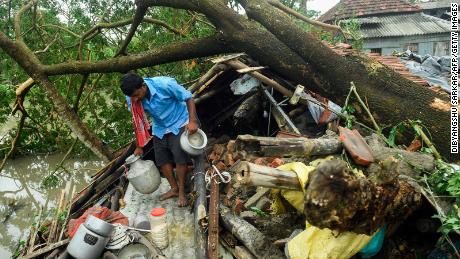
In the areas affected by the cyclone, many villagers live in temporary homes with thatched or tin roofs, which were easily swept away in the powerful winds.

In Bangladesh, nearly every coastal district has been seriously affected by Cyclone Amphan, according to Ranjit Kumar Sen, an official at the Bangladesh Ministry of Disaster Management and Relief.

Sen said that the damage along the coast was “huge.” Among the 10 killed in the country, five people were in Barisal state — including the Red Crescent volunteer — four in Khuna, and one in Chittagong.

Several poorly maintained dams broke down even before the cyclone made landfall, causing extensive flooding in parts of the country.

Snigdha Chakraborty, with charity Catholic Relief Services, said the country saw storm surges as high as 15 feet (4.5 meters), inundating houses throughout the country.

Cyclone Amphan made landfall on India’s east coast, near Sagar Island in West Bengal, at around 5 p.m. local time Wednesday (7.30 a.m. ET) and began tracking north toward Kolkata, with wind speeds of up to 160 kph (100 mph), according to data from the US Joint Typhoon Warning Center.

Amphan weakened into the equivalent of an Atlantic tropical storm as it crossed the border between West Bengal and Bangladesh Thursday morning, but is still packing strong winds of up to 110 kph (68 mph). The system is expected to continue weakening over the next 24 hours as it travels northeast.

The next danger will come from the heavy rain, which could lead to flash flooding across the region through Thursday morning.

Mass evacuations and coronavirus

An ambitious evacuation mounted by India and Bangladesh saw an estimated 3 million people moved to safety across the two countries, according to regional authorities.

The relief operation came despite India and Bangladesh remaining under strict lockdown orders due to the coronavirus. The virus, which continues to spread through both countries, has complicated the emergency response, as relief teams grapple with how to get people to safety while also protecting them against the risk of Covid-19.

India passed more than 100,000 confirmed infections earlier this week, according to Johns Hopkins University, and recorded its largest single-day spike on Wednesday with 5,611 new cases. Meanwhile, Bangladesh’s infection count is rapidly rising, with more than 1,300 new cases on Sunday, its biggest rise to date. In total, the country has recorded 26,738 confirmed infections, according to Johns Hopkins.

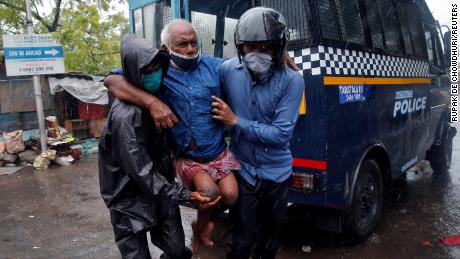
Police officers carry a disabled man to a safer place following his evacuation from a slum area in Kolkata, India.

In Odisha, where more than 150,000 people were evacuated, a total of 211 of the state’s 809 permanent cyclone shelters were being used as Covid-19 quarantine centers.

Pradeep Jena, special relief commissioner for Odisha state, said emergency services had to balance saving lives from the cyclone with saving lives from the coronavirus. In evacuation centers, Jena said they were trying to keep the elderly and pregnant women separate from the rest of the population and were working hard to obtain adequate soap.

“Social distancing is definitely a very good concept but enforcing it in the strictest possible manner in a disaster situation may not always be possible,” he said.

In India’s West Bengal, which bore the brunt of the cyclone’s winds, about 500,000 people were temporarily housed in storm shelters, according to authorities, while in Bangladesh the government said they had evacuated 2.4 million people as well as about 40,000 livestock animals.

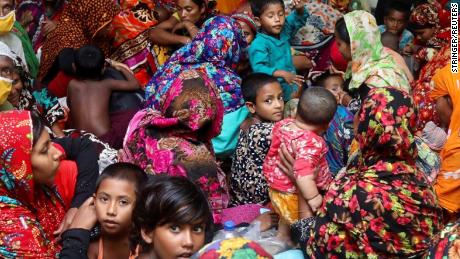
People gather at a cyclone center for protection before Cyclone Amphan made  landfall in Gabura, on the outskirts of Satkhira district, Bangladesh May 20.

It’s unknown when many of those people will be able to return home. Bangladesh Oxfam director, Dipankar Datta, said Wednesday that thousands of makeshift homes in Bangladesh had been uprooted due to the cyclone.

In what is likely to be one small glimmer of hope, Catholic Relief Services’ Chakraborty there had been no major damage reported so far in sprawling refugee camps in Cox’s Bazar, which are home to nearly 1 million Rohingya refugees and had been a source of concern to aid workers after Covid-19 cases were identified there last week.

Some weak shelters were damaged in the storm and now need to be repaired, she said.

Though there is concern that the precipitation from the storm — though it made landfall on the other side of Bangladesh — could still cause landslides and flooding in the camps.

Salman Saeed and Abir Mahmud in Bangladesh, CNN’s Rebecca Wright, Brandon Miller, Michael Guy, Joshua Berlinger, Ben Westcott and Manveena Suri contributed to this article.

Source link

Juncker: EU internal border closures ‘nonsense’

0

Former European Commission President Jean-Claude Juncker | Kenzo Tribouillard/AFP via Getty Images

Former Commission president describes it as ‘an arbitrary decision.’

Former European Commission President Jean-Claude Juncker voiced his opposition to internal border closures across the EU, branding them as “nonsense” in an interview with German broadcaster Deutsche Welle.

Juncker’s home country of Luxembourg was hit hard when Berlin imposed controls at its border with the Grand Duchy in March to limit the spread of the coronavirus.

“It forced tens of thousands of German cross-border travelers to make huge detours. It was nonsense,” Juncker said. “They closed the borders without thinking about the people who’d be the victims of such an arbitrary decision.”

The Commission has prioritized restoring free movement in the Schengen zone, asking countries to lift internal EU border checks wherever possible. Germany has outlined plans to ease foreign travel restrictions from June 15.

Juncker also spoke about the EU’s economic recovery plans, calling a Franco-German proposal for a €500 billion recovery fund “the right response.”

“It allows the European Union to respond with solidarity, especially for members in southern Europe. This is absolutely necessary,” he said.

Italy’s Prime Minister Giuseppe Conte described the Franco-German proposal as insufficient in an opinion piece for POLITICO, although noting it was a significant step. “If we are to overcome this crisis together, as a union of common interests and common values, much more needs to be done,” Conte wrote.


Source by [author_name]

Dozen injured as car crashes into Syd shop

A dozen people, mostly young women, have been injured after a station wagon crashed into a Sydney hijab shop days before the end of Ramadan.

Mobile phone and security camera video shows the wagon pushing a white sedan aside at traffic lights before racing through the intersection and ploughing into the Greenacre store about 3.15pm on Thursday.

Witnesses described the scene as “surreal”.

The male driver, 51, was conscious when arrested and remains under police guard in hospital.

“He’s only been briefly spoken to, he’s yet to be interview by detectives and crash investigators,” Assistant Commissioner Peter Thurtell told reporters on Thursday evening.

“I am aware he has some traffic matters. I’m unable to comment on any medical episode. There’s no information that’s been given to me that there’s been any medical episode.”

Three men and eight women – mostly aged 18 to 30 – inside or near the shop at the time were treated for minor injuries.

Two people with broken legs were carried out of the smashed shop.

They’re all in a stable condition, NSW Ambulance Acting Inspector Caitlyn Murphy said.

“Our paramedics were met with a very chaotic scene,” she told reporters.

“There was a large crowd of bystanders who were quite distressed.”

NSW Police said there is no indication the crash was terror-related.

The reason for the crash remains under investigation.

The driver of the white sedan was Abdul Jelani, the Seven Network reported.

“All of a sudden I saw this car come out of nowhere and hit other cars and then I get hit from the back,” Mr Jelani said.

“I locked my brakes and he just kept pushing and pushing. Then all of a sudden I ended up on that side of the road … and he ends up in the shop.”

Dairee frozen yoghurt manager Malik Islam was preparing for the nightly Ramadan trade when he heard people screaming – but he didn’t think it could be “as horrific as a car ploughing into a shop”.

“It actually ploughed into the centre of the shop, there were a lot of people trying to enter the shop to provide some support,” the witness told AAP.

Footage he saw showed the wagon “pushed that car out and flung straight across the intersection”.

“It was disturbing, it’s very surreal, you don’t expect it – it’s a very chaotic intersection normally,” Mr Islam said.

NSW Police initially said incorrectly that the vehicle which crashed into Hijab House was a Subaru SUV.

Source by [author_name]

Infectious Disease Expert Explains Why White House Coronavirus Testing ‘Not Smart’ At All

Infectious disease expert Michael Osterholm on Wednesday criticized the White House’s coronavirus testing protocol, saying it was not an example of smart testing and likening it to giving squirt guns to Secret Service agents to protect President Donald Trump.

Osterholm, the director of the Center for Infectious Disease Research and Policy at the University of Minnesota, explained to CNN’s Anderson Cooper how testing for COVID-19 itself, while important, is not the end-all for slowing the spread of the contagion that has now killed almost 95,000 people nationwide.

Instead, Osterholm argued, it should be seen as part of a wider system of testing “the right person at the right time with the right result.”

“You have to understand that a test is not just a single thing that happens. You have to be testing the right population,” said Osterholm, who noted how “today, if I tested any citizen in the state of Minnesota for antibody, I’d probably find over half of them that have it, are false-positive antibodies, meaning that they don’t really have it.”

“If I’m testing certain groups that I need to have absolute certainty that I’ve screened out for the virus, like we just saw at the White House two weeks ago. Well, we know that test didn’t do that at all,” he continued. “Those are not examples of smart testing. So you want the right test for the right person at the right time with the right result.”

As an example of the “right result,” he noted how many auxiliary and drive-by clinics were unable to give the result of the test to people they were testing, and that health departments were not tracking the information.

“This has got to be part of a system, much more than just ‘if we’re testing for 8,000 people today we’ve made it.’ It’s like the Dow Jones average,” said Osterholm. “We need to do smart testing to test those who need it and get the results back to them and make a difference.”

Cooper suggested it was “pretty alarming” that “even in the White House, the testing they’re doing, you’re saying that’s not smart testing.”

“That was not smart testing at all,” he said. “I mean, trying to use that test as it was used to protect the president of the United States is like giving squirt guns to the Secret Service and saying ‘protect the president.’”

“That was just not an effective use of that test because there were clearly examples we could have false negatives, many of them,” Osterholm added. “And so, again, testing is important, but you’ve got to use the right test, and how you use it.”

Osterholm later highlighted another potential pitfall.

“Many people are not aware of the fact that we’re running these testing machines 24/7 right now around the world,” he said, noting how spare parts for the devices had to be sourced from Asia and Europe.

“We just haven’t thought about all of the things it takes to keep a testing system in place and so that’s what we’re trying to come back to,” he added.

A HuffPost Guide To Coronavirus


Source by [author_name]

New Zealand PM Ardern floats ‘four-day week’ as a way to help the economy

0

In a Facebook Live video posted earlier this week, Prime Minister Jacinda Ardern shared the suggestion while discussing ways to revive domestic tourism in her country. Over the last few months, the coronavirus crisis has forced people around the world to lock down and decimated global demand for travel.

“I’ve had lots of people suggesting we should have a four-day week. Ultimately, that really sits between employers and employees,” Ardern said.

However, the idea has merit in that it might give domestic travelers “flexibility in terms of their travel and their leave,” she added. Ardern noted that 60% of New Zealand’s tourism industry comes from locals.

“There’s lots of things we’ve learnt about Covid and just that flexibility of people working from home, the productivity that can be driven out of that,” she continued.

The prime minister encouraged employers to consider allowing more flexible work set-ups — including remote work and putting in longer hours on fewer days — if possible, “because it certainly would help tourism all around the country.”

Four-day work weeks have become more popular recently as employers explore whether a tighter schedule can boost productivity.

New Zealand’s own government is no stranger to the idea of an alternative working schedule. Since 2018, several government agencies have signed up to pilot a program called “flexible work by default,” which directs employers to give their workers more freedom in various ways.
While it’s up to each participating agency to decide what that arrangement looks like, the government has outlined several possibilities — including allowing people to adopt shorter work weeks, “such as 40 hours over four days, or a nine-day fortnight.”
In 2018, New Zealand company Perpetual Guardian, which helps customers manage their wills and estates, also held a two-month trial of the concept. The firm said it was so successful, it wanted to make it permanent.

By working just four days a week, employees all reported higher productivity, better work-life balance and reduced stress, according to the firm, which had around 240 staffers.

“It was just a theory, something I thought I wanted to try because I wanted to create a better environment for my team,” founder Andrew Barnes told CNN Business at the time. “They went beyond my wildest dreams.”
Big businesses elsewhere are also starting to jump on the bandwagon. Last year, Microsoft (MSFT) took up the idea as the company’s team in Japan experimented by shutting down its offices every Friday in August, and giving all employees an extra day off each week.

The results were promising: While the amount of time spent at work was cut dramatically, productivity — measured by sales per employee — went up by almost 40% compared to the same period the previous year, the company said.

As a result, Microsoft announced that it would follow up with another experiment in Japan, and also asked other companies to join the initiative.

Source link

Coronavirus updates LIVE: Trump blames China for ‘mass worldwide killing’, global cases pass 4.95 million

That’s problematic and differs with early reports that described Covid-19 manifesting as pneumonia, according to researchers in Japan.

“Most cases are milder and could have more transmission potential because patients might not seek medical attention,” said Takeshi Arashiro, a junior resident at the Asahi General Hospital in Chiba, just outside Tokyo.

Early reports described Covid-19 manifesting as pneumonia, “but most cases are milder and could have more transmission potential because patients might not seek medical attention,” said Arashiro, who is also a collaborating researcher with the Infectious Diseases Surveillance Center in the National Institute of Infectious Diseases in Tokyo.

The lower threshold for testing people for the coronavirus while the cruise ship was quarantined in Yokahama “created an opportunity to observe mild Covid-19 cases and monitor patient symptoms,” he said.

Understanding the disease pattern that coronavirus infection can cause is important for informing strategies for detecting and controlling it.

The high proportion of people who test positive for the virus and have only mild or no symptoms makes fever-screening travellers, for example, much less useful in detecting probable infections than was the case with the related coronavirus that caused severe acute respiratory syndrome 17 years ago.

Bloomberg

Source by [author_name]

At Least 5 Million People Globally Have Been Infected With COVID-19

0

When the World Health Organization declared the coronavirus outbreak a global pandemic in mid-March, about 120,000 confirmed cases had been reported worldwide.

Early Thursday, that number surpassed 5 million.

According to a Johns Hopkins University tally, at least 5,000,500 people in 188 countries and territories have been infected with COVID-19 to date. Over 1.5 million of these cases were reported in the United States and another 300,000 were reported in Russia. Brazil, the U.K. Spain and Italy have each reported over 200,000 cases.

The global death toll from the virus stands at over 328,000.

On Wednesday, WHO said it had recorded its highest-ever daily number of COVID-19 cases. The agency said 106,000 cases had been reported on Tuesday — “the most in a single day since the outbreak began,” WHO’s Director-General Tedros Adhanom Ghebreyesus said during a virtual press conference. 

Tedros added that he was concerned about the spread of the virus in low- and middle-income countries ― and warned the pandemic was far from over. 

“We still have a long way to go in this pandemic,” he said.

A HuffPost Guide To Coronavirus


Source link

Sia Adopted 2 Teenage Boys As They Were Ageing Out Of Foster Care System

Sia is spending her time in self-isolation with a newly expanded brood. 

In a new interview on SiriusXM’s “The Morning Mash Up,” the “Chandelier” singer-songwriter opened up about adopting two teen boys last year. The boys, she explained, were both 18 years old at the time of the adoption. 

“They were ageing out of the foster care system,” she said, “and I love them.”

Sia, whose real name is Sia Kate Isobelle Furler, didn’t reveal many specifics about the 19-year-olds. As for how they were managing their time amid the coronavirus pandemic, she said, “They are both finding it pretty difficult, one more so than the other.” 

“But they’re both doing things that are really good for them right now,” she clarified. “They’re really doing a lot of educational stuff that’s good for them.” 

Sia briefly alluded to the adoption in GQ’s January profile of Diplo, whom she described as “one of the most talented and attractive people in the world.” 

“This year I wrote [Diplo] a text,” the famously private star told the magazine. “I said, ‘Hey, listen, you’re like one of five people that I’m sexually attracted to, and now that I’ve decided to be single for the rest of my life and I just adopted a son, I don’t have time for a relationship’ … If you’re interested in some no-strings sex, then hit me up.’”

Watch a segment of Sia’s SiriusXM interview below. 

News of the adoption comes as Sia is gearing up to return to the spotlight. 

On Tuesday, she dropped a new single, “Together,” which will be featured in a forthcoming movie “Music.”

Written and directed by Sia, “Music” follows Zu (played by Kate Hudson), a newly sober woman who becomes the sole guardian of her half-sister, Music (Maddie Ziegler), a young girl on the autism spectrum. The film, which also stars “Hamilton” veteran Leslie Odom Jr., will feature 10 new songs and is due out later this year. 

“I saw her on Instagram singing karaoke at her house, and she sounded like one of the only actresses who hadn’t been musical theater-trained,” Sia said of her decision to cast Hudson in the film. “So I just tweeted her.”


Source by [author_name]

Mark Cuban Goes On One Of Trump’s Favourite Shows And Rips Into His ‘Victim Card’

Billionaire investor and “Shark Tank” star Mark Cuban appeared on one of US President Donald Trump’s favourite Fox News shows Wednesday night and tore into the constant complaints coming from the White House. 

Given that Cuban is the owner of the NBA’s Dallas Mavericks, he initially spoke with Sean Hannity about how sports could return amid the coronavirus pandemic. But it wasn’t long before the conversation turned to the president ― and the exchange got a little heated.   

“This is what really bothers me about the president: He’s the most powerful man in the world and he always plays the victim card: ‘The Dems are out to get me, the media is out to get me,’” Cuban said. “You’ve got to be the leader, you’ve got to be the strongest man in the game and he just hasn’t shown that strength.”

Hannity interjected that “they” spied on Trump, but Cuban wouldn’t let him change the subject.

“Who cares?” Cuban shot back. “He’s the most powerful man in the world. Be powerful, be a leader, set an example.” 

Earlier in the interview, the two sparred over the administration’s response to the pandemic. Hannity noted that Cuban supports former Vice President Joe Biden, and said: “Tell me all the things that Bunker Joe did on coronavirus that you admire, then I’ll tell you what I think Trump did that I admire.”

But Cuban noted that Biden isn’t the president and has no role at all in the government.

“You can’t really put him in that category,” Cuban said, then shared some specific details about the Trump administration’s shortcomings.  

Check out more of their conversation below:


Source by [author_name]