Thursday, May 28, 2026

Anti-Trump Republican group releases new ad taking aim at “Rich Mitch” McConnell in GOP leader’s home state

An anti-Trump political action committee released a new advertisement targeting Senate Majority Leader Mitch McConnell on Wednesday, as the long-standing Kentucky senator campaigns for his seventh consecutive term in office.

The advertisement, titled “#RichMitch,” was created by the Lincoln Project, a group composed of Republican strategists and consultants aiming to prevent President Donald Trump’s re-election in November. Its latest video highlights disparities between McConnell’s personal affluence and the financial well-being of Kentucky’s population, noting the state’s low ranking in terms of employment opportunities, education and health care, compared with other United States regions.

“After 35 years, Kentuckians are still waiting for the kinds of opportunities Mitch worked so hard to give himself,” the ad’s narrator says, citing various reports that indicate Kentucky’s unemployment rate is among the nation’s highest.

Figures published by various government agencies have supported the Lincoln Project’s statements about job opportunity. According to recent data released by the United States Bureau of Labor Statistics, unemployment was more prevalent in Kentucky than in 37 states and Washington, D.C., as of April. On May 7, the Department of Labor’s weekly report detailing nationwide unemployment claims showed the majority had been filed by Kentucky residents throughout the coronavirus pandemic.

McConnell, whose net worth was estimated to be more than $10 million in 2019, has received backlash from other state leaders, like New York Governor Andrew Cuomo, for suggesting regions facing economic deficits as a result of the virus outbreak should declare bankruptcy instead of requesting federal assistance.

Additional reports from U.S. News and Wallet Hub place Kentucky near the tail end of nationwide rankings in quality of and access to education. An evaluation of Kentucky’s public health system included in the United Health Foundation’s most recent annual report yielded similar findings about its caliber compared with other states.


Mitch McConnell speaks at a press conference in Washington, D.C., on May 19. Anti-Trump political group the Lincoln Project released an advertisement criticizing McConnell on Thursday, amid his campaign for another term as senator of Kentucky.
Drew Angerer/Getty

The Lincoln Project’s criticisms of McConnell come as he campaigns for re-election as senator, a post to which he was first elected in 1984. Though some polls have shown McConnell is one of the country’s least-favored lawmakers, others conducted more recently found respondents were essentially divided in their allegiances to the current Kentucky senator and his 2020 Democratic opponent, Amy McGrath.

With several months remaining in the state senate race, Lincoln Project Communications Director Keith Edwards told Newsweek that Wednesday’s McConnell commentary will not be its last. “This is just the beginning,” Edwards said.

In previous comments to Newsweek on May 12, McGrath shared her hopes for a Democratic win at the upcoming election, despite McConnell’s lengthy congressional history.

“People in Kentucky know that he doesn’t care about them, and they want him gone,” she said in reference to voters. “They’re tired of him.”

Responding to the Lincoln Project’s advertisement on Thursday, a McConnell campaign spokesperson told Newsweek, “No scam PAC of grifters has ever been less relevant and no group of DC consultants will be forgotten faster than these thieves who bet everything on three days of dishonest ads in Kentucky.”

The Lincoln Project did not reply to Newsweek‘s request for additional comment in time for publication.

Source link

Antarctic ice sheets capable of much faster melting than we thought

0

Studying patterns of wave-like ridges on the Antarctic seafloor, scientists from the Scott Polar Research Institute at the University of Cambridge found that some 12,000 years ago, ice retreated at speeds in excess of 10 kilometers (6.2 miles) a year — far more rapid than today’s retreat rates, which are calculated using satellite data.

Researchers warn that, should climate change carry on weakening ice shelves in coming decades, we could soon see similar levels of ice retreat — more than were thought possible — with huge implications for global sea levels.

Though sea ice conditions stopped the team from retrieving images of the legendary wreck, they were able to map the seafloor near to the Larsen Ice Shelf, east of the Antarctic Peninsula.

The Larsen Ice Shelf originally covered an area of 33,000 square miles, but has shrunk dramatically as air temperatures warmed in the second half of the 20th century.

Sections of the shelf have disintegrated and broken away, and in 2017 around 12% of the remaining lower middle section of the shelf broke away as a single massive iceberg, measuring some 2,240 square miles.

Using autonomous underwater vehicles (AUV) operating about 60 meters (197 feet) above the seabed, researchers studied ridges on the seafloor, which had been created by ice squeezing sediment on the sea bed as it moved and began to float.

“We saw these absolutely beautiful delicate patterns of backstepping sets of very small ridges spaced about 20 to 25 meters apart and about half a meter high,” Julian Dowdeswell, director of the Scott Polar Research Institute, told CNN.

By examining the footprint of the ice sheet and sets of ridges on the seafloor, the team was able to find new evidence of past ice retreats, published in Science journal Thursday, which were faster than those observed in even the most sensitive part of Antarctica today.

“We now know that the ice is capable of retreating at speeds far higher than what we see today. Should climate change continue to weaken the ice shelves in the coming decades, we could see similar rates of retreat, with profound implications for global sea level rise,” Dowdeswell added in a statement.

A recent study by NASA showed that Antarctica and Greenland’s ice sheets lost 118 gigatons and 200 gigatons of ice on average per year, which caused the sea level to rise by about half an inch between 2003 and 2019.
This giant glacier in Antarctica is melting, and it could raise sea levels by 5 feet, scientists say

Warmer summer temperatures are chiefly to blame for this ice loss, according to NASA. The warm temperatures have melted ice from the surface of the glaciers and ice sheets.

Experts say this new study shows that, given the speed at which the ice retreated in the past, the future rate of change and ice retreat could be significantly greater than previously thought.

“What the geological record is showing is rates of change can be significantly faster than the fastest rates that we’ve observed in the satellite record, which of course means that ice can in principle be decanted back into the ocean faster than we thought — with implications for sea level rise,” Dowdeswell told CNN.

He explained that knowing how fast the ice shelves are capable of melting is important when looking at how models project the polar ice cap melting in future decades — and how much sea levels might rise.

Before, if models predicted high rates of melt, experts may be inclined to believe this was not possible, Dowdeswell said. “But now we can say it has happened, and therefore it is possible.”

Experts have warned that over the next three decades, hundreds of millions of people worldwide are at risk of losing their homes as entire cities sink under rising seas.
Scientists have warned that the planet’s warming is accelerating melting in glaciers and ice sheets from Greenland to Antarctica, and that sea levels will likely rise more than previously projected by the end of this century.

Experts have said that sea level rise is likely to exceed three feet by 2100 if carbon emissions continue to increase, and many of the 680 million people around the world living in low-lying coastal areas will experience annual flooding events by 2050.

CNN’s Jessie Yeung, Drew Kann and Mallika Kallingal contributed to this report.

Source link

U.S. economy shrank at 5% annual rate in Q1

The downward revision to first quarter GDP reflected weaker investment by businesses in their inventories which was partially offset by slightly stronger consumer spending.

Economists believe the lockdowns that shut wide swaths of the economy and triggered the layoffs of millions of workers will send the GDP sinking at an annual rate of 40% in the current quarter. That would be the biggest quarterly decline on records that go back to 1947. It would be four times the size of the previous decline set back in 1958.

Many forecasters believe growth will rebound sharply in the July-September quarter with the Congressional Budget Office predicting GDP will rise at an annual rate of 21.5%. Still, that gain would not be nearly enough to make up for the economic output that was lost during the first and second quarters.

And many economists worry that the positive GDP performance being forecast for the second half of the year may not come about if the current efforts to re-open the economy do not go well. If the relaxing of stay-at-home rules results in a second wave of the coronavirus that could be a serious setback to efforts to get consumers out shopping again in stores and eating in restaurants.

Sung Won Sohn, a business and economics professor at Loyola Marymount University in Los Angeles, said he was forecasting GDP would grow at an annual rate of around 9% in the third quarter and 15% in the fourth quarter of this year if there is no second wave of the virus.

But he said even with those gains, GDP for the whole year will be down 5.3%. Sohn said it will take years to make up the lost GDP, noting that it took over six years for the economy to climb back to where GDP output was before the start of the last years.

The Trump administration, which had been counting on a strong economy to give President Donald Trump a big boost in his re-election battle, has been talking up the coming rebound.

Calling it a “transition to greatness,” the president envisions strong growth in the second half of the year.

“You’re going to see some great numbers in the fourth quarter, and you’re going to end up doing a great year next year,” Trump said recently.

But Sohn and other economists say that the economy will likely not achieve sustained GDP gains until a vaccine has been found and it is widely available, something that could still be a year or more away.

“I think there is a pretty good chance there will be a second wave of the virus,” Sohn said. “Just because we have a vaccine doesn’t mean we will stop the virus in its tracks because of the amount of time it will take to get people vaccinated.”

The GDP report Thursday was the second of three estimates for the first quarter. The 5% decline followed a 2.1% gain at an annual rate in the fourth quarter of last year.

For the first quarter, consumer spending, which accounts for 70% of economic activity, fell at an annual rate of 6.8%. It was the biggest quarterly decline since an 8.7% fall in the second quarter of 1980 but was still a slight improvement from the government’s first estimate of an even bigger 7.8% decline.

Businesses decisions to slow their inventory restocking trimmed 1.4 percentage-points from GDP in the first quarter, three times the initial estimate of a 0.5 percentage-point drag from restocking cutbacks.

Business investment in new plants and equipment fell at an annual rate of 7.9% in the first quarter, a slightly smaller decline than first reported, while residential construction increased at an 18.5% rate, slightly slower than first estimated.

Source link

More than two dozen North Korean bankers charged in $2.5 billion money-laundering scheme

0

Twenty-eight North Korean nationals face a slew of charges related to bank fraud, money laundering and criminal enterprises, in what appears to be the first case brought against members of the North Korean financial system.

The 50-page indictment, which was signed in February and unsealed Thursday morning in Washington, DC, federal court, details a web of front companies and “cover branches” of a state-sponsored bank that were stood up in foreign countries, including China and Russia to help skirt international restricts on the regime’s ability to spend globally. Five Chinese nationals also were charged.

The scheme, dating back to 2013, was allegedly built amid several years of escalating sanctions placed by the US and other world powers on North Korea that aimed to deter the country’s growing arms capacity and have crippled their economy. The bank at the center of the Justice Department’s allegations, the Foreign Trade Bank of the Democratic People’s Republic of Korea State, is the country’s main financial institution, and in 2013, was designated as a blocked entity by the US Treasury Department.

The indictment says the Pyongyang-based bank dispatched the defendants to countries including Russia, China, Thailand, Libya, Austria and Kuwait, where they took up residence and operated the new, secret branches, as well as more than 250 front companies.

From there, prosecutors say, they worked with “third-party financial facilitators to procure commodities and facilitate payments in US dollars on behalf of parties in North Korea.”

“The defendants and other co-conspirators concealed (Foreign Trade Bank) involvement in US dollar payments from Correspondent Banks in order to trick the banks into processing payments that the banks otherwise would not have done,” the indictment says.

Source link

Couples Who Eat Together May Not Stay Together

This also doesn’t take into account the crunches, lip smacks, cutlery scrapes and sated aahs so many people find so excruciating. But in many instances, the complainers are not just being ornery; they could have a condition called misophonia, in which one experiences strong negative feelings to specific sounds — like the proverbial nails on a chalkboard.

This is something Alex Olins is grappling with, not on her end, but on her husband’s. The director of an employment and citizenship program at a large nonprofit organization in Seattle, Ms. Olins, 49, is often on the receiving end of her husband’s ire, specifically as it relates to her chewing. “I don’t think I chew loudly,” she said. “No one else has ever mentioned this to me.” Except him.

Although her husband, John, was never diagnosed with misophonia, she believes he could have it. “It seems to me to justify or at least explain his irritability and sensitivity about this issue,” she said.

Since quarantining, and eating three meals together on a daily basis, the tension has gotten worse. In the past, the couple could tune out the aggravating things about each other — especially the food-related ones, “by not eating all of our meals together due to work, school and sports schedules, and being out and about in the world and living our lives freely,” Ms. Olins said. But it’s a different scene now. Any annoyance is intensified by the amount of time the family spends together.

Not that all of the meals are unpleasant. Many are fun, filled with laughter. But others, she said, are “a grind.” “We are fortunate to have enough to eat, a roof over our heads, and to be healthy, so we try to remind ourselves of that when we are just sick of each other,” Ms. Olins said. “Sometimes it works, sometimes not. I annoy John with my chewing and then I get annoyed with him for focusing on the negative when we need to try our best to be kind.”

Clearly, happy eating clans do exist. Some couples and families bond over simmering pots of chili, and ladle with love. Others handle their differences in other ways.

Source link

Pennsylvania Democrats Say They Weren’t Told When GOP Member Tested Positive

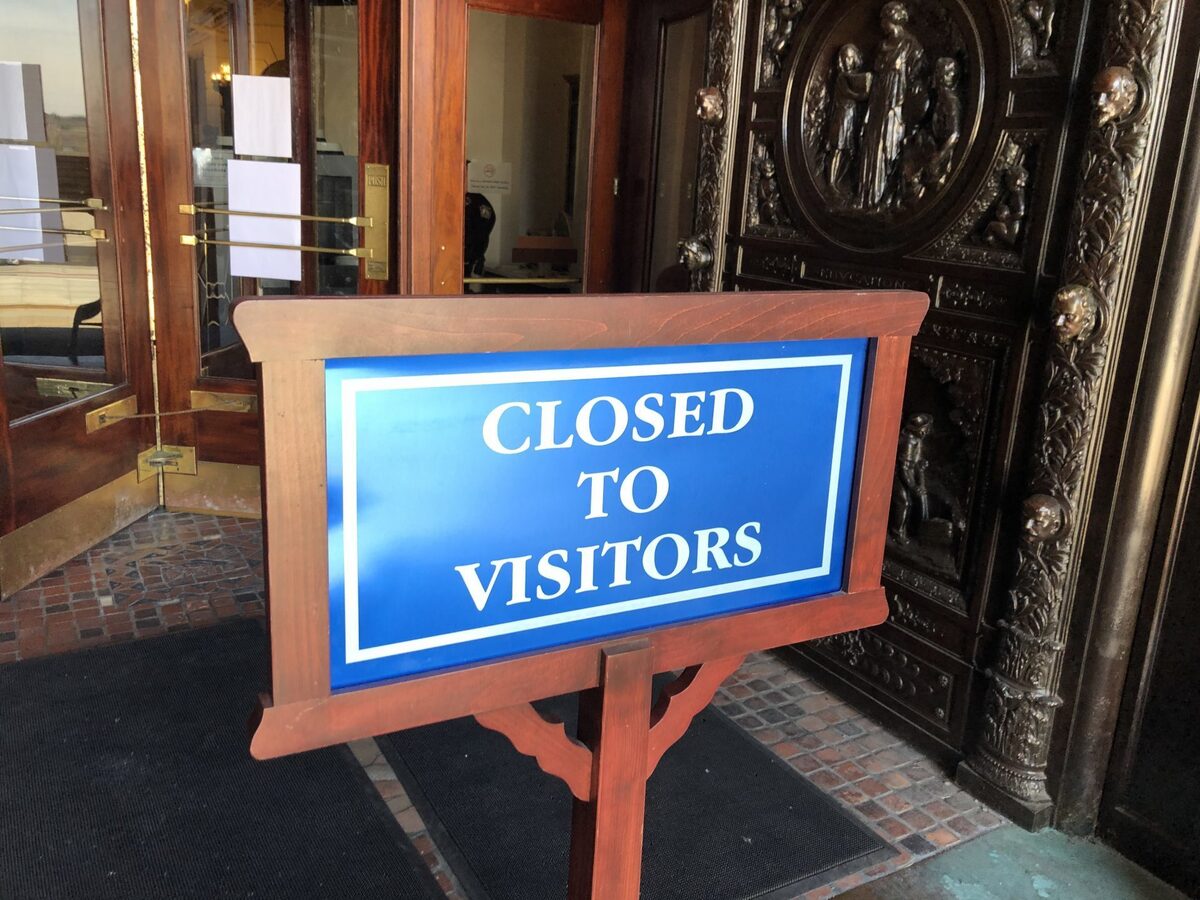
A sign outside of the Pennsylvania Capitol in Harrisburg on March 16. The Capitol was closed to the public, but lawmakers are still allowed to work there. Republican State Rep. Andrew Lewis recently tested positive for the coronavirus.

Ed Mahon/WITF/PA Post


hide caption

toggle caption

Ed Mahon/WITF/PA Post

A sign outside of the Pennsylvania Capitol in Harrisburg on March 16. The Capitol was closed to the public, but lawmakers are still allowed to work there. Republican State Rep. Andrew Lewis recently tested positive for the coronavirus.

Ed Mahon/WITF/PA Post

Even though the Pennsylvania House approved rules changes in March to allow nearly all members to vote remotely, some lawmakers have returned to the Capitol in Harrisburg to conduct business.

One of them, Republican state Rep. Andrew Lewis, said Wednesday that he was tested for the coronavirus on May 18 and his test came back positive on May 20. He says his last day working in the state Capitol was May 14.

The announcement raised questions about how many other lawmakers were exposed to the coronavirus, whether they were tested and who was notified about a potential risk.

Some Democratic lawmakers wrote on Twitter that they weren’t notified about Lewis’s case until Wednesday, a week after he got his test results back. In a statement, Democratic Leader Frank Dermody criticized House Republicans for not sharing the information more broadly.

“What makes this situation even more galling is that some House members, a vocal few, have attempted to make a virtue out of not wearing a mask when in close proximity to others,” Dermody said.

“…This attitude shows a fundamental lack of respect for fellow lawmakers, our staff and our families back home. On their behalf, we are demanding more answers about this than we’ve received thus far.”

Later Wednesday evening, a video posted to Facebook by state Rep. Brian Sims made its way around social media and state Rep. Kevin Boyle called on Attorney General Josh Shapiro to investigate.

In his statement, Lewis said he experienced mild symptoms, a fever that lasted about 24 hours, and a brief cough. He said he has recovered and completed a quarantine period, which he implied began when he was exposed to the coronavirus and not when he was diagnosed with it.

In a video message on Wednesday, Lewis said he wore a mask and didn’t shake any hands on May 14 — which he said was his last day in the Capitol.

“It’s pretty much a ghost town at the Capitol right now — the cafeteria’s closed — so I actually only interacted with a handful of folks, like maybe four or five people,” Lewis said in a Facebook livestream video.

Lewis said two state lawmakers who sit near him were both notified, as were others he had contact with on May 14.

During the coronavirus pandemic, Republican lawmakers, who control the Pennsylvania House and Senate, have tried to push Democratic Gov. Tom Wolf to allow more businesses to reopen. Wolf on May 19 vetoed a bill that would have required him to allow car dealers, barbers, hairdressers, messenger services, pet groomers and manufacturing operations to open statewide.


Source link

Coronavirus updates LIVE: Global COVID-19 cases top 5.9 million as Australian death toll stands at 103

If you suspect you or a family member has coronavirus you should call (not visit) your GP or ring the national Coronavirus Health Information Hotline on 1800 020 080.

Source by [author_name]

Your Friday Briefing

0

Beijing will be hashing out the specifics of the legislation in the coming weeks, and the final ruling will help determine the fate of a city that has been a link between China and the West for decades.

Early signals from the Chinese authorities point to a crackdown once the law takes effect, which is expected by September.

What it means: Under the new legislation, activist groups could be banned. Courts could impose long jail sentences for national security violations. China’s feared security agencies could operate openly in the city. And civil liberties, at the core of Hong Kong’s society, might not last.

Analysis: Beijing is “now willing to risk permanent harm to one of the motors of its four-decade economic expansion in order to make sure that its authority over Hong Kong will not be questioned,” our correspondent Keith Bradsher explained.

Coronavirus infections are spreading at an alarming rate on far-flung islands of the world’s fourth-most-populous country, and it could get worse soon. After hundreds of thousands of Indonesians gathered for Ramadan over the past weeks, some experts fear a big surge in cases.

So far, Indonesia has counted on its sprawling archipelago and young population to slow the spread. But the number of cases is rising, and could be higher than what the country’s limited testing shows. Young people are dying at alarming rates.

As hospitals struggle, experts say a full-blown outbreak like those in Europe and the U.S. would be devastating.

Case study: A random sampling of 11,555 people in Surabaya, the country’s second-largest city, found last week that 10 percent of those tested had antibodies for the coronavirus. It could be an alarming glimpse at runaway transmission.

Details: In early May, Indonesia had recorded fewer than 12,000 cases and around 865 deaths. By Thursday, the number had increased to 24,538 confirmed cases and 1,496 deaths.

Twenty-eight North Koreans and five Chinese nationals have been charged in the scheme.

The charges are an acknowledgment that the United States has been unable to stop North Korea from pushing ahead with its nuclear weapons program, through economic sanctions and through President Trump’s attempts to forge a rapport with North Korea’s leader, Kim Jong-un.

Like most Europeans, our reporter Patrick Kingsley was used to traveling freely across borders in the European Union. But as he recently crossed the Czech-German border, police officers stopped and searched his car and suitcase. It was “a mildly inconvenient episode,” but it also showed “how haphazard and disorientating life in Europe has become.”

Minneapolis protests: Police officers fired tear gas and rubber bullets across South Minneapolis overnight Wednesday and into Thursday as people set buildings on fire and looted stores days after an African-American man died in police custody. The Justice Department said it was making the investigation of his death a priority.

English Premier League: The most-watched sports league in the world is returning on June 17, pending a signoff from health authorities. The teams will play in stadiums without fans.

Snapshot: Above, a giant kookaburra that Farvardin Daliri built in his yard in Brisbane, Australia, to make people laugh. The replica cackles its distinctive laugh from a sound system he installed inside. “My way of art is to worship what’s in front of me,” he told our reporter.

What we’re reading: The Poem-a-Day series. “Amid the noise and clatter of the news, it’s nice to pause and sit quietly with a poem,” writes Gina Lamb, a Special Sections editor.

Cook: This flavorful grain salad gets its crunch from sliced vegetables, and its tenderness from pockets of cooked chickpeas.

Danielle Allentuck is one of 23 young journalists who spent the past year in The Times’s first fellowship group, a program aimed at developing the next generation of reporters and editors.

She worked as a reporter on the Sports desk, writing about N.F.L. draft picks, profiling Simone Biles and covering spring training. She wrote about what she learned along the way. Here’s an excerpt:

I was always the youngest person at assignments and often the only woman. I learned how to be confident and stand my ground. When I asked a fan at a Mets game if he would be willing to be interviewed, he told me he couldn’t talk to me because I was “like 12.” I promptly replied: “Geez, that’s so rude. I turned 13 last week.” I kept walking and soon found the perfect person to interview for my story.

Sometimes, other reporters tried to push me out of postgame scrums, but I learned to fight my way to the front so I could be seen and heard. Age is just a number. If you’re hired to do a job, do it.

My best stories came from observing my surroundings. At the U.S. Gymnastics Championships in Kansas City, Mo., I noticed that male gymnasts carried honey around with them. I started asking around and soon discovered they did that to improve their grip.

I spent hours watching sidearm and submarine pitchers perfect their craft at a training camp in Durham, N.C. I even got to throw a bullpen session. Back in New York, as I worked on edits for the article, I got into a lively debate about arm angles and technique with my colleagues. Soon, we were standing in the middle of the newsroom demonstrating how we would each approach the pitch.

Source link

Nurses work and care in fear of Covid – The Mail & Guardian

Xolisa Peters*, a nurse at Cape Town’s Tygerberg Hospital, says she prays more now, during the coronavirus outbreak, than she did before.

Her drive to the brown-bricked building in Bellville in Cape Town’s northern suburbs is quiet and reflective. She doesn’t know if this shift at work will make her a statistic.

Peters works in the paediatric ward but, although this is far removed from the areas of the hospital treating Covid-19 patients, she’s not unaffected by the Western Cape’s exponentially increasing number of positive cases.

Public-sector workers unions say about 150 staff members at Tygerberg have tested positive for the coronavirus to date.

“We’ve had so many nursing staff either testing positive or currently in quarantine that I can arrive at my ward this morning and then be asked to go work in another ward that has Covid patients. I have to mentally prepare myself every day,” Peters says. 

Although she’s not borne the brunt of the outbreak just yet, being on the front lines of the medical response is starting to take its toll on the 30-something nurse. “You only have so much mental energy to deal with so much every single day. I will never refuse an assignment; I will always help. But you reach a point where you just feel exhausted…

“Every day as I get in I ask: ‘Is this the day where there’s an explosion of patients with flu-like symptoms? Will there be enough staff?’ It’s very frustrating not being able to prepare your mind before work because you just don’t know what is going to happen.”

Another nurse, who only wants to be identified as Sister Asanda, works in Tygerberg’s Covid intensive care ward, the epicentre of the medical response in the Western Cape, if not South Africa. She details the mental strain of working in the hospital that is considered the ground-zero of treating coronavirus patients. 

Here doctors and nurses are forced to place patients under ventilation as a last medical resort. Many don’t survive. The staff here deal with death every day.

“It is very stressful. One of my colleagues in my ward just tested positive. It’s very difficult, but we need to support each other. We have some people who’ve become hysterical when they found out one of their colleagues is positive, especially since we’ve had staff in this hospital die already,” says the nurse, who has 16 years of service.

Of the six healthcare workers in the Western Cape who have died from Covid-19, two were working at Tygerberg hospital.

Two weeks ago, trauma nurse Anncha Kepkey died after contracting the coronavirus. Sister Asanda says she knew Kepkey since the time they studied together. On Kepkey’s social media profile, her picture is bordered by a frame that reads, “I can’t stay home, I’m an essential worker.”

“I was broken when I heard that news. She was a wonderful person. We lost someone who was hands-on and dedicated,” Asanda says.

“Nothing in our training prepared us for this. I’ve done my four-year course, I did ICU [intensive care unit] training, I did primary healthcare [and] I have experience in dealing with infectious disease, but this is not the same.

“We’ll usually have at most two patients with a serious infection, but now it’s a whole ward of the same thing,” she adds.

Sister Sylvia Makamu also works in the paediatric ward at Tygerberg hospital. She was among nurses picketing outside the hospital earlier this week with the support of trade union The National Union of Public Service and Allied Workers.

The union is calling on the hospital management to ensure that nurses are protected with personal protective equipment, and ensure health workers are tested after coming in contact with a positive case.

Makamu said she wants to be tested, although she’s not showing symptoms, because it will put her mind at ease.

“There are children who are Covid-positive in my ward. I don’t feel safe. When there are staff shortages, I get posted to wards where people are in quarantine, awaiting their test results.

“When people come back tested as positive, I don’t get to be tested if I don’t show symptoms, and that worries me,” Makamu says.

Western Cape Health authorities admit the outbreak in the province is now beginning to affect health workers. It is a pattern that has been seen around the world. As more people need medical attention, more staff are affected themselves.

“All over the world, the human resource system becomes affected and overloaded. We have to prioritise healthcare workers. Almost half of the staff in the province who have been affected have already recovered,” says Western Cape health MEC Nomafrench Mbombo.

Testing workers suspected of being Covid-positive is a priority, says Mbombo, but this is taking place at the expense of other people, who now have to wait longer.

The psychological effect of the outbreak has also been recognised. The department wants to prevent fatigue and a drop in morale.

The head of the Western Cape department of health, Keith Cloete, says the department is regularly meeting with labour unions to brief them on the plan to fight the virus.

“The anxiety is not about policy. The anxiety is people feeling tired and anxious. We [are] backing that up with support [for nurses] and we may need to bring in more psychosocial and psychological support,” Cloete says.

*Not her real name


Source link

‘Exactly where I was meant to be’ – The Mail & Guardian

FINAL WORD

It’s been a year since we moved offices. It was a big move. We had forfeited a good address in Rosebank for the eighth floor of a neglected, high-rise building in an area desperately trying to be trendy. And we couldn’t have been happier. The new address felt more like us. It unburdened us from the ego that the good address so generously fed.

It would help us move beyond some of the bad decisions we’d all been paying for, although we had no part in making them. This was just a better place for us. As a bonus, it was cheaper to rent.

The Mail & Guardian, 35 years old this year, was still mired in financial trouble. Years of predatory ownership had severely damaged the business. As the publication careened from crisis to crisis, I became its fourth editor in five years in 2016.

But I never wanted to be the editor of the Mail & Guardian.

The outer extremities of my vanity were flattered by hints that I may be offered the job. The greater part of who I am, however, did not seek it. Indeed, when I was actually offered the position one Monday morning in October 2016, my immediate response was an emphatic “No”.

“Why not?” asked the chief executive, Hoosain Karjieker, who appeared to have expected nothing but my enthusiastic acquiescence.

Not five minutes before that conversation I had smiled with relief when one of my friends in a Facebook messenger group of journalists and other low-lifes predicted a seasoned political journalist to be the new editor of the M&G. So this offer was a shock — not least about the quality of information shared in said group.

But I also had my own media startup, The Daily Vox, to take care of. Hoosain said he had a plan for that. Considering the strained finances that come with managing a media startup, my curiosity was piqued. As he rattled off numbers and statistics about how a potential partnership between my startup and the M&G could work, I was tempted.

I could do with a change. But then, I also knew better. It was hardly a secret that the M&G was struggling financially. “Why would I want to get involved knowing the M&G has no money?” I asked.

By the end of that day, however, after consulting with family, friends and mentors, I had accepted the job.

I was not even 33 years old. I was a woman. I had never worked in traditional media. I was visibly Muslim. I felt a sense of condescension and incredulity regarding my ability when my appointment was announced.

The messages of support and congratulations, however, were far more voluminous. And this gave me strength.

In a few weeks, sitting at my desk at the old office, I felt something I hadn’t felt before. I felt like this was exactly where I was meant to be. It is a feeling I now wish I had savoured longer.

The first edition of the Mail & Guardian under my stewardship coincided with the release of the report of former public protector, Thuli Madonsela about allegations of state capture by the Gupta family. The release of the report was the death knell of Jacob Zuma’s presidency.

It was Madonsela’s final report as public protector. That week at the M&G, we described her report as having “future proofed” the country.

That so many of the incidents cited in Madonsela’s reports began life on the pages of the M&G — not to forget our colleagues at the Sunday Times and City Press — was a boost for the value of investigative journalism in our democracy.

In the long list of Madonsela’s sources, the Mail & Guardian was mentioned several times. Thus, the importance of journalism — good journalism that holds power to account — was emphasised. And more than that, Madonsela’s report hinted that an era of deferred responsibility was over. There was something like hope in the air, for South African politics, for the centrality of the media in a vibrant democracy, for the Mail & Guardian.

And I took strength from that.

My big plan was to restore the pursuit of quality journalism at the centre of the Mail & Guardian. Through the years of turmoil, the M&G newsroom had been weakened and efforts to rebuild it stymied. And although I cannot complain of a lack of support for that vision, the first — and continuing — requirement of me as M&G editor was to cut costs.

At first it was easy. There were several costs that made little sense to me. But as the years wore on, and the business environment worsened, it became more difficult. Although I understood the need for a more agile newsroom, I also understood the need for good journalists to produce quality journalism.

And, although I too suffered some stops and starts, I had assembled a good team to do just that. But the media space was changing. The surest sign of that change came in 2018 when the Daily Maverick published the “Gupta Leaks” In another time, perhaps that leak would have been to the M&G.

But there would also be much to celebrate. We won awards and took on powerful elites. More than anything else, I am proud to have established a team, an “us”, forging together a disparate group of people in the singular pursuit of good journalism.

But the economy had worsened, print circulation was under pressure and digital advertising revenues were collapsing. Something — or someone — had to give.

In December 2017, the M&G was lent a new life. The Media Development Investment Fund (MDIF), a New York-based nonprofit, acquired the majority shareholding in the company. Standing beside the South African-based representatives of the MDIF, our aim was to restore M&G to its rightful place in the South African media landscape.

Throughout my time here, I have been conscious of the possibility of being the editor under whom the M&G fails. I have been equally vigilant about the prospect of being the editor under whom the M&G records a decline in quality. My job then was to somehow balance the needs of the news business with the need for people to do good journalism.

And my experience is not unique.

It is the experience of many other newsroom leaders around the world — the need to keep costs down, while producing an excellent legacy product and still meeting the needs of readers’ changing behaviour through digital products.

It was a challenge I relished. For one, I thought my experience of running a digital news startup would allow me to rapidly turn around tired workflows and decrepit digital infrastructure. Some changes were easy to make; others, more fraught.

I was the person tasked with making unpleasant decisions that severely affected the reality of the people with whom I worked; people who I had come to love. In the meanwhile, I also worked with a board of directors who were growing more anxious about the sustainability of the business.

As I pack up the last of my things from the office, I know that the transformative potential of good journalism has not deserted the people who bring the M&G to life every day.

And indeed, if the pandemic never happened I may have been writing a very different farewell. 

At the end of this month, I will no longer be leading the M&G. There is a lot that is uncertain in the world right now. But one thing is certain: the M&G remains one of the most important sources of news in Africa. And it will continue to be so.

Last week, as we rang the bell at the end of the print production cycle of another edition of the M&G, I looked across the newsroom. Our view of the urban forest of Jo’burg’s northern suburbs still leaves me in awe.

In the newsroom the desks are still piled with court papers, newspapers, documents and menus from nearby restaurants. The glinting embers of the dying day flooded through the large windows.

Outside, the roads were empty. South Africa was still shut down. Inside, the chairs too were mostly empty — as they are likely to be for some time yet. Watching the darkness flood over the sky, I stood, alone, and smiled.



Source link