Hello and welcome to our live coverage of the coronavirus pandemic for Monday, May 25, 2020.
Latika Bourke here, taking you through developments overnight.
The global death toll from coronavirus has passed 341,000. There are more than 5.3 million known cases of infection but more than 2.1 million people have recovered, according to the Johns Hopkins University tally.
In Australia, the death toll stands at 102 and there have been a total of 7109 cases, with 4 new cases of infection detected on Sunday, taking the total of number of people how have recovered from the virus to 6506.
The ACT, South Australia, Northern Territory, Western Australia and Tasmania have not reported a new case of coronavirus for more than a week.
The NSW government said beauty and nail salons, zoos, reptile parks and aquariums can re-open in June while schools reopen on Monday
Get our Coronavirus Update newsletter for the day’s crucial developments at a glance, the numbers you need to know and what our readers are saying. Sign up to The Sydney Morning Herald’s newsletter here and The Age’shere.
If you suspect you or a family member has coronavirus you should call (not visit) your GP or ring the national Coronavirus Health Information Hotline on 1800 020 080.
German Health Minister Jens Spahn | Filip Singer/Pool via EPA-EFE
Jens Spahn says the US should wait until after the pandemic before considering reforms though.
Donald Trump “does have a point” about the need to change the World Health Organization, said German Health Minister Jens Spahn, but he urged the U.S. not to leave the body and to wait until after the coronavirus crisis to consider reforms.
Last week, the U.S. president threatened to end funding to the WHO and pull out of it altogether, unless it could demonstrate its independence from China.
Without mentioning China, Spahn told the Financial Times that the U.S. “does have a point — the WHO needs to reform its governance and accountability.”
“We need to figure out exactly where the money goes,†he added.
But Spahn said now was not the right time to undermine the global health body. “In the middle of a crisis, when you’re putting out fires, you can’t talk about reforming the fire brigade,†Spahn said. “First, we have to deal with the crisis, and only then talk about the WHO.”
U.S. contributions to the WHO are critical said Spahn, adding that he would be “very sorry†to see the country leave.
“Of course the U.S., Germany, Europe — we can do a lot on our own, but there are a lot of countries in the world that can’t,†the German politician said. “They need support and they should get it. If Ebola breaks out in another part of the world then we’ll no longer be able to control.”
A Missouri hairstylist who had COVID-19 symptoms and tested positive for the disease served 84 clients over eight days earlier this month, a county health department said Friday.
On Saturday, the Springfield-Greene County Health Department announced that a second hairstylist at the salon tested positive for COVID-19. The person reportedly worked five days while experiencing mild symptoms, potentially exposing 56 clients to the virus.
With the second confirmed case, the total number of clients who were potentially exposed to the virus at the salon is 140.
The second hairstylist tested positive for COVID-19 only after they were alerted by the health department of possible exposure at their workplace, a Great Clips location on South Glenstone Avenue in central Springfield.
The health department said it would notify and offer testing to the 140 clients who have been potentially exposed, as well as at least six other coworkers. These individuals do not need to self-quarantine unless symptoms develop.
The hairstylists and their clients were wearing face coverings, which could potentially limit the exposure, according to the health department.
The first stylist also visited a gym several times while infectious, as well as a Dairy Queen and Walmart, the health department said.Â
Great Clips, a budget hair salon chain headquartered in Minneapolis, said in a statement that its central Springfield location would be closed while it undergoes thorough sanitizing and deep cleaning, The Associated Press reported.
Identifying those who had come into contact with the hairstylists was possible in these cases thanks to the salon’s impeccable records, Clay Goddard, director of the Springfield-Greene County Health Department, said during a news conference. Still, more incidents like this could overwhelm the department’s capacity to identify the origin of infections.
“I’m going to be honest with you: We can’t have many more of these,†Goddard said. “We can’t make this a regular habit or our capabilities as a community will be strained.â€
There have been more than 11,000 confirmed cases of coronavirus in Missouri and at least 685 deaths. Gov. Mike Parson (R) allowed the state’s stay-at-home order to expire on May 3.Â
All businesses in Missouri outside of St. Louis County, including movie theaters and concert venues, were allowed to reopen beginning May 4 as long as they implemented certain social distancing measures. St. Louis County and the City of St. Louis began to gradually ease coronavirus restrictions last week.
A HuffPost Guide To Coronavirus
Calling all HuffPost superfans!
Sign up for membership to become a founding member and help shape HuffPost’s next chapter
A cyclist has died after being struck by a car in Melbourne’s southeast, with the driver failing to stop and help her.
The 60-year-old Mentone woman was hit on Beach Road at Beaumaris about 5.25pm on Sunday, by a Holden Commodore.
The driver struck the cyclist from behind, then left the scene and the car was later located at Waller Court in Cheltenham.
A cyclist has been killed in a hit-run in Melbourne this evening. (9News)
9News reporter Eliza Rugg said the woman was “doing all the right things”.
“She had reflective gear on, she had lights on, she was riding in the bike lane.”
Police have spoken to two women who were in the vehicle but have yet to find the driver. They say they know the man’s identity, and are urging him to come forward and hand himself in.
“We know who this man is, that’s driving this car,” Victoria Police Detective Sergeant Mark Amos told 9News.
“My advice to him is simple: turn up at a police station, and do it now.”
Anyone who may have witnessed the incident or have dashcam footage of it has been urged to contact Crime Stoppers on 1800 333 000.
LONDON — Boris Johnson has a choice: to keep his chief adviser or to maintain the credibility of the U.K. government’s lockdown rules.
That’s the message from a growing number of Tory MPs who are feeling the backlash from their constituents over the alleged multiple breaches of coronavirus lockdown rules by Dominic Cummings, the strategic guru who masterminded the Brexit campaign and Johnson’s path to a thumping election victory.
Two days after the Guardian and Mirror reported that Cummings had driven 250 miles from London to stay at a property next to his parents’ house in Durham while his wife had coronavirus symptoms, the story was still dominating front pages and the morning political shows on Sunday. These included new claims that Cummings had been spotted 30 miles from his parents’ house on Easter day and in Durham on April 19, allegedly on a separate trip up from London.
Tory backbenchers are highly attuned to constituent anger over any suggestion that there is one rule for those in power and another for everyone else. “Cummings must go before he does any more harm,†prominent Brexiteer MP Steve Baker told Sky News’ Sophy Ridge on Sunday. “If he doesn’t resign, we’ll just keep burning through Boris’ political capital at a rate we can ill afford in the midst of this crisis.â€
Downing Street and senior ministers have rallied to Cummings’ defense and the adviser himself insists that he acted “reasonably and legally†because he was acting in the interests of his four-year-old son. But former Tory Immigration Minister Caroline Nokes tweeted there could not be “wriggle room†for some people when it comes to lockdown restrictions, and that she had made her views clear to her whip.
According to a YouGov snap poll, 68 percent of respondents said they thought Cummings had broken the lockdown rules.
“My inbox is rammed with very angry constituents and I do not blame them. They have made difficult sacrifices over the course of the last 9 weeks,†she wrote.
Other Conservative MPs have publicly joined Baker’s call, including Simon Hoare, Roger Gale, Craig Whittaker, Peter Bone and Damian Collins, with the latter saying Cummings has a “track record of believing that the rules don’t apply to him and treating the scrutiny that should come to anyone in a position of authority with contempt.â€
According to a YouGov snap poll, 68 percent of respondents said they thought Cummings had broken the lockdown rules, compared to 18 percent who said he had not. Fifty-two percent said they thought he should resign. Meanwhile, an online petition calling for Cummings to be sacked had collected more than 50,000 signatures on Sunday.
This is bad news for Johnson, who is due to face the House of Commons’ liaison committee made up of senior MPs on Wednesday and will certainly be quizzed on why he has stuck by his adviser despite the apparent breaches of the rules.
Fresh allegations ‘completely untrue’
Transport Secretary Grant Shapps toured the TV studios Sunday to deny the latest allegations from the Observer and Sunday Mirror newspapers, telling the BBC’s Andrew Marr that Cummings would not resign.
“You’re right, everyone’s been making huge sacrifices … the key thing is not to keep moving around but we’ve never told people specifically where they have to locate themselves,†he said, adding that “Mr. Cummings decided that the best way to provide that security was to be in a location where the sister and the niece could drop food off on the doorstep.â€
He also said Cummings had not returned to Durham afterward for a second time. “When he came back to London, which was on 14th April, he has remained in London since and hasn’t been back to Durham, so there are lots of things being said here which are completely untrue,†he told Sky’s Ridge.
But he conceded he did not know whether Cummings had stopped during his 250-mile journey up to Durham — potentially infecting other people en route. And asked about the alleged witness sighting of Cummings in Barnard Castle on Easter Day, 30 miles from Durham, Shapps told Marr, “I don’t know about whether those reports are true or false.â€
Shapps conceded that Cummings’ father had spoken to police — contrary to what the transport secretary had said at a press conference on Saturday. But he said it was the police who had been contacted by Cummings’ father, not the other way round.
Labour’s Shadow Home Secretary Nick Thomas-Symonds said there should be an urgent investigation by the Cabinet Office and Johnson should take Sunday’s daily government press conference to provide answers. Labour, the Liberal Democrats and the Scottish National Party wrote last night to Cabinet Secretary Mark Sedwill, calling for an urgent inquiry.
Thomas-Symonds told Marr show that “the allegations we’ve seen are extraordinarily serious and they do need to be dealt with.†He urged Johnson to chair the daily press conference Sunday to answer questions directly.
Brazil’s Supreme Court released a video of President Jair Bolsonaro meeting with members of his cabinet last month. Bolsonaro can be heard swearing several times on the nearly 2-hour long video, which is part of an inquiry into allegations he sought to interfere with federal police investigations. CNN’s Nick Paton Walsh reports.
A man has died after a suspected drowning on the NSW South Coast.
Emergency services were called to Long Beach, near Batemans Bay, about 12.30pm on Sunday after a member of the public found an empty kayak and notified police, NSW Police said in a statement on Sunday.
Police found a body in the water and an officer retrieved it.
The man has not been formally identified but is believed to be 43 years old.
An investigation has begun and a report will be prepared for the coroner.
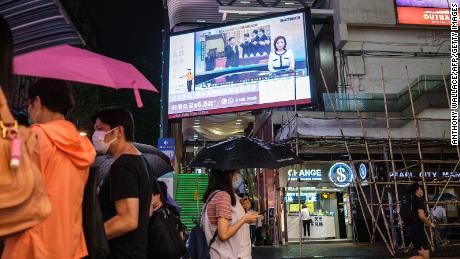
Police fired tear gas at the crowds less than an hour after the start of the march, which did not receive official authorization and went against coronavirus social distancing restrictions, which ban groups of more than eight people meeting. An online stream showed protesters throwing objects at police.
Protesters had begun gathering around midday in Causeway Bay, a busy shopping district, despite a heavy police presence across Hong Kong Island. Attempts to claim the march was a permitted “health talk” were unsuccessful, and police quickly declared the protest illegal and ordered people to disperse.
Several thousand people marched nevertheless, chanting slogans which became a familiar refrain in the city during the over six months of anti-government unrest, including “Liberate Hong Kong, revolution of our times.”
Others chanted “Hong Kong independence, the only way out,” and others flew blue, pro-independence flags. Such activity could likely be illegal under the proposed security law. Beijing has often expressed outrage over separatist sentiment in the city, which remains a niche issue but gained influence during last year’s unrest.
Asked if she was worried about the potential repercussions of chanting such slogans, Macy Wong, 26, said that she was comfortable doing so, as others were doing the same.
“Independence is Hong Kong’s long-term goal,” Wong said. “Maybe it’s not feasible in the near future, but that’s ultimately what we want.”
Anti-sedition law
China announced Thursday that it plans to introduce a new national security law in Hong Kong — bypassing the city’s legislature — which is expected to ban sedition, secession and subversion against Beijing. It will also enable mainland Chinese national security agencies to operate in the city for the first time.
The announcement sparked immediate outcry from opposition lawmakers in Hong Kong, human rights groups and multiple international governments.
It also sent chills through the city’s financial markets with Hong Kong’s benchmark Hang Seng Index plummeting more than 5% on Friday, its worst one-day percentage drop since July 2015.
Chinese Foreign Minister Wang Yi said on Sunday that Beijing must institute the law in Hong Kong without delay.
Speaking to reporters during the National’s People’s Congress, Wang said it is the role of China’s central government to create a safeguard and enforcement mechanism for national security.
“We must get it done without the slightest delay,” Wang said.
Wang said the law, which bypasses the Hong Kong legislature, would create more stability and confidence in the Special Administrative Region and provide a better environment for security.
Beijing’s move implies much greater intervention in the city, which has largely been allowed to manage its own affairs since the former British colony became a semi-autonomous region of China more than 20 years ago.
“It is the end of ‘one country, two systems’,” said Dennis Kwok, a pro-democracy lawmaker, referring to the principle by which Hong Kong has retained limited democracy and civil liberties since coming under Chinese control. “(They are) completely destroying Hong Kong.”
The move is likely to fuel further anger and protests in the city, which was rocked by over six months of increasingly violent anti-government unrest last year.
Those protests began over proposed law that would allow for extradition to mainland China, but expanded to include calls for an independent inquiry into police brutality and greater democracy.
The legislation, expected to be passed by china’s National People’s Congress (NPC) later this month, is set to be introduced in Hong Kong through a rarely used constitutional method that will bypass Hong Kong’s legislature.
The law will have drastic effects on large swathes of Hong Kong society, from the city’s political sphere to media, education and international business.
Chinese officials and state media defended the law as vital to protecting national security in the wake of last year’s protests and a 17-year failure by the Hong Kong government to pass similar legislation, since the last effort was met with mass protests in 2003.
“National security is the bedrock underpinning a country’s stability. Safeguarding national security serves the fundamental interests of all Chinese people, including our HK compatriots,” NPC spokesman Zhang Yesui told a news conference in Beijing on Thursday.
Biggest blow since handover
Hong Kong has always prided itself on following the rule of law, with an independent judiciary and civil liberties far beyond what is allowed across the border in mainland China.
These rights are enshrined within the Basic Law — the city’s de facto constitution — and guaranteed (in theory) by an agreement between China and the United Kingdom when Hong Kong was handed over to Chinese rule in 1997. Hong Kong, unlike China, is also party to international treaties guaranteeing various civil liberties.
The new law challenges all of this. By criminalizing such a broad swath of ill-defined acts, it could give the authorities leeway to go after the city’s opposition as they see fit.
In China, sweeping national security laws have been used to target human rights activists, lawyers, journalists and pro-democracy campaigners. Nobel Peace Prize laureate Liu Xiaobo, who died in 2017 after more than a decade behind bars, was convicted of “inciting subversion of state power.”
US Secretary of State Mike Pompeo condemned the proposed national security law, warning that the passage of the legislation would be a “death knell” for Hong Kong’s autonomy.
“The United States strongly urges Beijing to reconsider its disastrous proposal, abide by its international obligations, and respect Hong Kong’s high degree of autonomy, democratic institutions, and civil liberties, which are key to preserving its special status under US law,” he said, adding that the US stands “with the people of Hong Kong.”
CNN’s Sarah Faidell, Chermaine Lee and Alexander Lin contributed reporting.
In a normal year, more than 4 million people flock to Yellowstone National Park, half of them during the summer months. They fill visitor centers, gift shops and lodges, which are staffed by thousands of workers who come from all over the world and live within the park. And they pack boardwalks to gaze at Old Faithful, one of the world’s largest predictable erupting geysers, and Grand Prismatic, a widely recognizable neon blue, yellow and orange hot spring.
America’s first national park features more than 1,000 miles of hiking trails and some 300 backcountry campsites, but it is those magnificent geological features that draw most visitors, creating bottlenecks that can be an annoyance in peak season. But this year, as parks open back up amid a still-unfolding pandemic, they present serious risks.
“How do we successfully manage 11,000 people on a boardwalk at Old Faithful every day?†Cameron Sholly, Yellowstone’s superintendent, asked during an April 21 conference call. At that point, it was a hypothetical. This week, Yellowstone partially reopened for the first time since March. Pictures quickly surfaced of crowds of out-of-state visitors gathered in close proximity. Memorial Day weekend is typically the start to summer, which means it will only get tougher. Â
Mike Keller, general manager of Yellowstone National Park Lodges, estimated only 10 to 15 of the approximately 140 visitors he observed at Old Faithful at one point on Thursday morning were wearing protective masks. The cold and rain kept bigger crowds at bay that day, but the three-day holiday weekend is expected to draw scores of visitors to Yellowstone and other national parks.
It’s the kind of situation that advocacy groups like the National Parks Conservation Association hoped to avoid, urging the Trump administration to close parks and not reopen them until it could guarantee the safety of visitors and staff.Â
“We get it, people feel like they want to be outside,†said Kristen Brengel, NPCA’s vice president of government affairs. “But we want to make sure they are safe.†The reality, she added, is that national parks draw big crowds and many sites have staffing shortages because the pandemic kept them from hiring seasonal rangers. That means fewer people to manage and disperse large crowds.
“I just want to make sure everyone knows what they are getting themselves into,†she said.Â
Slow To Close, Quick To Reopen
George Frey via Getty Images
Visitors leave the Zion Lodge parking lot to go on hike in Zion National Park on May 15 in Springdale, Utah. Zion National Park had a limited reopening Wednesday as part of its reopening plan after it was closed due to the COVID-19 pandemic.
The Interior Department, the parent agency of the National Park Service, has faced backlash for its handling of parks during the COVID-19 crisis, much as it did during the 2018-19 government shutdown. In early March, as cases of COVID-19 began to balloon in the U.S. and private businesses were forced to close their doors, the agency resisted shuttering national parks and monuments. Interior Secretary David Bernhardt joined Trump in downplaying the coronavirus threat, telling staff in a pair of memos that “this virus is NOT currently spreading widely in the United States†and “Americans don’t need to change their day-to-day lives but should stay informed and practice good hygiene.â€Â
It wasn’t until mid-March that Interior gave park superintendents the authority to modify and suspend operations as they saw necessary to address COVID-19. Local officials responded by quickly closing dozens of sites around the country, including Yellowstone, Grand Teton and Yosemite. For the majority of parks that remained open, many with limited operations, NPS waived entrance fees ― a move it said supported social distancing outdoors but that sent visitors flocking to iconic parks like Grand Canyon and Zion, forcing additional closures.
Late last month, as the U.S. death toll from COVID-19 approached 50,000, Trump signaled that Americans would soon be able to enjoy America’s parks again. “We will have them open quickly,†he said during an April 22 Earth Day speech.Â
In recent weeks, Bernhardt has toured a number of park sites as they’ve ramped up operations and taken to Twitter and radio interviews to assure the public that the administration is working rapidly to expand access.Â
— Secretary David Bernhardt (@SecBernhardt) May 13, 2020
Yet it wasn’t until this week, days before the busy Memorial Day weekend, that park managers received guidance from Interior on resuming operations, managing crowds and promoting social distancing, according to internal documents HuffPost obtained. Those guidelines indicate parks will rely heavily on signage at entry points and heavy traffic sites about the importance of complying with social distancing guidelines. Parks employees should encourage visitors to adhere to those recommendations, but are not authorized to enforce wearing masks, the guidance says.Â
One NPS ranger who requested anonymity to speak candidly told HuffPost he feels the administration is moving dangerously fast and is “extremely worried†that parks could become ground zero for a surge in new cases. The park he works at has a small stockpile of personal protective equipment, but he estimated it would run out in two weeks once the site fully reopens.
“I feel like I’m going to get it eventually,†he said of COVID-19. “I just don’t feel there is any way for me to avoid it.â€Â
William Campbell via Getty Images
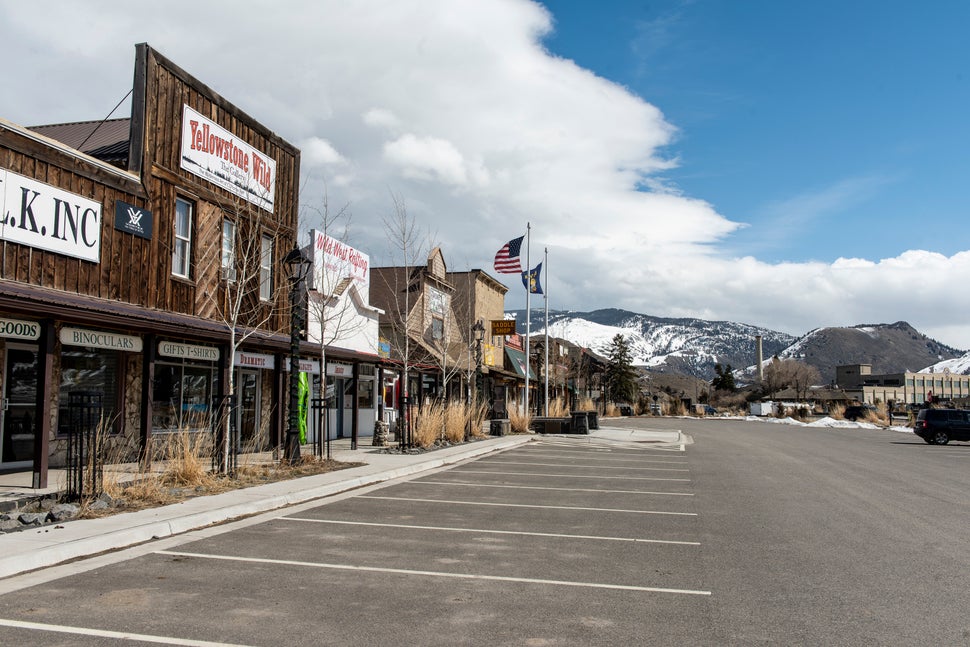
Closed tourist shops in Garidiner, Montana, at the north entrance to Yellowstone on March 24.
As a law enforcement officer, the ranger is concerned about visitors refusing to wear face coverings and practice social distancing, and that employ encouraging people to follow health and safety guidelines will be met with hostility.
“I don’t want to become the mask police,†he said.
And if there is an outbreak of cases at parks or visitor numbers become unmanageable, he’s not confident that local officials will have the leeway to shut things down without Interior intervening. One case of COVID-19 could force a park’s entire law enforcement arm into quarantine.Â
“It seems to me like the openings and closings of parks is based on politics and not the safety of employees and visitors,†the ranger said.
Interior says its phased reopening will prioritize health and safety and be guided by states’ plans to begin reopening businesses and lift stay-at-home orders. But health experts have warned that many states have not met benchmarks that would allow them to safely ease restrictions. Earlier this month, an influential model nearly doubled its projected U.S. death toll from COVID-19, from 74,000 by early August to more than 134,000, in response to states relaxing social distancing requirements. As of Friday, the number of confirmed deaths in the U.S. from COVID-19 was over 95,000.
In a Friday letter, House Natural Resources Chairman Raúl M. Grijalva (D-Ariz.) urged Interior and NPS “to exercise extreme caution†in reopening sites and requested documents related to the agencies’ plans.
“I recognize the benefits of reopening national parks and other public land sites when appropriate,†Grijalva wrote. “But rushing to reopen national parks prematurely and in the absence of stringent safeguards threatens public health and puts lives in jeopardy.â€
Interior and NPS did not respond to HuffPost’s questions Friday about its phased reopening of parks.
‘We Will Ask Them To Leave’
Along with NPS staff, the parks’ seasonal contractors continue to face enormous uncertainty.Â
Yellowstone National Park Lodges typically has more than 2,200 rooms available for tourism during summer months, but it had to reduce that to 550 in order to properly adhere to social distancing guidelines. That has meant a workforce reduction of approximately 66%.
The company that runs the lodges notes on its website that seasonal workers are expected to observe community safety standards. Gatherings in common areas are prohibited. Residences are to be cleaned and disinfected multiple times a day. Hiking is only allowed on certain trails.
“Everyone has a social responsibility to ensure that they’re taking actions and behaviors to guarantee their safety and the safety of others,†Keller said. “That’s why as a company, we’re saying we’re wearing masks.â€
Lodge and restaurant buildings will also have screens placed at checkout stations, animal prints six feet apart where lines are expected to form and elaborate signage reminding guests to partake in social distancing, Keller explained. The lodge system manager said he isn’t surprised to see park visitors congregating in large groups at popular observation sites, as the public response has been the same in most newly reopened tourist attractions.
“At the same time, if customers come into our indoor areas and they’re not social distancing or behaving responsibly, we will ask them to leave the building or change their behavior so they’re in compliance with what’s expected of them,†Keller said.Â
The few employees who live in the park throughout the offseason are already experiencing the new normal of distancing in employee residences. Several workers left the park when it closed, but some had no choice as Yellowstone is their primary or only residence.Â
Davon Fulton, a sous chef from Brooklyn, New York, who is in his fourth season working in a Yellowstone lodge kitchen, remained in employee housing for about two months even though he had been furloughed. He didn’t consider leaving the park.Â
“They allowed us to stay in the dorm and fed us for free until they reopened. I didn’t want to go back to New York,†Fulton explained. “I’m not really worried about coronavirus. I’m just happy to get back to work.â€Â
Several lodges will remain shut entirely due to social distancing limitations that arise with shared bathrooms and common areas, and most employee housing has been deemed unusable for the same reason. In a normal season, there may be up to three employees in bunk beds sleeping in one room.
The social experience that comes with dorm living is usually a highlight for park workers ― “summer camp for adults,†as some put it. This year will look a lot different. For now, housing is limited to one resident per room. The employee pub isn’t open, the dining room is now takeout only and group recreation activities, from kickball tournaments to talent shows, have all been canceled.
Ravaged By COVID-19, Navajo Nation Braces For Park Tourism
ASSOCIATED PRESS/Matt York
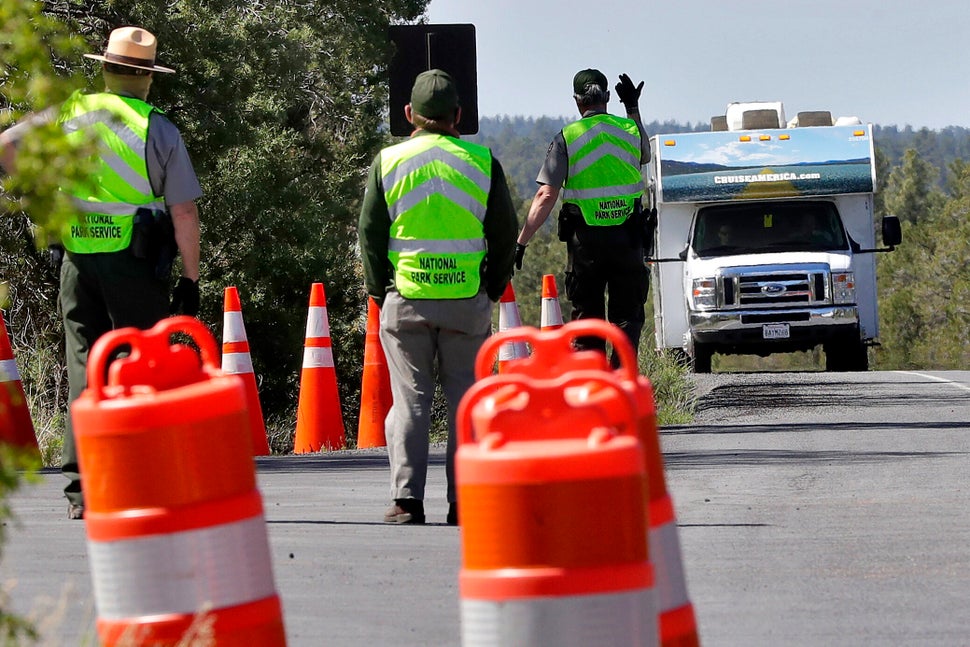
U.S. Park Rangers wave through the final visitor of the day before closing the entrance to the Grand Canyon for the day on May 15. The National Park Service is using a phased approach to increase access on a park-by-park basis during the COVID-19 pandemic.
It’s not just park workers who are anxious about what reopening will look like. A number of neighboring communities, including some that depend on seasonal park recreation, have also voiced concerns about how to handle an influx of tourists.
In Arizona, Grand Canyon National Park, one of the most-visited parks in the U.S. with nearly 6 million visitors in 2019, reopened in a limited capacity last weekend. It will partially open again Memorial Day weekend. The Navajo Nation, the largest and most populous American Indian reservation, borders the park on the east, and has been a hot spot for the virus, with more than 4,200 confirmed cases on the reservation and at least 100 deaths.Â
Last week, the reservation surpassed all 50 U.S. states’ in its per capita infection rate. This is in part due to Navajo Nation’s impressive testing apparatus, which has conducted tests on over 27,000 residents, or 13.2% of residents. By comparison, New York state has reported testing about 5.2% of its population.
Navajo officials worry tourists driving through the reservation to get to the Grand Canyon could unintentionally spread the virus or contract it along the way. Though Grand Canyon National Park’s website advises visitors traveling through Navajo Nation to wear masks and abide by social distancing guidelines, it does not mention the reservation’s stay-at-home order and weekend curfews.
Navajo President Jonathan Nez said local police saw an influx of visitors traveling through the reservation last weekend.Â
“If you disobey the curfew, if you disobey the public health orders, you will be held accountable,†he told HuffPost. Navajo police may hand out $1,000 citations to those flouting the coronavirus orders, he added.
Nez said he called on Interior Secretary David Bernhardt during a meeting Wednesday to keep the park closed until the infection rate decreases more dramatically. Bernhardt refused, Nez said.Â
“My assumption is he’s getting considerable pressure to open the United States of America from his boss,†Nez said, referring to President Donald Trump.
“The economy is getting hit hard,†he continued. “But for us, our focus is on the health and well-being of the Navajo Nation.â€Â
Asked about the Navajo Nation’s request, an Interior spokesperson said Bernhardt “had a productive discussion with President Nez on several important matters, and the Department will continue to collaborate with him on many issues, including Grand Canyon National Park.â€Â
While it will likely be months before the national park system as a whole returns to any semblance of normalcy, additional parks are slated to start welcoming back visitors in the coming weeks. Rocky Mountain National Park in Colorado is set to phased reopening on May 27, while Arches and Canyonlands national parks in Utah will begin May 29. Others, like Glacier National Park in Montana and Death Valley National Park in California, have not set reopening dates.
Keller, 50, has lived and worked in Yellowstone ― a crown jewel of the park system ― for 35 years. He has seen it withstand catastrophic wildfires in the 1980s, the rise and fall of hotels and millions of tourists come and experience everything that the park has to offer.
“It’s a place that’s very special to me and I love being here,†he said. “The park will survive this too.â€Â
A HuffPost Guide To Coronavirus
Calling all HuffPost superfans!
Sign up for membership to become a founding member and help shape HuffPost’s next chapter
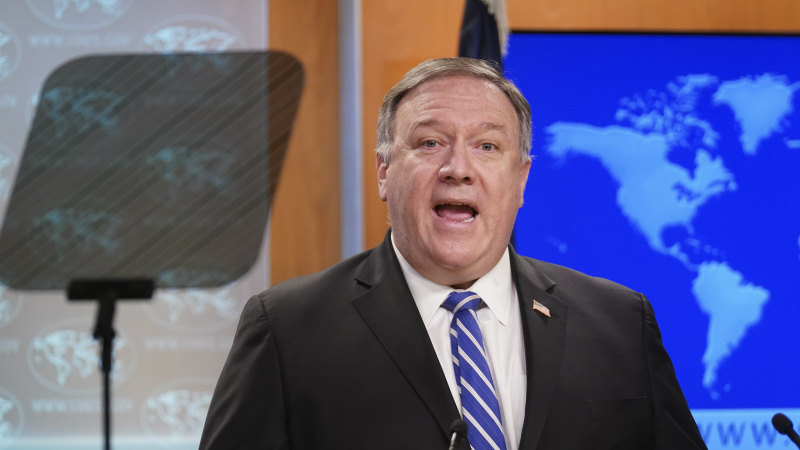
Hours after Mr Pompeo appeared in an interview warning against Victoria’s involvement in China’s backing of foreign infrastructure projects, the US government sought to clarify the remarks and insisted it had confidence in Australia’s ability to protect the security of its telecommunications.
On Sunday Mr Pompeo was asked on Sky News about whether Victoria joining the Belt and Road Initiative raised concerns about Australia and if it exposed Victorians to any threats.
Mr Pompeo said all Australians should know that “every one of those Belt and Road projects needs to be looked at incredibly closelyâ€.
US ambassador Arthur Culvahouse.Credit:Dom Lorrimer
Mr Pompeo said the US would not take any risks regarding its telecommunications infrastructure or national security with regards to its “five eyes” security partners. Australia is one of those partners.
“I don’t know the nature of those projects precisely but to the extent they have an adverse impact on our ability to protect telecommunications from our private citizens or security networks for our defence and intelligence communities we will simply disconnect,†he said.
But several hours later US ambassador to Australia Arthur Culvahouse, issued a statement saying Mr Pompeo had been asked to “address a hypothetical†and he was unfamiliar with Victoria’s Belt and Road discussions.
“We are not aware that Victoria has engaged in any concrete projects under BRI, let alone projects impinging on telecommunications networks, which we understand are a federal matter,†Mr Culvahouse said.
A Victorian government spokeswoman said the Belt and Road Initiative was about creating opportunities for Victorian businesses and local jobs.
“Telecommunications regulation is the responsibility of the Commonwealth government,†she said. “Victoria has not, and will not in the future, agree to telecommunications projects under the BRI.”
Mr Andrews restated his commitment to the employment benefits of a partnership with China, which he said was in “everybody’s interests”.
Loading
Mr Morrison, however, remained critical of the arrangement.
“We didn’t support that decision at the time they made it,†he said. “And national interest issues on foreign affairs are determined by the federal government. I respect their jurisdiction when it comes to the issues they’re responsible for and it’s always been the usual practice for states to respect and recognise the role of the federal government in setting foreign policy.â€
Victorian Liberal members have told The Age they want Opposition Leader Michael O’Brien to reject the deal. Despite being critical of the arrangement, Mr O’Brien refused to say whether the Victorian Coalition would ditch the deal if in power.
One senior Liberal said there was widespread opposition to Belt and Road within the party.
“Everybody wants to scrap it,†the figure said.
Mr O’Brien said the opposition would scrutinise the deal from an economics, security, employment and sovereignty point of view.
“But I can tell you everything is on the table because when it comes to protecting Victorian jobs and Victorian sovereignty I will be somebody who puts Victoria first.â€
He called on the state government to explain how Victorians benefited from the Belt and Road Initiative.
“It was supposed to be about increasing agricultural trade between Victoria and China,†he said. “Instead we’ve seen our barley farmers whacked with an 80 per cent tariff.â€
We use cookies on our website to give you the most relevant experience by remembering your preferences and repeat visits. By clicking “Accept”, you consent to the use of ALL the cookies.
This website uses cookies to improve your experience while you navigate through the website. Out of these, the cookies that are categorized as necessary are stored on your browser as they are essential for the working of basic functionalities of the website. We also use third-party cookies that help us analyze and understand how you use this website. These cookies will be stored in your browser only with your consent. You also have the option to opt-out of these cookies. But opting out of some of these cookies may affect your browsing experience.
Necessary cookies are absolutely essential for the website to function properly. These cookies ensure basic functionalities and security features of the website, anonymously.
Cookie
Duration
Description
cookielawinfo-checbox-analytics
11 months
This cookie is set by GDPR Cookie Consent plugin. The cookie is used to store the user consent for the cookies in the category "Analytics".
cookielawinfo-checbox-functional
11 months
The cookie is set by GDPR cookie consent to record the user consent for the cookies in the category "Functional".
cookielawinfo-checbox-others
11 months
This cookie is set by GDPR Cookie Consent plugin. The cookie is used to store the user consent for the cookies in the category "Other.
cookielawinfo-checkbox-necessary
11 months
This cookie is set by GDPR Cookie Consent plugin. The cookies is used to store the user consent for the cookies in the category "Necessary".
cookielawinfo-checkbox-performance
11 months
This cookie is set by GDPR Cookie Consent plugin. The cookie is used to store the user consent for the cookies in the category "Performance".
viewed_cookie_policy
11 months
The cookie is set by the GDPR Cookie Consent plugin and is used to store whether or not user has consented to the use of cookies. It does not store any personal data.
Functional cookies help to perform certain functionalities like sharing the content of the website on social media platforms, collect feedbacks, and other third-party features.
Performance cookies are used to understand and analyze the key performance indexes of the website which helps in delivering a better user experience for the visitors.
Analytical cookies are used to understand how visitors interact with the website. These cookies help provide information on metrics the number of visitors, bounce rate, traffic source, etc.
Advertisement cookies are used to provide visitors with relevant ads and marketing campaigns. These cookies track visitors across websites and collect information to provide customized ads.