UK’s coronavirus quarantine in force from June 8

0

Britain’s Home Secretary Priti Patel | Tolga Akmen/AFP via Getty Images

Travelers to Britain will be required to self-isolate for 14 days and face fines if they don’t comply.

LONDON — People arriving in the U.K. from overseas will need to self-quarantine for 14 days from June 8, Home Secretary Priti Patel said Friday.

The new measures will apply to all residents and foreign nationals, with exemptions in place for truckers and freight workers, medical professionals working on the coronavirus response, and seasonal agricultural workers, who will be permitted to self-isolate on the property where they are working.

Those moving within the U.K.’s Common Travel Area with Ireland will also be exempt.

Those who breach their quarantine in England will face £1,000 fines or potential prosecution. While the new rules apply to the whole of the U.K., Scotland, Wales and Northern Ireland will be responsible for their own enforcement.

All arriving passengers will have to fill in a form, before they arrive in the U.K., providing contact details and onward travel plans, so that they can be contacted if they, or someone they may have been in contact with, gets the virus.

The U.K.’s Border Force will be empowered to refuse entry to non-resident foreign nationals who refuse to comply. Failure to complete the “contact locator form” will be punished by a £100 fine, and public health authorities will carry out random checks in England to ensure compliance with the quarantine measures.

Anyone who cannot self-isolate at home, in a hotel, or with friends or family, will be required to stay in facilities organized by the government. Travelers are recommended to travel to their place of quarantine in personal transport, such as a car, where possible.

The U.K. measures comes as many EU countries are rethinking their quarantine requirements. Germany announced plans to loosen quarantine rules earlier this month and Italy is set to follow. France however introduced a voluntary two-week quarantine this week.

So-called “air bridges” — agreed between the U.K. and countries with a low rates of coronavirus infection where citizens are allowed to enter without quarantine — are still being considered by the government, but no such arrangements are yet in place. The overall policy, including the list of exemptions, will be reviewed every three weeks from the date the measures come into force.

“We are introducing these new measures now to keep the transmission rate down and prevent a devastating second wave,” Patel said.  “I fully expect the majority of people will do the right thing and abide by these measures. But we will take enforcement action against the minority of people who endanger the safety of others.”

The U.K.’s plan for a quarantine regime was first announced by Prime Minister Boris Johnson on May 10. Explaining the decision to introduce the measures now — as the U.K. emerges from the peak of its coronavirus epidemic — John Aston, Home Office chief scientific adviser said: “The scientific advice so far has been clear: while there has been significant community transmission of the virus within the U.K. the impact of putting in place additional border restrictions would have been negligible to the spread of the virus.

“However, the spread of the virus within the U.K. is now lessening. We have been successful in getting the reproduction number R — the average number of new people infected by one infected person — below 1. As the number of infections within the U.K. drops, we must now manage the risk of transmissions being reintroduced from elsewhere.”


Source by [author_name]

Businesses fear the worst for Hong Kong’s future

0

China announced Thursday that it plans to introduce a law in Hong Kong that is expected to ban sedition, secession and subversion against Beijing. It will also enable Chinese national security agencies to operate in the city.

Investor reaction was swift and fearful: Hong Kong’s benchmark Hang Seng Index (HSI) plummeted more than 5% on Friday, its worst one-day percentage drop since July 2015.
Beijng’s move was so stunning because it implies much greater intervention in the city, which has largely been allowed to manage its own affairs since the former British colony became a semi-autonomous region of China more than 20 years ago. Beijing intends to introduce the law on the city’s behalf, bypassing its legislature.

“Hong Kong today stands as a model of free trade, strong governance, free flow of information and efficiency,” said Robert Grieves, chairman of the American Chamber of Commerce in Hong Kong, in a statement. “No one wins if the foundation for Hong Kong’s role as a prime international business and financial center is eroded.”

A traditionally stable place to operate

Hong Kong’s political and legal freedoms, which are not available on the mainland, have given comfort to foreign companies that view the city as a stable place to operate, free of the restrictions that come with doing business in other Chinese cities like Shanghai or Shenzhen. (Many American and other Western companies already do business in the mainland, though they are often required to work with local partners. Others are still locked out of China altogether.)
The benefit also works in reverse: Chinese companies use the city as a place to raise capital and broaden their investor base, or as a launch pad for overseas expansion.
While confidence in the city was shaken during last year’s antigovernment protests, most companies ultimately chose not to abandon Hong Kong. And the city’s stock exchange had a banner year — it was the world’s top location for IPOs, beating rivals in New York and London.

Even so, Hong Kong’s status as a global business destination never quite felt secure after the protests broke out.

Top executives at its flagship airline, Cathay Pacific, resigned last summer after the carrier was swept up in controversy related to the protests that angered Beijing. And the city’s richest billionaire, Li Ka-shing, appealed for calm as the demonstrations stretched into the back half of the year.

“The road to Hell is often paved with good intentions,” Li said in August. “We need to be mindful of unintended consequences.”

Late last year, the city became entangled in escalating tensions between the United States and China after Washington passed a law in support of the protesters. The law linked Hong Kong’s special trading status with the United States to an annual review of its unique freedoms.
The status grants the city exemptions from the tariffs that the United States imposed on Chinese goods during the trade war between the two countries, for example.
In the context of the nearly $740 billion in goods and services traded in 2018 between the world’s top two economies, the city is a small player.

The United States imported nearly $17 billion in goods and services from Hong Kong in 2018, while exporting $50 billion.

But those numbers don’t tell the whole story of the US-Hong Kong relationship, and the special status offers the city much more than trade privileges.

“[It’s] a bit misleading … because the US counts trade that passes through Hong Kong to China as trade with China,” said William Reinsch, the Scholl Chair in International Business at the Center for Strategic and International Studies in Washington. “Regardless, I think the real issue is less the actual amount of trade than the signal a change in status would send about the unreliability of doing business with Hong Kong.”

A serious development

More than 1,300 US companies alone operate in the city, according to analysts at Citi, who added that the threat of revoking Hong Kong’s special status with the United States “could weigh on business confidence.”

“It remains to be seen if the US would revoke the act immediately,” they wrote in a research note on Friday. “Our economists have argued special status of [Hong Kong] is likely to stay in the near term, as both US and China have significant interests in maintaining the status quo.”

Tensions between the United States and China, though, have been ratcheting up recently as the two seek to blame each other for the coronavirus pandemic. The Trump administration last week, for example, moved to restrict the Chinese tech firm Huawei from working with US companies. Beijing could respond by blacklisting foreign companies.
Here comes the US crackdown on China stocks
US lawmakers, government agencies and stock exchanges have also recently taken steps aimed at limiting Beijing’s access to America’s vast capital markets. The State Department is now requiring American journalists working for Chinese state media in the United States to provide personal information including details of their spouses, children, and anyone else they live with.

Secretary of State Mike Pompeo said Friday that Beijing’s plan would be “a death knell” for the autonomy Hong Kong was promised. And if it went ahead, it would affect Washington’s assessment of the status of the territory.

“The United States strongly urges Beijing to reconsider its disastrous proposal, abide by its international obligations, and respect Hong Kong’s high degree of autonomy, democratic institutions, and civil liberties, which are key to preserving its special status under US law,” he said.

“This authoritarian national security plan will most certainly bring into question [Hong Kong’s] status as a global banking center,” wrote Stephen Innes, chief global markets strategist at AxiCorp, in a research note Friday. “I think this is quite serious.”

Companies that do business in Hong Kong are also concerned about what Beijing’s national security law could mean for people who work in the city, and whether it could have a chilling effect on the ability to attract foreign workers.

“A Beijing inspired national security law leaves open an interpretation of how such an act will be enforced,” said Tara Joseph, president of the American Chamber of Commerce in Hong Kong, in a statement.

The business lobby group added that the “enactment of a vaguely defined national security law will make it harder to recruit and retain top tier talent.”

Source link

Love on the Mountain Bike Trail

For a first date, they went on another mountain bike ride, in nearby Saranac Lake, N.Y., and then afterward to trivia night at a local bar. A first kiss soon followed, as did more dates and more trail rides.

“She’s got really, really beautiful eyes and a beautiful smile that lights up the area,” Mr. McNamara said.

In the spring, as a sort of stress test for their relationship, the couple piled into Mr. McNamara’s 1990 Ford Econoline and drove down the Mid-Atlantic coast to North Carolina, stopping along the way to go mountain biking.

“That’s when I definitely fell in love with him,” Ms. Voyer-McGiver said.

In summer 2018, they moved in together. Ms. Voyer-McGiver recently completed training as a registered nurse (though the traditional “pinning” ceremony was a casualty of the coronavirus pandemic) and has applied for work at a hospital in Saranac Lake. She graduated from the State College at Purchase.

“I think we kind of knew that marriage was coming down the pipeline after that,” he said.

On April 23, the two hiked to a viewpoint that they can see from their house, and were married. Mr. McGiver, the cousin, who is a Universal Life minister, officiated; his wife, Jamie West-McGiver, who is a photographer, took pictures.

After the wedding, the two did not rush home for a first pedal together as a married couple. “But there is a good chance any honeymoon of ours will involve mountain biking,” Ms. Voyer-McGiver said.

Source link

Pakistan passenger flight crashes in Karachi

0

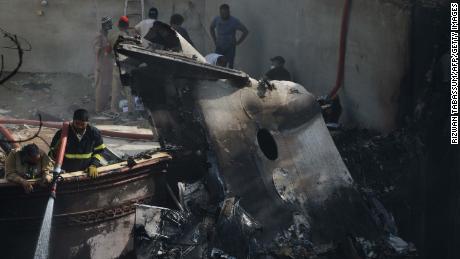
Pakistan’s Aviation Ministry said the flight from Lahore was carrying 99 passengers and 8 crew members.

The 11 bodies were taken to Jinnah Hospital, according to hospital spokesperson Seemi Jamali. It is unclear if those fatalities were victims from the ground or the plane.

A spokesperson for the provincial government of Sindh said at least two passengers on board survived the crash. “Their names are Zafar Masood & Mohd Zubair,” Murtaza Wahab said in a tweet.

Masood is the CEO of the Bank of Punjab, according to Wahab who said she had visited him at Dar Ul Sehat Hospital.

Earlier, local government officials said five survivors were taken to hospital but did not indicate if they were passengers or victims from the ground.

The airliner came down in Model Colony, a busy residential area near Jinnah International airport.

Flight PK 8303 took off from Lahore and was due to land at 2:30 p.m. local time in Karachi but went missing from the radar, Pakistan International Airlines (PIA) spokesman Abdullah Khan told CNN.

The pilot of the Airbus A320 airliner made a mayday call saying he was experiencing technical problems, Khan told CNN.

“He had been told both landing strips were available for his use but he preferred to use the go-around landing route, we are looking into the technical issue. Our prayers for the lives that have been lost,” Khan said.

An emergency response protocol has been activated, he added.

The flight was a special one to help passengers get home for the Eid holidays after the lockdown, Khan said. Pakistan started a phased easing of its nationwide Covid-19 lockdown on May 9.

Friday is the first day of a week-long Eid holiday in Pakistan to mark the end of Ramadan.

Pakistan’s Army sent helicopters to assess the damage and rescue efforts, while urban search and rescue teams are being deployed on the ground, Pakistan’s military tweeted Friday.

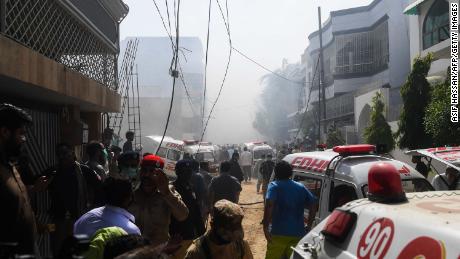
The Pakistan Red Crescent Society also said it had sent ambulances and rescue workers to the scene.

Rescue workers arrive at the site after a Pakistan International Airlines aircraft crashed at a residential area in Karachi on Friday.

Pakistan’s Prime Minister Imran Khan posted on Twitter that he was shocked and saddened by the crash. An “immediate inquiry” would be set up, he said.

Pakistan’s civil aviation authority allowed limited domestic air travel to resume Saturday after a two-month suspension imposed as part of efforts to contain the spread of the coronavirus. International flights are not expected to resume until June 1.

This is not the only crash in recent years involving a PIA aircraft. An ATR-42 twin-engine propeller plane operated by the airline came down in December 2016 near Abbottabad in Pakistan, killing all 47 people on board.

This story has been updated to correct the plane’s flight number.

CNN’s Sophia Saifi and Adeel Raja reported from Islamabad and Laura Smith-Spark wrote from London.


Source link

Coronavirus updates LIVE: Morrison government reveals JobKeeper ‘error’ as global COVID-19 cases surpass 5.1 million, Australian death toll stands at 101

“Around the world there have been a number of different apps developed – Singapore, Australia, other places, – one of the challenges that those apps have encountered is that it has to sit in the foreground of your phone and drains the battery,” he said

“That’s why the fix that Apple and Google are talking about bringing in at the beginning of June will be extremely important as a base for an effective contact tracing, or exposure notification app.

“It is our expectation that when the time comes for that to be released, we will be able to recommend strongly to Canadians a particular app that will help us manage the spread of COVID-19.”

Canada has recorded 6152 deaths from coronavirus and logged more than 81,000 infections. Trudeau said the country’s outbreak is under control and that authorities have the capacity to test around 60,000 people per day.

Source by [author_name]

In COVID-19 Britain it pays to run your washing machine on Sunday afternoon

0

Electrical demand is expected to drop by a fifth this summer in the U.K. | Frank Augstein/AFP via Getty Images

With surplus electricity putting pressure on the UK’s electrical grid, one utility is urging its customers to run appliances this weekend.

Coronavirus-related industrial slowdowns have seen electricity demand plummet throughout the world as grids struggle to handle the suddenly excessive supply of power.

In the U.K. — where electrical demand is expected to drop by a fifth this summer as shops and factories remain closed — there have been worries that the unused power could overwhelm the grid and cause blackouts. In response, operators are contemplating shutting down some renewable generation sources.

That’s going to be an even more pressing problem over the upcoming bank holiday weekend that marks the start of the summer season, when electricity consumption tends to drop.

In order to prevent grid instability, Octopus Energy, which buys power generated from renewables on the wholesale market, made its customers an usual offer this Friday — the company will pay people to use power.

“We will pay over 100,000 of our customers with smart meters to run the dishwasher, use their oven or watch TV this weekend,” Octopus CEO Greg Jackson told POLITICO. “If they were to charge an electric car, for instance, they’d make 35 pence and be able to travel 50 miles, which is great because traveling the same distance in a petrol car you’d pay about £6 to fuel up.”

The grid-based problems being experienced by the U.K. are likely to become increasingly common as power generation becomes greener.

Jackson explained that the first-of-its-kind scheme was seeking to find alternative ways to balance a sensitive power grid while also rewarding customers equipped with smart meters, which allows them to control their energy use. About 4 million smart meters have been installed in the U.K. and the goal is to have 85 percent of power customers equipped with them by 2024.

“With the smart meter technology we’re able to better manage power and empower customers to benefit from incentives available at specific hours, making the most of domestic household consumption at a moment when fewer factories and commercial surfaces are operating,” he said.

Jackson argued that if wind and solar farms were shut off due to power oversupply, that could end up spooking investors and harm future investments in Britain’s clean energy transition. “If we start wasting electrons, that transition will become more complicated.”

Julian Leslie, head of networks for the U.K.’s National Grid, said that the drop in demand caused by the pandemic had raised concerns about the stability of the grid.

While he said the electric power transmission network had “mechanisms in place to avoid emergency restrictions or system disturbances,” he added that customer-driven approaches like the one taken by Octopus could help soak up surplus power.

“As we roll out smart meters in the U.K., time of use tariffs that incentivize the use of low-carbon energy at off-peak hours could prove to be a useful tool if they’re used at a wide, predictable scale,” he said.

Depending on the success of the scheme, similar initiatives could be feasible in other energy markets that use smart meters, which would lead to a more efficient use of renewable power.

The grid-based problems being experienced by the U.K. are likely to become increasingly common as power generation becomes greener.

A study published by Imperial College London and electric utility Drax on Thursday showed that during the first three months of the year renewable energy sources provided more electricity than fossil fuels. Those findings line up with National Grid data — Leslie said there has been no coal-generated power since April 10, something that hasn’t happened since the Industrial Revolution.

Leslie said that solar and wind penetration had contributed to a “mindset shift” in Britain, where he said that after decades considering coal as a base load for power output, renewables were now being considered the base source to be “topped up.”

“There’s no reason why we as a system operator need to buy coal, and it doesn’t look like we’ll need to until the winter, when demand will likely rise again,” he said.


Source by [author_name]

Chinese trial of potential coronavirus vaccine shows positive signals

0

The authors of the report note that the results must be “interpreted cautiously” | Rodger Bosch/AFP via Getty Images

Authors warn results should be ‘interpreted cautiously.’

A trial of a potential coronavirus vaccine developed in China has indicated that it’s safe and produces virus-specific antibodies and T cells.

However, the authors warn that the results, published in the Lancet, must be “interpreted cautiously.”

“The challenges in the development of a COVID-19 vaccine are unprecedented, and the ability to trigger these immune responses does not necessarily indicate that the vaccine will protect humans from COVID-19,” said Wei Chen of the Beijing Institute of Biotechnology, who is responsible for the study.

The trial is the first human trial of a potential vaccine to be published in a peer-reviewed journal. Earlier this week, Moderna reported on positive interim data from its human trial, but these results have yet to be peer-reviewed.

The Chinese phase 1 clinical trial was carried out on 108 adults who didn’t have coronavirus. The vaccine was well tolerated, with most negative reactions being classified as mild or moderate. Participants either received a low, middle or high dose of the vaccine.

After 28 days, half of those receiving the low and middle dose had neutralizing antibodies, compared with three-quarters of those in the high dose group — meaning that they blocked the infection from the virus. The majority of participants also had a rapid T cell response to the vaccine.

While the phase 1 trial didn’t have a randomized control group, a randomized phase 2 trial with 500 participants is underway. It will observe them up to six months after receiving the vaccine.

The study was funded by the National Key R&D Program of China and National Science and Technology Major Project — both government-funded projects — as well as the Chinese pharmaceutical company CanSino Biologic.


Source by [author_name]

Europeans ‘regret’ US plan to withdraw from Open Skies Treaty

0

Open Skies went into effect in 2002 and has been signed by more than 30 countries, allowing signatories to conduct observation flights over each other’s military facilities | Dmitry Kostyukov/AFP via Getty Images

Pushing back against Washington, 10 countries say pact ‘remains functional and useful.’

By

Updated

PARIS — Ten European signatories of the Open Skies Treaty, including France and Germany, expressed regret Friday over the Trump administration’s decision to withdraw from the pact, which was set up to bring more transparency to military activities.

“We regret the announcement by the government of the United States of its intention to withdraw from the Open Skies Treaty, even though we share its preoccupations about the implementation of the treaty’s provisions by the Russian Federation,” a statement from the foreign ministries of France, Germany, Belgium, Spain, Finland, Italy, Luxembourg, the Netherlands, the Czech Republic and Sweden said.

Open Skies went into effect in 2002 and has been signed by more than 30 countries, allowing signatories to conduct observation flights over each other’s military facilities. It has been especially useful to European nations since it has allowed them to observe Russian military movements without the need for spy satellites or other high-tech means.

The United States has accused Russia of violating the treaty and cited this as its main reason for giving six months’ notice that it plans to withdraw. In a statement on Thursday, Secretary of State Mike Pompeo said the U.S. may reconsider “should Russia return to full compliance with the Treaty.”

After a meeting of NATO members on Friday, alliance Secretary-General Jens Stoltenberg placed the blame for the treaty’s current difficulties squarely with Moscow.

“Russia has for many years imposed flight restrictions inconsistent with the Treaty, including flight limitations over Kaliningrad, and restricting flights in Russia near its border with Georgia. Russia’s ongoing selective implementation of its obligations under the Open Skies Treaty has undermined the contribution of this important Treaty to security and stability in the Euro-Atlantic region,” he said.

“Russia’s return to compliance is the best way to preserve the benefits of the Treaty,” Stoltenberg said.

The treaty is the third building block in international arms control structures that Trump has withdrawn from since taking office, following on from the Iran nuclear deal in 2018 and the Intermediate-range Nuclear Forces treaty in 2019.

European officials have also expressed fears over the renewal of the New Start treaty, the last agreement limiting U.S. and Russian strategic nuclear weapons, which is due to expire next February.

Calling the Open Skies Treaty “crucial,” the 10 countries that signed Friday’s joint statement said they would continue implementing the pact and that it “remains functional and useful.”

“We will continue implementing the Open Skies Treaty which has an obvious added value for our conventional arms control architecture and our shared security,” the statement said.

The Europeans also said they would “continue talking with Russia as previously decided among NATO Allies and other European partners in order to settle the outstanding issues such as the unwarranted restrictions imposed on flights over Kaliningrad,” and called on Russia to lift them.

Russia reacted on Friday through its Deputy Foreign Minister Sergei Ryabkov, who said the U.S. withdrawal undermines international security, and that Washington had not provided evidence that Moscow is violating the treaty’s provisions, according to Reuters.

This article has been updated with comments from NATO Secretary-General Jens Stoltenberg. 


Source by [author_name]

Lindsey Graham’s Hypocrisy On Trump Is Laid Bare In New Attack Ad

The rank hypocrisy of Sen. Lindsey Graham (R-S.C.) on President Donald Trump is laid bare in a searing new attack ad released Friday.

Footage of Graham blasting Trump as a “jackass,” “kook,” “crazy” and “unfit for office” before the 2016 election is juxtaposed with clips of him later lavishing praise on the president, even calling for him to receive the Nobel Peace Prize.

The 81-second spot, produced by the new Democratic LindseyMustGo super PAC, slams the senator as “spineless,” “shameless” and “dangerous” and calls for him to be voted out of office in the November election.

Graham, now one of Trump’s most reliable congressional defenders, faces tough competition from Democratic challenger Jamie Harrison. Pundits have predicted Graham could face “a single-digit race” against Harrison, the former chair of the South Carolina Democratic Party.

“We’re simply tired of his snarling, revengeful, dirty payback politics down here and I promise you we will do whatever we legally can to make his last nine months in the U.S. Senate a miserable hell,” former MSNBC contributor Jimmy Williams, a senior adviser to the PAC, told The Washington Post.

It’s not the first time that Graham’s astonishing reversal on Trump has come under scrutiny. The Intercept’s Mehdi Hasan in January showed why Graham is “the most shameless man in American politics” with this montage:

Author Don Winslow released this “Valentine’s Day” tribute in February: 

A mocking Twitter account pretending to be the lawmaker’s conscience was launched by a video editor at the conservative news website The Bulwark. And Hillary Clinton suggested Graham had “a brain snatch” in order to perform his Trump U-turn.


Source by [author_name]

Top Places in Croatia

0

It’s difficult to know where to start, but these are my top 3 places in Croatia – posted online in the hope that others find this useful. 

They are in no particular order, but I’d strongly advise you to visit them all! 

I was only in the area for a week, and these are all easily accessible from Split, which was my nominal base for the week (I moved around a fair bit but flew in and out of Split International airport).


1. Hvar

This is a beautiful little island with everything you would expect for a tine place tht has been inhabited since Roman time – cute little squares, tiny walkways through castle-like walls.  It has fantastic views (especially from up high, if you make the slog up the hill to the fort), with 360 degrees of sea.

The best bit about Hvar is the food though – with tens of hte very best restaurants in the Med clammering your your attention (and your wallet!).  It’s not a cheap place to eat, but I would definitley recommend Agava, amongst others.  It is THE standout restaurant.


2. Trogir

I loved the feel of Trogir.  There is an old town that is literally on its own island (and a UNESCO-heritage site), brilliant beaches, and a nightlife that keeps you up until way past your bedtime – especially if you’re a fan of euro-trance like I am!


3. Krka

I’ve seen lots of waterfalls in my time, but with these tehre is so much going on – it’s basically 7 different waterfalls piled on top of each other.  The approach by boat from Skradin is also nice, as is the fact that instead of piling to see them all and pushing through the crowd, you can just head up to them on your boat. 🙂

Source link