China removes pangolin scales from traditional medicine list

0

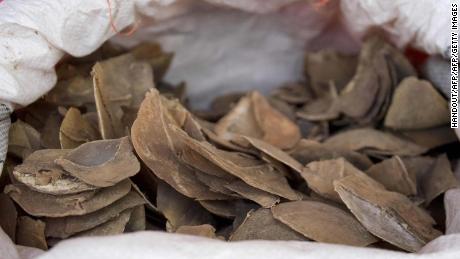
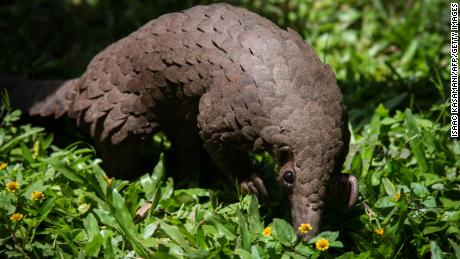
Pangolins are scale-covered insectivores, about the size of a house cat, that are highly valued in Asia for their meat and scales. Last year alone, authorities seized more than 130 tons of pangolin related products, a figure estimated to represent up to 400,000 animals, according to conservation group WildAid.
There are eight species of pangolin found in Asia and Africa. To date, three species are listed as critically endangered by the International Union for Conservation of Nature — the Chinese pangolin, Philippine pangolin and Sunda pangolin, which is found across southeast Asia. The remaining five species, including the Indian pangolin, are listed as either vulnerable or endangered.

Although pangolin scales are made of keratin — the same material found in human fingernails and rhino horn — traditional Chinese medicine promotes the belief that they improve blood circulation and reduce inflammation.

According to Chinese state-run media Tuesday, the latest edition of Chinese Pharmacopoeia — an official government compendium of drugs covering traditional Chinese and Western medicines — no longer includes pangolin scales on the list of approved ingredients, owing to “wild resources exhaustion.”

“These actions of China will have a real impact, these are steps that were critical, that needed to be taken if real conservation was going to happen for these animals,” said David Olson, director of Conservation at WWF Hong Kong.

“Most of the demand for pangolin is coming from traditional Chinese medicine and consumption. That’s what is driving this large scale illegal trade.”

The decision to remove the pangolin from the official list comes just days after China’s State Forestry and Grassland Bureau announced that the Chinese pangolin would be upgraded to a “first-level protected wild animal,” the highest possible protection status alongside pandas and tigers.

Sophia Zhang, director of the Pangolin Working Group at the China Biodiversity Conservation and Green Development Foundation, said that while she was pleased by the result, she felt it came “a bit late.”

“Many years have passed. How many pangolins have already been hunted and killed?” she said.

Devastating impact

The trade in pangolins has had a devastating impact on local populations in Asia. According to the International Union for the Conservation of Nature, pangolin populations in China have dropped by more than 90% since 1960.
As pangolins in Asia were hunted to their limits, a booming trade began in scales from pangolin species native to Africa. Between 2013 and 2019, two African species of pangolin, the white-bellied pangolin and the giant pangolin, have seen their populations move from vulnerable to endangered.

Despite China banning the import of pangolin products in 2018, the trade continued, with large shipments regularly intercepted on their way to the country.

But Steve Blake, chief representative of Wildaid in Beijing, said there had been a growing public movement inside China in recent years pushing for greater protection for pangolins.

“The momentum has been building for years … when this news was announced yesterday it was trending on (Chinese) social media with more than 150 million views,” he said.

‘Don’t wait’

The latest move to protect pangolins comes in the wake of new research that suggests pangolins kept in wildlife markets across China may have helped incubate the novel coronavirus before it spread to humans.

The virus has now infected more than 7 million people across the world since it was detected last December in the Chinese city of Wuhan, including at least 84,000 cases in mainland China.

According to a team of researchers from Duke University and Los Alamos National Laboratory, the virus swapped genes repeatedly with similar strains infecting bats, pangolins and a possible third species prior to jumping to humans.

The researchers concluded that although it was too soon to blame pangolins for the pandemic, it was clear that people must reduce their contact with wild animals that can transmit new infections.

Following the outbreak, the Chinese government outlawed the consumption of all wild animals countrywide in an effort to avoid further deadly outbreaks.

But experts said that for both bans to be effective, they must be properly enforced by authorities and combined with public education campaigns.

Pangolins may have incubated the novel coronavirus, gene study shows
“It would be naive to think it’s just going to completely disappear,” said WildAid’s Blake. Overall, the trade in wild animals for consumption in China is estimated to be worth more than $73 billion and experts said that banning it may just push it underground.

“They need better enforcement and greater public awareness to reduce the demand, make sure the public is aware of the risks of consuming these products and aware of the impact on the environment,” he said. “It takes a bit of time.”

Zhang from the Pangolin Working Group said she was worried that the damage to the pangolin populations in China may be irreversible.

“Not only do pangolins need to be removed from the list — pangolins are already a tragedy and rarely can be seen now — all endangered species should be removed from the medicine list,” she said.

“Don’t wait until the animal will soon die out before taking it out from the list. There will be no turning back then.”

CNN’s Shanshan Wang, Eric Cheung and Steven Jiang contributed to this article.

Source link

Can you spot the cat hiding in this viral picture?

0

Can you spot Norah the cat? (Twitter/@katehinds)

Cats never fail to amaze their owners when it comes to places they can get themselves into.

Kate Hinds, a newsroom planning editor at a radio station in the US, seems pretty used to her cat Norah ending up in all kinds of places.

Last Sunday, Kate tweeted a picture of her impressive bookshelf with the caption ‘Today in find the cat.’

And it appears to have stumped the internet (spoiler alert – the answer is below so don’t scroll if you don’t want to know!).

Kate’s tweet has picked up over 40,000 retweets and 220,000 likes as people struggle to spot where Norah has hidden herself.

Plenty of users responded with guesses – or just gave up.

‘Wow, I couldn’t find it at all, but when I got my 10 year old son to look, he found the cat in seconds. Phew! How did he do that?,’ one user replied.

‘I’m usually good at this game!’ another said.

The tweet also received plenty of replies from other cat owners showing that cats really, really like bookshelves.

If you want to know where she’s hiding, Kate shared a follow-up snap to reveal all.

Apparently, this is one of Norah’s favourite resting spots.

Kate told Cnet that she adopted Norah a little over ten years ago from a rescue shelter.

So if you’re ever wondering where your own cat may have gone, perhaps she’s behind the TV?


Source link

Amitabh Bachchan sponsors air travel of 500 migrant workers to their hometown Varanasi : Bollywood News – Bollywood Hungama

The ongoing Covid-19 pandemic has impacted our lives in a heavy and undeniable manner. The daily wage labourers and the migrant labourers are among the worst hit by the pandemic as well as the national lockdown. Public figures from all walks of life are pitching in to help them, with a number of Bollywood celebrities being at the forefront.

As per a report, megastar Amitabh Bachchan has now taken it on himself to send 500 migrant workers back to their hometown Varanasi. The report states that utmost secrecy is being maintained since Bachchan doesn’t want his deeds to be publicised. However, he was deeply moved by their plight and decided to charter a private airlines’ Varanasi-bound flight. 180 migrant workers were supposed to fly by the morning flight and was asked to report at the airport at 6 am on Wednesday morning. Two more flights to the same destination are to follow. Reportedly, Bachchan will be arranging more flights to West Bengal, Bihar and Tamil Nadu among other states to send more migrant workers home.

He earlier organised ten buses to take send migrant workers to their hometowns in Uttar Pradesh, and also sponsored the monthly ration for 1,00,000 daily wage workers and their families.

BOLLYWOOD NEWS

Catch us for latest Bollywood News, Bollywood Movies update, Box office collection, New Movies Release & upcoming movies info only on Bollywood Hungama.

Loading…

Source link

The cities, states and countries finally putting an end to police neck restraints

0

The term “chokehold” is often used in mainstream discourse to refer to any neck hold, but police generally categorize neck restraints in two ways: the stranglehold and the chokehold. Strangeholds — also called carotid restraints, sleeper holds or blood chokes — temporarily cut off blood flow to the brain and are meant to render a subject unconscious for a time. Chokeholds — also called airway holds — restrict breathing by applying pressure to the windpipe.

Law enforcement officers say the techniques are used to gain control of aggressive or resisting subjects. Some departments state that they should only be employed as a last resort, when the officer believes the subject poses a threat to their or others’ lives. But as the cases of Floyd, Garner and others have shown, neck restraints have the potential to go badly wrong — sometimes resulting in death.

Here are some of the cities, states and countries that are banning police neck restraints.

France

The French government announced on Monday that police will no longer be able to use chokeholds when arresting people.

Interior Minister Christophe Castaner said the use of chokeholds — which he described as applying pressure on an individual’s neck or throat while holding them on the ground — was a “dangerous method” and will no longer be taught in police training.

“I hear the criticism, I hear a powerful cry against hatred,” said Castaner, referring to large Black Lives Matter protests that took place in several major French cities last week. He added “racism has no place in our society, not in our Republic.”

The move came after more than 23,000 protesters took the streets on Saturday to call for an end to police violence, according to Interior Ministry figures released Sunday.

California

Gov. Gavin Newsom directed police departments last week to stop training officers to use carotid holds, calling the technique “a strangle hold that puts people’s lives at risk.”

Carotid restraints are performed by compressing the sides of the neck to restrict blood flow to the brain and render a person unconscious.

As Trump uses fear of change to stoke his base, here's what some cities are doing

Newsom’s directive came after the San Diego Police Department and the Sacramento Police Department announced they would stop using the restraint, effective immediately.

The Los Angeles County Sheriff’s Department (LASD) followed on Monday by issuing an immediate moratorium on the use of carotid restraints in situations that “do not rise to the level of deadly force,” the department said.

The department’s use of force policy also prohibits personnel from using chokeholds, strangleholds and carotid restraints performed with legs, knees or feet, according to a news release.

New York state

Lawmakers passed legislation on Monday banning the use of chokeholds by officers.

Known as the Eric Garner Anti-Chokehold Act, the bill would create a new crime of aggravated strangulation, punishable by up to 15 years in prison.

New York legislators expected to pass bills targeting police misconduct

“This offense would occur when a police or peace officer, using a chokehold or similar restraint, applies pressure to the throat or windpipe of a person, hindering breathing or the intake of air, and causes serious physical injury or death,” a news release from the New York State Assembly stated.

The New York Police Department banned the use of chokeholds by officers in 1993. But there has long been confusion over what constitutes a chokehold, and the policy has not always been enforced, according to the New York City Civilian Complaint Review Board.

Minneapolis

A Hennepin County judge is ordering the Minneapolis Police Department to stop using all neck restraints and chokeholds when dealing with suspects.

The plan was first approved by Mayor Jacob Frey and the city council late last week, in cooperation with the state Department of Human Rights.

The ban comes after former Minneapolis officer Derek Chauvin pressed his knee into George Floyd’s neck for nearly nine minutes.

Under the court order, officers must immediately notify a supervisor if they see inappropriate use of force. Officers are also required to physically intervene against unauthorized use of force when possible, or otherwise “shall be subject to discipline to the same severity as if they themselves engaged in the prohibited use of force.”

Washington, DC

In a Tuesday newsletter, DC Councilwoman Brianne Nadeau announced the council had unanimously passed a policing reform bill that among other things bans chokeholds.

The legislation also calls for body cam footage to be released within 72 hours after an officer-involved fatality and forbids from watching that footage before writing their report.

It also requires officers undergo further training on racism and white supremacy.

Florida

The Broward County Sheriff’s Office said it will not use chokeholds to restrain or secure any person except in situations where deadly force is justified.

And in Miami, police officers are prohibited from utilizing the LVNR (lateral vascular neck restraint) chokehold, neck hold any any other restraint that restricts free movement of the neck or heard or restricts an individual’s ability to breathe.

Chicago

In February, the Chicago Police Department announced that “carotid artery restraints, ” chokeholds and “any other maneuvers for applying direct pressure on a windpipe or airway would be classifies as a deadly force technique.

Police directives state officers are not allowed to use chokeholds or similar maneuvers that put pressure on a person’s airway as a takedown technique “unless the use of deadly force is authorized.”

Houston

At George Floyd’s funeral Tuesday, Houston Mayor Sylvester Turner said he will sign an executive order banning chokeholds and enact other police reforms.

“In this city, you will require de-escalation,” the mayor said, according to CNN affiliate KTRK. “In this city, you have to give a warning before you shoot. In this city, you have a duty to intervene.”

“In this city, we will require comprehensive reporting. In this city, you must exhaust all alternatives before shootings, and there will be other things in this executive order,” he added, according to the news station.

Washington state

Washington state Gov. Jay Inslee says he wants police across the state to restrict the use of chokeholds in restraining suspects, following the widespread protests that came after Floyd’s death.

“We need to rethink the use of police force, and look more broadly at police tactics,” Inslee said during a news conference Monday.

The governor said the Washington State Patrol already tightly regulates the use of chokeholds that restrict a person’s airflow, with limited exceptions when an officer’s life is in danger, and he wants all law enforcement agencies to adopt similar rules.

“Possibly there are things where life itself is in danger… but police are going to have to convince us that that’s the situation,” he added.

Denver

The Denver Police Department announced Sunday it was banning chokeholds and carotid compressions “with no exceptions,” according to a news release.

The department announced that officers would have to report to a supervisor if they intentionally point a weapon at someone. It would also produce a report on the incident to improve data collection and evaluation, the department said.

Additionally, Denver Police Department Metro/SWAT unit members will wear body cameras they will be required to activate during operations.

Phoenix

The Phoenix Police Department announced on Tuesday that it would suspend use of the “carotid control technique,” effective immediately.

“We can’t function as a department without the trust of our community and there are adjustments we can make to strengthen that trust,” Chief Jeri Williams said in a statement.

The department said the move is part of its regular evaluation of policies and procedures to align with “21st-century policing practices, community expectations, and our department’s mission and values.”

CNN’s Sarah Dean, Gregory Lemos, Brian Vitagliano, Andy Rose and Konstantin Toropin contributed to this report.

Source link

Request for applications for: Epidemiologist for Lesotho Covid-19 project – The Mail & Guardian

0

SPONSORED

Background

The Government of Lesotho (GOL) has received a two-year funding from the World Bank to implement Lesotho Covid-19 Emergency Preparedness Response Project. The project aims to prevent, detect and respond to the threat posed by Covid-19 and strengthen national systems for public health preparedness. Two components have been identified to guide implementation of activities of the project. Component one deals with Emergency Covid-19 Response, and under this component the GOL will be supported to strengthen Covid-19 Case Detection, Confirmation, Contact Tracing, Recording and Reporting, Containment, Isolation and Treatment through enhanced Clinical Care Capacity; and Community Engagement, Prevention and Risk Communication. 

Activities under this component will enhance disease surveillance through training of Village Health Workers and procurement of surveillance instruments, improve sample collection and transportation, and ensure rapid laboratory confirmed diagnoses through procurement of laboratory equipment and training of laboratory staff to promptly detect all potential Covid-19 cases and to carry out contact tracing to respond to the Covid-19 pandemic. In addition, the project will support renovation of Mafeteng Hospital to establish the critical care units and wards for Covid-19 patients. Component two of the project will strengthen monitoring and evaluation. Under this component support will be directed to the Covid-19 Incident Management System Co-ordination Structure, operational reviews and logistical support to the co-ordination structure during project implementation.

Using funding from this project, the PIU seeks to engage an epidemiologist to be based at the MOH-HQ – Project Implementation Unit. The epidemiologist will provide technical support to the Ministry of Health in building the capacity of the disease surveillance programme in responding to the current Covid-19 pandemic.

Job Summary

The epidemiologist will provide technical support to the Ministry of Health in building the capacity of the disease surveillance programme in responding to the current Covid-19 pandemic. S/he will be responsible for creating and supporting epidemiological investigative work under the Project in collaboration with other key stakeholders. The epidemiologist will contribute to and/or co-ordinate the collection, validation, analysis, interpretation and dissemination of Covid-19 surveillance data with the aim of guiding Government efforts in responding to the pandemic.

  1. Duties and Responsibilities

Under the guidance and supervision of the Project Co-ordinator, the epidemiologist will ensure that epidemiological investigative work under the Project is carried out as planned. S/he will forecast and model the progression of the pandemic, both in terms of new cases and deaths, as well as the economic impact of disease outbreaks under different scenarios. S/he will build the capacity of the Ministry of Health disease surveillance programme in responding to the current Covid-19 pandemic by carrying out the following:

  1. Contribute to and/or co-ordinate the collection, validation, analysis, interpretation and dissemination of Covid-19  surveillance data with the aim of improving performance of the project and guiding GOL response to Covid-19 pandemic;
  1. Contribute to the strategic and day-to-day co-ordination of Covid-19 surveillance networks, including preparation, organisation and follow-up of meetings of project and other key stakeholders involved in implementation;
  1. Liaise with national and international bodies involved in the surveillance of Covid-19, including all ports of entry, in order to be up to date on all events related to Covid -19.
  1. Contribute to the strengthening and integration of epidemiological and laboratory surveillance of Covid-19 in Lesotho;
  • Provide technical advice and direct support to the relevant authorities in monitoring and responding to Covid-19 pandemic in Lesotho;
  • Support IHR to conduct real-time surveillance of outbreak prone diseases and other acute public health events;
  • Co-ordinate and support routine descriptive epidemiology for monitoring of trends using alert and action thresholds; epidemic forecasting on Covid-19  in Lesotho;
  • Conduct Trainings related to strengthening Covid-19 surveillance in Lesotho;
  1. Communicate routine Covid-19 surveillance data in a timely manner through high-quality reports and research findings through peer-reviewed publications and presentations at scientific conferences;
  • Co-ordinate and/or contribute to scientific studies supported under the project;
  • Support Monitoring and evaluation activities under the project through provision of data for performance review, including evidence based target setting;
  • Create routine statistical summary reports and present findings to stakeholders, maintain records and databases for the Lesotho Covid-19 Emergency Preparedness and Response Project;
  • Participate in MOH–SI and Research meetings to present disseminate epidemiological reports supported by the project;
  • Contribute to the production of rapid risk/outbreak assessments and public health emergencies as may be required under the project; and

The Epidemiologist will be reporting directly to the Project Co-ordinator.

The duration of the assignment shall be 18 months, subject to a probation period of four months and satisfactory performance. The Contract may be renewed based on need and satisfactory performance.

The duty station shall be the Ministry of Health Head Office, Maseru, with frequent field visits to project sites.

Successful candidates will be offered a performance-based contract; subject to review after the first year with possibly of extension dependent on performance and availability of funds.

Application Instructions

Interested and suitability qualified candidates should forward their applications indicating the advertisement and position on the subject line of letter and envelope, together with detailed curriculum vitae indicating work experience. (Day time telephone contacts, names and telephone contacts of three referees to reach the undersigned not later than June 18 2020) to: 

Attn: Procurement Specialist

Procurement Unit, Ground Floor,
Ministry Of Health Headquarters,
Corner Constitution Road & Linare Road
P. O. Box 514,
Maseru 100, Lesotho,

Tel:(+266) 2732 3277

Email: [email protected]

Only shortlisted and successful candidates will be contacted within two weeks from submission deadline. If you do not receive a call and email from us consider application not successful.


Source link

Homeless immigrants secure winter shelter in Cape Town

0

By James Stent for GroundUp

A total of 20 people, who have been living in Van Riebeeck Park in Vredehoek, now have accommodation for the winter months in a Cape Town backpackers’ lodge.

In April, GroundUp reported on the group of people living in the park, most of whom are not South African citizens, who had regular encounters since lockdown with police. Later in the same month, we reported that members of this group claimed they were picked up by authorities and left without their possessions in Goodwood.

Walter Nyamugama, originally from Zimbabwe, said that a group of 20 people had been living in the lodge since 3 June. Nyamugama said that he had approached the local Community Action Networks (CANs) to help secure shelter for the winter months. The CANs have been raising funds for the group, and securing donations of food and clothing.

Nyamugama said that he and other members of the group had been living in lodges similar to this before the lockdown, but they lost their income when informal trade dried up, and then also lost their accommodation. Non-South African citizens may not receive government COVID-19 support such as food parcels.

Nyamugama says that once he had found a lodge that was willing to house members of the group, the CANs and Holy Trinity Church in Gardens approached the Haven Night Shelter, which paid the group’s security deposit. Nyamugama said that members of the group living in the lodge would be contributing to covering the costs of accommodation by selling wire sculptures and bracelets.

RAISING MONEY TO COVER RENT

The City Bowl CANs banded together to organise an online pub quiz on Monday 8 June, hosted by Jon Keevy, to raise money to cover the rent for the group, with local businesses and residents contributing prizes. Over R29,000 was raised.

Nyamugama said that he was “happy, excited, and confused”. He said that securing accommodation for 20 people was bittersweet, as there are still more people living in the park.

“It’s not easy, as not everyone can stay in the lodge. There’s a new challenge because 27 people still live at the park,” said Nyamugama.

Holy Trinity Church has been acting as a drop-off point for food donations for the group, as well as providing a place for the people living in the park to meet, charge their phones, and access the internet.

The church will continue to serve those living in the lodge and those remaining in the park. According to a 2 June blogpost on the CBD CAN website by Miki Redelinghuys, Ladles of Love will be providing a daily meal to the group.


Source link

NATO chief says on Huawei: UK review of 5G security is important

0

LONDON (Reuters) – The head of the NATO military alliance said on Wednesday that the West could not ignore the rise of China and so it was important that the United Kingdom had a review of the role of Huawei in its 5G network to ensure its security.

FILE PHOTO: The British flag and a smartphone with a Huawei and 5G network logo are seen on a PC motherboard in this illustration picture taken January 29, 2020. REUTERS/Dado Ruvic

NATO Secretary General Jens Stoltenberg said China was coming closer to the West in various ways – in the Arctic, in cyberspace and in critical infrastructure, including telecommunications.

“I trust that the UK government will design their networks in ways that protect the networks and make sure that the UK has secure 5G networks,” Stoltenberg told BBC radio.

“Therefore, also I think it is important that there now will be a new review looking at exactly how to make sure that should happen,” he said.

As part of a broader reassessment of relations with China, Britain’s National Cyber Security Centre is analysing the impact of recent U.S. sanctions on Britain’s decision earlier this year to allow Huawei a role in building its 5G network.

Prime Minister Boris Johnson in January granted Huawei a limited role in Britain’s 5G mobile network, frustrating a global attempt by the United States to exclude the Chinese telecoms giant from the West’s next-generation communications.

Defying Britain’s closest ally in favour of China on the eve of Brexit, Johnson ruled that “high-risk vendors” such as Huawei [HWT.UL] would be allowed into the non-sensitive parts of the 5G network.

But the coronavirus outbreak, disagreements over Hong Kong and U.S. President Donald Trump’s anger over China has prompted Britain to reassess relations with Beijing.

“China is coming closer to us, we see that in the Arctic, we see they are heavily investing in critical infrastructure in Europe, and we see of course China also operating in cyberspace,” Stoltenberg said.

“So this is not about deploying NATO into the South China Sea but responding to the fact that China is coming closer to us.”

The North Atlantic Treaty Organization was created in 1949 by the United States, Canada, France, the United Kingdom and other western European states to provide collective security against the Soviet Union. The Soviet Union collapsed in 1991.

Reporting by Guy Faulconbridge and Kate Holton; editing by Michael Holden

Source link

Tucker Carlson Rails Against Elmo And His Dad In Bonkers New Rant

0

Tucker Carlson has found a new threat to American values ― and its address is on Sesame Street. 

On Tuesday, the Fox News host complained that “decades of relentless propaganda” had weakened the nation.

“All of it designed to make us feel that we have no right to stand up for ourselves, to stand up for our country,” he said. “We are too sinful to resist, we deserve whatever we get. Shut up and take it, America.”

His prime example was a CNN town hall event on racism for parents and children that featured characters from the classic PBS show. Elmo’s father, Louie, showed a “Love, Justice, Peace” sign he was planning to bring to a protest and explained racism to his son, who wanted to know why people were so upset. 

“Across the country, people of color ― especially in the black community ― are being treated unfairly because of how they look, their culture, race and who they are,” Louie said. “What we are seeing is people saying, ‘Enough is enough.’ They want to end racism.”

The show’s central message was ultimately one of tolerance. 

“On Sesame Street, we all love and respect one another,” Louie told Elmo. 

But Carlson saw a very different message. 

“Got that, Bobby?” Carlson said, addressing a fictional child. “America is a very bad place, and it’s your fault. So no matter what happens, no matter what they do to you when you grow up, you have no right to complain. That’s the message and it starts very young.”  

While Carlson seemed surprised by “Sesame Street” characters championing inclusion, that’s been a consistent theme throughout the show’s more than 50-year history. 

See more of Carlson’s rant below: 


Source link

5.5 Lakh Covid-19 Cases in Delhi by July 31 Possible, Community Transmission is on: Scientists

0

Image for representation.

Warning of more trouble ahead, Delhi Deputy Chief Minister Manish Sisodia on Tuesday said the number of Covid-19 cases could surge to 5.5 lakh by July 31. This is dramatically higher from the city’s tally of 31,309 cases on Wednesday. India’s Covid-19 count is 2,76,583.

  • PTI New Delhi
  • Last Updated: June 10, 2020, 12:53 PM IST

Mathematical models of the progression of Covid-19 show it would be “possible” for Delhi to have 5.5 lakh cases by the end of July, several scientists have said while stating that community transmission of the disease may have started a while ago.

Warning of more trouble ahead, Delhi Deputy Chief Minister Manish Sisodia on Tuesday said the number of Covid-19 cases could surge to 5.5 lakh by July 31. This is dramatically higher from the city’s tally of 31,309 cases on Wednesday. India’s Covid-19 count is 2,76,583.

“The model that I used for India found that there could be around 8-10 lakh cases in India by mid or end of July. So it won’t be surprising to get to those figures (5.5 lakh) in Delhi,” said Samit Bhattacharya, mathematics professor and researcher at the School of Natural Sciences at Shiv Nadar University.

“Delhi getting around 5.5 lakh cases by end July might be possible as the number of cases is growing,” Bhattacharya said.

According to virologist Upasana Ray, only epidemiologists and statisticians can comment on exact numbers and predictions.

“I believe that if the government is telling something, there must be some basis to it,” Ray, senior scientist at CSIR-IICB, Kolkata, added.

Reaching the alarmingly high figure of 5.5 lakh is possible using mathematical modelling, agreed Lovi Raj Gupta, executive dean of Science and Technology, Lovely Professional University (LPU) in Punjab.

“The validity and the accuracy would depend on the selection of the model based on the variation of data. As this is time-series data, trends and seasonality play vital role,” Gupta said.

Time series analysis is a statistical technique dealing with data in a series of particular time periods or intervals.

“You look at what is happening previously and average it out and on the basis of that you can create the differencing pattern of the future. It can be very well done using time series variation,” Gupta said.

Mathematical modelling can be used to understand how a virus spreads within a population, according to a research article published in the journal BMC Public Health.

The essence of mathematical modelling lies in writing down a set of mathematical equations that mimic reality. These are then solved for certain values of the parameters within the equations.

The solutions of the mathematical model can be refined when information already known about the virus spread is used — for example, available data on reported number of infections, the reported number of hospitalisations or the confirmed number of deaths due to the infection.

Talking to reporters after a meeting of the Delhi Disaster Management Authority, Sisodia also quoted officials from the Centre as saying there is no community transmission of Covid-19 in Delhi.

Delhi Health Minister Satyendar Jain added in a separate conversation with the media that the source of infection is “not known” in nearly half the fresh cases being reported.

Bhattacharya said community transmission “definitely” started a long time back in Delhi.

“It doesn’t mean the whole of Delhi will have infections uniformly for community transmission to happen. Nearly 30,000 infections in Delhi have already happened and according to the Delhi population it is definitely community transmission,” he said.

“As far as my understanding of disease transmission, in local transmission there is a small spike in the number of infections. After that it gradually increases, and definitely at that point starts the community transmission,” Bhattacharya added.

Ray explained that community transmission is said to happen or is a stage of disease transmission which by definition lacks exact source of transmission for many reported cases, that is the source of infection might not be traced back.

“We have seen a very long and stringent lockdown in our country. Yet, the number of cases have been seen to be rising. In many cases we can’t trace back the source.”

“If the rise in Covid-19 cases can’t be linked to community transmission, then the next question should be…..what is the reason for such an increase? Is the virus more virulent? We don’t know that either. Are we bringing in infection from elsewhere? How can that be? It was a lockdown.”

While all these assumptions are true, it will not be wrong to say that just an increase in infection numbers won’t point to community transmission, Ray added.


https://pubstack.nw18.com/pubsync/fallback/api/videos/recommended?source=n18english&channels=5d95e6c378c2f2492e2148a2&categories=5d95e6d7340a9e4981b2e10a&query=5.5,Lakh,Covid-19,Cases,in,Delhi,by,July,31,Possible,,Community,Transmission,is,on:,Scientists,arvind,kejriwal,coronavirus,&publish_min=2020-06-08T18:17:57.000Z&publish_max=2020-06-10T18:17:57.000Z&sort_by=date-relevance&order_by=0&limit=2

Source link

#AstraZeneca wins fresh US backing in race for #COVID-19 treatment

0

AstraZeneca (AZN.L) has secured support from the U.S. government to advance the development of antibody-based COVID-19 treatments as the British drugmaker ramps up efforts beyond its potential vaccine to combat the global health crisis.

The company said on Tuesday (9 June) it had signed a second set of deals with authorities in the United states backing its development of a monoclonal antibody treatment against the coronavirus.

It declined to disclose details of the agreement but said it had agreed terms with the Defense Advanced Research Projects Agency (DARPA) and Biomedical Advanced Research and Development Authority (BARDA) to move two COVID-19 antibody therapies it has licensed from researchers into clinical studies in the next two months.

Companies and governments are scrambling to bring a solution for the illness caused by the new coronavirus to market as soon as possible, and many in the medical community believe antibody-based therapies hold great potential.

The United States has already secured 300 million doses of AstraZeneca’s experimental COVID-19 vaccine, AZD1222, and Defense Secretary Mark Esper vowed last month that the U.S. military and other parts of the government would work with the private sector to produce a vaccine at scale by year-end.

AstraZeneca said it has licensed six monoclonal antibody candidates from Vanderbilt University in Nashville, Tennessee. Two of those six prospective proteins will be tested as a combination approach for COVID-19. (bit.ly/3cSDR0d)

Antibodies are generated in the body to fight off infection. Monoclonal antibodies mimic natural antibodies and can be isolated and manufactured in large quantities to treat diseases in patients.

Shares of London’s most valuable listed company were up 1.3% at 8,307 pence by 11h14 GMT.

Source by [author_name]