Air power has played an increasingly important role in the Libyan conflict. The relatively flat featureless desert terrain of the north and coast means that ground units are easily spotted, with few places to hide.
The air forces of both the United Nations-backed Government of National Accord (GNA) and eastern-based commander Khalifa Haftar and his self-styled Libyan National Army (LNA) use French and Soviet-era fighter jets, antiquated and poorly maintained.Â
More:
While manned fighter aircraft have been used, for the most part the air war has been fought by unmanned aerial vehicles (UAVs) or drones. With nearly 1,000 air strikes conducted by UAVs, UN Special Representative to Libya Ghassan Salame called the conflict “the largest drone war in the world“.
UAVs are useful for several reasons. Not only do they provide valuable information about the enemy that can be spotted a long way off, but they are able to attack any targets immediately with a far higher rate of success. In the event the drone is shot down and destroyed, the pilot is safe, back at base and able to pilot the next drone that takes off.
Russian fighters flown out of western Libya after Haftar retreat
Initial GNA success
The arrival of Chinese-made Wing Loong drones in 2016 made a significant difference to the LNA’s military capabilities. First used in the battle for Derna in eastern Libya, the drones had a decisive impact on the outcome as forces loyal to Haftar battled fighters from the Shura Council of Mujahideen in a brutal battle for the city.
These Chinese-made drones – operated by pilots from the United Arab Emirates (UAE) and flown out of the Al Khadim airbase in the east – have a combat radius of 1,500km (932 miles), meaning they can deliver precision-guided missiles and bombs, striking anywhere in the country.
These drones were used to great effect in the battle for Tripoli, which General Haftar announced in April 2019 against the GNA. Government forces were repeatedly pushed back into a tight pocket as the capital was besieged by the LNA. For all the talk of “precision” air strikes, the civilian casualty toll mounted as targets were hit in increasingly built-up urban areas.
There were now doubts that the UN-recognised GNA, led by Prime Minister Fayez al-Serraj, could hold out much longer, despite support from Italy and Qatar.
Su-35 long-range fighter jets were among those flown into Libya this month [File: Ilya Naymushin/Reuters]
Turkey’s intervention
That all changed in December 2019 when Turkish President Recep Tayyip Erdogan confirmed Turkey would sharply increase its military support for al-Serraj and the GNA.
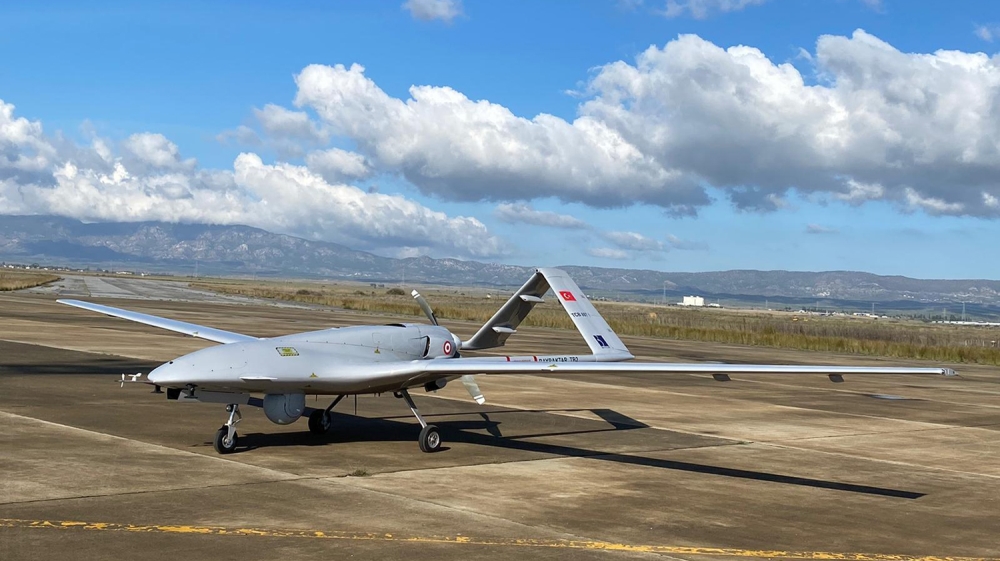
Along with troops, Erdogan sent Turkish-made armed drones, namely the Bayraktar TB2. Smaller and with a much shorter range than the Wing Loong, the Bayraktar was still able to engage and destroy the LNA’s ground targets, harass its supply lines, and attack forward air bases that were once considered safe. Pro-government ground troops could now advance with air cover, the enemy’s positions known to their commanders.
Will setback to Khalifa Haftar change the course of Libya’s war?
The effect was dramatic as the GNA launched a counteroffensive and in a lightning strike seized the coastal towns of Surman, Sabratah and Al-Ajaylat along with the border town of Al-Assah. This was followed up by repeated attacks on the Al-Watiya airbase, which Haftar’s forces were using as their main point of operations.Â
The airbase was finally retaken on May 18, a severe blow to Haftar’s ambitions in western Libya as not only was it the LNA’s principal headquarters there, it was also his supply and logistics hub.Â
LNA units were forced to retreat, especially as their Russian-made, UAE-supplied, Pantsir S-1 air defence units were being comprehensively destroyed, leaving the retreating forces with little to no protection from air attacks. Media reports claimed sophisticated Turkish jamming gear was responsible for disorienting the Pantsir’s radar, leaving it vulnerable to air strikes from the Bayraktar drones.
Turkish-made Bayraktar TB2 drones have hammered Haftar’s supply lines and troops [DHA via AP]Â
Further advances to the south and east of Tripoli significantly loosened Haftar’s grip on the capital, as forces loyal to him have been forced to retreat. Hundreds of mercenaries from the Russian military contractor Wagner Group have been evacuated from Bani Walid airport.
In an ominous turn of events, the United States Africa Command said Russian fighter jets flew from its Khmeimin airbase in Syria to the LNA-held facility at Jufra, in central Libya, to bolster Haftar’s forces and their allies. Multirole MiG-29s and two Sukhoi Su-24 ground attack fighters were sent along with an escort of at least two Su-35 advanced 4.5 generation long-range fighter jets, in a clear signal to Turkey and the GNA that Haftar’s defeat should only go so far.
The US’s reaction to this has been sharp – the issuing of satellite photos an indication of its concern.
They are flown by Russian military members & escorted by Russian fighters based in Syria to Libya, landing in Eastern Libya near Tobruk for fuel. At least 14 newly unmarked Russian aircraft are then delivered to Al Jufra Air Base in Libya. (2/2) pic.twitter.com/bB9g66pVUc
The potential threat is that Russia could “seize” bases on the Libyan coast and “deploy permanent anti-access, area denial capabilities” creating, according to US Air Force General Jeffrey Harrigian, “very real security concerns on Europe’s southern flank”.
While airpower can at times turn the tide in a military conflict, it has also been used in Libya as a threat-level indicator, a diplomatic tool, and a warning of potential escalation if events are left unchecked.
Grab your Mickey Mouse ears and your magic wands! Disney World plans to re-open Magic Kingdom and Animal Kingdom July 11th and Epcot and Hollywood Studios July 15th.
Walt Disney World Parks in Orlando, Florida are slated to reopen in July 2020. Alex Menendez/Getty
The parks previously shut down in mid-March due to the coronavirus pandemic.
“While there is still much uncertainty with respect to the impacts of COVID-19, the safety and well-being of our guests and employees remains The Walt Disney Company’s top priority,” Disney said in a statement when the parks initially closed.
Disney World Shanghai was the first Disney park to open on May 11 amid the coronavirus pandemic.
Disney Springs in Orlando has already begun a phased reopening on May 20, with temperature checks and social distancing measures in place. Additionally, Universal Orlando recently announced that they will reopen on June 5 at limited capacity.
Newsweek reached out for comment from Walt Disney World and has not heard back at the time of publication.
“I love you, but I don’t trust youâ€, whispers from black heart to black heart like a mantra against our farcical solidarity. Where self-deprecation meets self-love, can there be a successful collective? Can a revolution come from the transmuted wounds of the Black woman? Can a festival turn into eternal solidarity? Can we be friends and allies for long enough to defeat our common enemies, delirious self-doubt, capitalism’s ability to turn all creative output into a commodity? Can we override those epigenetic tendencies rooted in generational trauma, by simply gathering and sharing ideas on our own terms, or is it too late for that pure and reckless kind of love, that troubled and troubadour Black love?Â
Can Black women who are also professional writers, griots in our own right, reclaim private generative and creative practices without sacrificing our careers in capitalist institutions? Or is it time we make that sacrifice, not of ourselves, but of the institutions that cannot survive without our energy as commodity, capital, indomitable soul?Â
The 1960s and ’70s were decades riddled with Black collectives whose members, whether artists, scholars, or politicians, joined to refract the decay of impending late capitalism with collectively improvised strategies for recovery from that toxic system. The diaspora sometimes feels like one big festive party, but no one knows whose house it is, no one has openly volunteered to host the gathering, everyone is trespassing and exhibits the guilty decadence that comes with stealing oneself into pleasure under dire circumstances.Â
Black women have done the most tending to that voluntary soul-risking that occurs when we try to counter the myth of white dominance and seek power in the Western world, as a diaspora and as individuals.Â
Under those conditions, when acting openly makes you a moving target and constant witness of atrocity the general population might not be able to fathom, Black collectives become hypermacho to overcompensate for how petrified members are of the state; how subordinate to it even in insubordination. Black female members of these groups, groups like the Black Panthers, Kawaida, the Umbra Poets, Move Philadelphia, et cetera, feigned militant servileness at times, or just employed quiet grace that could be mistaken for obedience, to ensure that the survival of Black families and communities would not be undermined, as much by the gender war as by the race war.Â
There is mildly disturbing footage of Amina Baraka for example, instructing a woman at the Spirit House she ran with her husband Amiri, that women must be feminine and constantly available to their men; that it is their duty to diasporic justice and revolution. She calls this a “collaborationâ€but its terms are indiscriminate black female submission to black men who preach about revolution.Â
Festac in 1977 would be a galvanising factor in the evolution from the concept of the pious, black, revolutionary, trophy wife, to a very literal Sisterhood, wherein black feminine creative power could be explored for its own benefit. The first formal meeting of this group, who called themselves The Sisterhood in tender love and solidarity, the only sorority we’ve ever needed, was at June Jordan’s home in February of 1977 and featured a karass of Black women writers and thinkers. The summer festival had brought in its harvest of momentum; it had done the work, planted the seeds that would feed us in a more barren season and land.Â
Instantly, the writers decided they would work together to create Black-owned and -run publications, vivid alternatives to the New York Times and the Village Voice, instead of the ever-fantasised ones extant in dream and idea. They would provide bodies for the ghost narratives of the future; they would tend to suspended bones, the writing that exceeded publishing outlets, that upset imperialism too much to extract resources from it; they would lend these coming children a skin of words.Â
The Sisterhood would keep this clandestine, however, and use their ritual meetings not as bureaucratic alignment with this or any publishing goal, but as real opportunities to bond while safe from the white gaze, and the Black male gaze. The Sisterhood would gather like chrysalis in the Western literary world’s expansive blindspot and roil there, messy and preparatory.Â
Toni Morrison, an editor at Random House at the time, would spearhead additional gatherings to plan for the publication, which would be called Kizzy, roots. They sought black investors and wanted to use “mass appeal†to address every aspect of Black survival. In the idea’s dying days, all of that fervour dissipated into a group of Black women discussing their depression and methods for surviving that: how could they be happy visionaries as Black women, and not the kind motivated or debilitated by anger? Where could they place their collective optimistic fatalism if not as Kizzy, as roots, as something harrowing? How could sorrow be avoided when mourning the impossible? Could lament be heroic also?Â
Whether doing the tending to publication or to men or to one another, as Black women we have been socialised to neglect ourselves, and not notice for so long that it seems like every cathartic burst is thwarted by preemptive grudges or fantastical and urgent preoccupations with what our rebellion could become if we just see it through. The seeing it through; the capacity for porousness; the reluctant surrender to ourselves at the risk of upsetting our men and our children and our oppressors, all who say they love us — it seems like so much practice at not being completely seen causes Black women to internalise every critique and pathology of every blind entity, as natural healers, and in doing this we constrict ourselves.Â
The Sisterhood was a beautiful mode of transmutation, but it was also a trauma bond; an occasion to commiserate and help one another to digest quiet neglect. We had moved past the “stand by your man†Black revolutionary ethos; we were now standing by one another, alone together, but that didn’t make for a more perfect union. It gave us a clearer mirror, more to face, more intended caretaking, this time at least with accomplices and willing shadows.Â
In the constant tacit open combat that we Black women embrace, it isn’t enough for women to come together feeling impalpably connected; the maintenance of that tender sentiment requires “capital†— a Black-owned and -operated institution, a place to be and inscribe.Â
When the first and most necessary step on that path was to create a functional chosen family, it seems The Sisterhood and Kizzy slipped into the quicksand of that sociology before ever reaching the economic and political force that would have made the endeavour exceed its founding members. Legacy building is the most threatened activity of Black life. Black women often take up this work because we can disguise it as vanity instead of the overt militancy it is.Â
The Sisterhood fell prey to the bipolar nature of Black uprising throughout the diaspora. We’re either inundated with a will to power as we were in much of the 1960s and parts of the 1970s, or we’re dejected by all of the murders and state violence our will is met with, falling into either despair or the kind of apathetic decadence in which we use cultural production as an escape instead of a strategy toward resistance. Black Beauty is what we love.Â
The Sisterhood possesses that beauty even still, compels Black women to make efforts at full self-actualisation. Today this history weighs on the consciousness like myths with the heroes and details mixed up and forgotten. Did the Sisterhood really exist for real? How do we archive and revive our evidence of things not seen? Will we have to repeat this decadence and this despair endlessly because we never quite establish a place to put it, we never quite own the venue, and the healing bitter roots are rotting and fermenting into poison? Â
At the same time, the Sisterhood reminds us that Black women are always our own antidote, our own cure. Even as we spend ourselves foolishly trying to save everyone we love, and even some people we hate, we are entirely capable of organising and healing ourselves first; maybe always just a little too altruistic to neglect the rest of the world the way it sometimes tries to neglect us. The Sisterhood was a refuge and refusal conceived by women who cared even when they didn’t have to, and could have been abject capitalists, which is proof that soul overrides elitism in great Black women and in Black culture at large, and that victimhood can and must be transcended.
Harmony Holiday is a writer, dancer, and archivist/myth scientist, and the author of Go Find Your Father/ A Famous Blues (Ricochet Editions, 2014) and Negro League Baseball (Fence Books, 2011). She lives in New York and Los Angeles.Â
The ECB earlier said the economy could shrink by between 5 per cent and 12 per cent, but speaking in a youth dialogue, Lagarde said that the “mild” scenario is already outdated and the actual outcome would be between the “medium and “severe” scenarios, Reuters reported.
In another major development, the European Union’s executive proposed a 750 billion-euro ($825 billion) recovery fund to help the bloc’s economy through the deep recession induced by the coronavirus pandemic, commissioner Paolo Gentiloni said on Wednesday.
Gentiloni, who is in charge of economic affairs at the commission, wrote in a tweet that the move is a European turning point to face an unprecedented crisis.
However, the 27-nation EU remains deeply divided over what conditions should be attached to the funds, and Wednesday’s proposal from the EU’s executive arm is likely to set off weeks of wrangling.
The move comes with the world’s biggest trading bloc set to enter its deepest-ever recession as the impact from the coronavirus ravages economies. Virtually every country has broken the EU’s deficit limit as they’ve spent to keep health care systems, businesses and jobs alive.
Earlier this month, the leaders of Germany and France historically, the two main drivers of EU integration agreed on a one-time 500 billion-euro ($543 billion) fund, a proposal that would add further cash to an arsenal of financial measures the bloc is deploying to cope with the economic fallout.
That plan would involve the EU borrowing money in financial markets to help sectors and countries that are particularly affected by the pandemic. The European Commission’s blueprint is likely to resemble the Franco-German plan in many ways while attaching the fund to the EU’s next long-term budget.
The big question will be how much money will take the form of grants and how much would be loans. Austria, Denmark, the Netherlands and Sweden a group of countries dubbed the Frugal Four for their budgetary rectitude are reluctant to see money given away without any strings attached, and their opposition to grants could hold up the project.
Will it be grants or loans? And if it will be grants, who are going to pay the grants? Loans, I think is a more interesting way forward to discuss, but we also have to discuss under what conditions shall we give these loans, Swedish Finance Minister Magdalena Andersson said on Tuesday.
Whatever its content, the commission’s plan is likely to spark heated debate and the EU does not have time for the wrangling to drag on. The new budget period begins on Jan 1, and countries across the bloc are desperate for funds now.
All 27 member countries must agree for the recovery fund to take effect.
More than 5.6 million cases of the virus have been confirmed worldwide, and more than 351,000 people have died from it, according to data compiled by Johns Hopkins University. Efforts to curb the outbreak have led to the global disruption of daily life and the economy, as schools and workplaces shutter in hopes of slowing transmission.
HuffPost US
HPFR 27 May
France has halted the use of hydroxychloroquine as a treatment for patients suffering severe forms of COVID-19.
HuffPost France reports (in French) that the decision comes just two days after the World Health Organization said it was pausing a large trial of the malaria drug due to safety concerns.
British medical journal The Lancet reported that patients getting hydroxychloroquine had increased death rates and irregular heartbeats, adding to a series of other disappointing results for the drug as a way to treat COVID-19.
U.S. President Donald Trump and others, including Brazil’s Jair Bolsonaro, have pushed hydroxychloroquine in recent months as a possible coronavirus treatment.
France decided at the end of March to allow the use of hydroxychloroquine in specific situations and in hospitals only. No vaccine or treatment has yet been approved to treat COVID-19 which has killed more than 350,000 people globally.
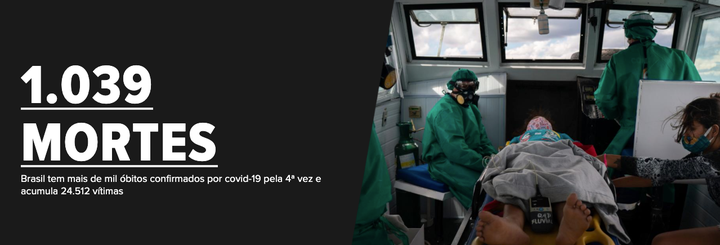
The march of coronavirus through Brazil shows no sign of slowing after the country recorded more than a thousand deaths in a day for the fourth time.
The total death toll in Brazil now stands at 24,512, while infections have risen to 391,222, second only to the U.S.
HuffPost Brazil reports (in Portuguese) that the state of São Paulo has recorded 6,423 deaths, followed by Rio de Janeiro with 4,361 deaths. The latest figures come as Brazil’s four largest news media outlets said they have withdrawn their reporters from coverage of President Jair Bolsonaro’s official residence due to the lack of security to protect them from heckling and abuse by his supporters.
Bolsonaro has made a habit of stopping at the residence’s entrance to speak to cheering supporters, take selfies with them and make comments to the journalists, but in recent days his supporters at the gates have turned on the reporters with angry verbal attacks. On Monday, about 60 supporters heckled the reporters loudly, with shouts of “liars,†“scum†and “communists.â€
The attacks on journalists have intensified as Bolsonaro’s political situation has deteriorated under criticism of mishandling the coronavirus crisis. He is also under investigation for allegedly interfering in law enforcement and his supporters see the media as part of a plot to oust him.
For the first time since it shut down in mid-March, traders returned to the floor of the New York Stock Exchange Tuesday morning, operating under COVID-19 safety measures, including temperature checks for anyone entering the building, mandatory mask-wearing and reduced capacity on the trading floor.
To commemorate Wall Street’s reopening, New York Gov. Andrew Cuomo (D) rang the bell at 9:30 a.m., which signals the traditional beginning of the trading day.Â
Today I ring in the start of the trading day and the return of traders to the floor of the NYSE. In the two months the floor was dark, NYers bent the curve and slowed the spread of this virus. #NewYorkToughhttps://t.co/sef84ZRzNK
The World Health Organization is pausing an international trial of hydroxychloroquine — the anti-malarial drug touted by President Donald Trump as a possible treatment for the coronavirus — due to concerns for the safety of patients, HuffPost’s Mary Papenfuss reports.
Officials cited a large study of 100,000 patients published Friday in The Lancet. Researchers found that patients treated with the drug in the hospital had a “significantly higher risk of death†than those who weren’t given it.
An April study of U.S. veterans produced similar results.
Since March, Trump has pitched the treatment as a “game-changer,†without evidence. On Sunday, he said in an interview that he had just completed a two-week course of treatment. “And by the way, I’m still here,†he told Full Measure News.
Pressure continues to build on Prime Minister Boris Johnson after a junior minister resigned from the British government over an alleged breach of lockdown rules by the U.K. prime minister’s top advisor, HuffPost U.K reports.
Douglas Ross, a junior minister in the Scotland Office, said Tuesday that he was quitting after hearing about Dominic Cummings’ efforts to defend his 270-mile trip from London to the northeast of England in March.
Ross said he could not “in good faith†tell his constituents who could not care for sick relatives or say goodbye to dying ones while obeying lockdown rules that Cummings acted appropriately.
Cummings remains under fire over allegations he breached coronavirus lockdown restrictions but Johnson’s chief adviser has said he does not regret his actions and declined to apologize.
At least 15 Conservative MPs have said Cummings should go, while several others have spoken out against his actions.
POLATLI, Turkey — The economic fallout of the COVID-19 pandemic has sparked food security fears across the world. In Turkey, it has underscored the crucial role that seasonal workers — impoverished people crisscrossing regions for manual jobs — play in the country’s food supply chain. Sustaining agricultural activity is critical for Turkey, where the pandemic has worsened existing economic woes, including an agricultural decline that has fueled food price hikes in recent years. But with the agricultural season now in full swing, seasonal workers are left with a tough choice: brave the coronavirus risk in neglected encampments to earn their bread or avoid risky working conditions and lose their scarce incomes.
On a roadside near Polatli, a town not far from Ankara, several hundred seasonal workers from Sanliurfa, a province some 900 kilometers (560 miles) away, have already erected a tent city where few precautions were visible against an outbreak when Al-Monitor visited last week. A few spacious tents aside, families of up to 10 people stay in small sheds made of tarps and sticks, many of which abut on another for steadiness. The only running water in the encampment comes from a sole irrigation hose.Â
Life exposed to contagion risks is certainly not a matter of choice. Asked whether they were aware of the risks, a worker confirmed he did fear contracting the novel coronavirus. Then why not wear a mask, at least? “Where can I possibly get a mask from?†he replied.Â
According to the workers, neither the field owners nor the authorities have tried to provide them with face masks. And no one from the local agriculture or health department has visited the encampment since the workers’ arrival in mid-May, they said. In another nearby tent city, the head of the group said, “We called the authorities. They said they were understaffed because of the coronavirus and would come only after the holiday.†He was referring to the three-day Eid al-Fitr holiday, which ends May 26.
Water in plastic washbowls, soap and dishwashing liquid is all the workers and their children have for cleaning and sanitation. Makeshift latrines and bathing spaces, covered with blankets for privacy, stand in close proximity to the tents. Women cook food in large pots over cooking pits in the ground, using dry branches to build fires.
Asked about the risk of contagion, one worker who brought his children along said, “We keep dying anyway. What difference does it make if I die in an accident or in a pandemic?†He was referring to the high rate of work accidents among seasonal agricultural workers in Turkey, a rate second only to that in the construction sector.
The workers expect to toil longer hours this summer because travel restrictions over the pandemic delayed their arrival, leaving a backlog of work in the fields. “Previously, we would work eight hours a day, but now we will be working 12 hours to get the job done,†the leader of the workers said.Â
The labor shortages have already hit the crops in some regions. Cherry orchards went unharvested in the western Aegean region last month, while onions rotted in fields in the south.
The government has since eased travel restrictions for seasonal workers. Yet the conditions it imposed on social distancing and hygiene rules are hard for them to meet.
Ertan Karabiyik, secretary-general of the Development Workshop, a non-profit group that recently penned a report on the issue titled “Virus or Poverty?,â€Â said, “The workers are required to increase distancing in the tents, but how are they supposed to get additional tents? They are required to wear face masks, but how are they supposed to get and pay for those masks? What the workers earn is already below the minimum wage — they cannot meet those requirements.â€
Additionally, the workers now pay more to reach their workplaces as transportation services are required to operate on reduced capacities and charge higher fees from the passengers accordingly. To reach Polatli, the workers from Sanliurfa had to pay 400 Turkish liras ($59) per person, the payment for a week of labor in the fields.
The number of seasonal agricultural workers, estimated at some 800,000 in normal times, is expected to decrease across the country this year, according to Karabiyik. In Sanliurfa, for instance, a sixth of the usual 6,000 seasonal workers have stayed at home.Â
And what happens if the coronavirus hits the encampments? “That would be the moment of truth,†said Besim Can Zirh, a sociologist at Ankara’s Middle East Technical University who contributed to the Development Workshop’s report. According to the scholar, an outbreak would probably lead to quarantining the affected encampment, leaving its inhabitants out of work and throwing both their wages and the crops into jeopardy.Â
Without enough workers to cultivate or harvest the crops, disruptions in output might result in supply shortages and push prices up. According to Zirh, cherry and plum prices went up and tomato prices fluctuated in early spring when seasonal workers were still subject to tight travel restrictions. An onion producer in the southern province of Hatay, interviewed for the report, said he had to leave his crops in the field because he failed to find workers to employ, Zirh said.Â
Without additional support for seasonal workers, productivity in agriculture might decrease. Neither Zirh nor Karabiyik expect a major food crisis in Turkey, but further increases or fluctuations in agricultural product prices could be imminent. In April alone, food prices rose 2.53%, well above the 0.85% overall consumer inflation, compounding a similar uptick in March.
The experiences of containing the spread of Covid-19 has posed both obstacles and opportunities for the formal and informal sectors of South Africa’s economy. Some have had the good fortune of navigating and manoeuvring successfully through the pandemic, but others are sinking.Â
The Covid-19 lockdown has negatively affected children who are informal traders. Child traders have not been able to sell their wares, and the meagre income they used to get has meant devastation for them and their families. Â
In the Mapungubwe Institute for Strategic Reflection’s book, Beyond Tenderpreneurship: Rethinking Black Business and Economic Empowerment, it is argued that the informal sector has to be better understood so that economic empowerment policies can be designed for it. The publication further argues that the opportunities that this economy has for entrepreneurship and employment could expand economic participation and emerging policies should not impose formal sector regulatory mechanisms in the informal business context. South Africa needs to re-look at informal trading and come up with policies that aim at alleviating the plight of child traders.Â
The legal working age in South Africa is 15 and, according to Statistics South Africa’s Survey of employed and the self-employed 2013, informal traders aged 15-24 account for 4.9% of the informal sector in South Africa. This makes child informal traders aged 15-17, in particular, one of the most vital working-age populations. Their contribution to the economy, however, remains largely unexplored which makes them vulnerable.
Thousands of children are forced to become traders to escape poverty and sustain their families. In 2013, more than a third of children were living below the Food Poverty Line (FPL) of R441 per month. This means that 33.3% of children cannot afford to buy a basket of food that costs R441 at 2020 prices. These children also live in homes where there is no working adult.Â
Research conducted by Wilson Mabasa (2015): The impact of informal traders on the economic development of Limpopo, found that that province has one of the largest informal sectors in South Africa. I have also personally observed this in the village I grew up in, Turfloop, near Polokwane. There are plenty of children going from door to door, selling different things in order to survive.
One of them is 19-year-old Lesedi*, who started selling fried fish wrapped in newspaper for R7 a portion, from the age of 12. Growing up in a female-headed household, with an unemployed mother, three other siblings, and her own two children, social grants and selling fish are the only sources of income for her family.Â
Every day after school, from about 3pm to 6pm, she would go around the streets selling and soon earned the nickname “Fishâ€. On a good day, especially after pay-days, Lesedi would make about R350 and on bad days, she’d make about R70, bringing in roughly R4 000 a month. Selling fish meant she could avoid using up her children’s social grants.Â
Since the Covid-19 lockdown, this system has drastically changed. Neighbours are not buying from child traders because they fear contracting Covid-19. There is also growing apprehension of meeting police officers on the streets, so most traders do not even come out to sell.Â
To make the situation worse, Lesedi does not qualify for a trading permit — since she sells hot, cooked food door-to-door — or unemployment relief. All that she receives from the government’s R500-billion relief package is the South Africa Social Security Agency (SASSA) grant for her two children. The threat of hunger is looming, although the increased grants and food parcels do all help somewhat.
It stands to reason that informal child traders have a wealth of trading knowledge that should be harnessed and nurtured. The government should mobilise these young entrepreneurs, support and encourage them to succeed and inspire others to do the same. Â
The department of small business development should also provide training and skills that will enable these young entrepreneurs to grow from being survivalists to being self-employed.Â
*Not her real name
Keabetswe Mogosoane is a political economy research intern at the Mapungubwe Institute for Strategic Reflections. She holds a BA communication degree and BA honours in political studies from North West University
Can you talk about the timing of this project? Festac took place at the beginning of 1977, after a difficult planning period. What is its continued relevance to the diaspora, in particular now?
The most immediate trigger was the failure of South Africa’s World Cup in 2010 — we knew Bafana Bafana were not going to win it and that it wouldn’t deliver all the jobs-jobs-jobs promised. The justification for the megalomaniac spending for that event had to be cultural — to alter, fundamentally, the way Africans see themselves and how the world sees us. Instead they produced that waka-waka nonsense. But it wasn’t enough to point to the failure of the imagination: we began to research global cultural events that the continent had hosted in the 20th century, that were not restricted by the instrumental logic that guided South Africa’s World Cup.
Like pan-Africanism, it is a story that begins in the diaspora and moves to the continent with the wave of independence of the 1960s — first in Nkrumah’s Ghana in 1958 with the All African Peoples Conference. These gatherings take a cultural slant with the First World Festival of Negro Arts (Fesman) in 1966 in Dakar, and eight years later at the Pan-African Cultural Festival (Panaf) in Algiers. Festac ’77 in Lagos marked the closing of this “festival decadeâ€.
Each of these festivals is remembered as a singular moment in the history of the country in which it took place. Always the first of its kind and ideologically dissonant — whereas Dakar ’66 manifested as a platform for Negritude’s ideals of black culture, Panaf ’69, mandated by the OAU (Organisation of African Unity) looked to culture as a tool of liberation and development. However, individually and as a cluster, they functioned as laboratories for the development of new, worldwide politics and cultures. Their shared aim was to look beyond the binaries established by the cold and hot wars (East-West, North-South), and give form to universalisms that had emerged since the Haitian revolution. In other words, to institutionalise the black world.
To circumvent the limits of nativism (Dakar ’66) and Afro-radicalism (Algiers ’69), Festac ’77 imagined black solidarity as inclusive. So, people and communities (black diaspora) as well as postcolonial states (African) would be represented. The tension between these modes of affiliation, black/African (and plenty others), is what the festival is all about — it simultaneously presents and celebrates the art of statelessness and state-art, while putting all forms of political representation under pressure.Â
For example, members of the Africobra arts collective (Chicago) are part of the United States delegation — except the US isn’t invited, only black Americans. They’re not there as members of Africobra either, because artists are invited as individual members of a recognised political community. They end up representing a country that does not exist — Black America. But it gets better. The only state symbol at their disposal is a flag — Marcus Garvey’s flag of pan-Africanism, which is itself a challenge to the ideaof the nation-state. On the other hand, Miriam Makeba was a citizen of nine countries (excluding South Africa) and represented them all. The poet Mário Pinto de Andrade, one of the founders of Angola’s MPLA, appeared at Festac as Guinea-Bissau’s minister of culture. That’s the beauty and depth of the mess that Festac makes visible.
The work of producing pan-Africanism as a political reality is ongoing and, sadly, what we currently celebrate as “Africa Day†is the reduction of that project into a manageable bureaucracy in the OAU — now the AU (African Union). But the questions — What is black? Who is Africa? — are very much alive in the cultural realm. One of the questions this book asks is, can a past that the present has not yet caught up with be summoned to haunt the present as an alternative?
How did you approach the research for this? Was there a central source that provided much of the material or were you calling on existing networks across the black worlds for material?
The Centre for Black and African Art and Civilisation in Lagos is an important resource to understand Nigeria’s investment in Festac — three successive military governments carried the project. It was founded by Olusegun Obasanjo in 1979, to act as custodian of the Festac archive and it holds many important planning documents and recordings of performances. But no central archive can contain the enormity of this event. Like the map in Jorge Luis Borges’s famous parable, it would need to be as big as the territory.
We had to use our network to gather material, and take time to build trust with people in countries we’ve never visited. We’re fortunate to have brilliant researchers, like Stacy Hardy, Graeme Arendse, Duduetsang Lamola and Ben Verghese, in the group. We used side projects to advance the research — for instance we published an issue of the Chronic in 2015 that examines divisions between North and sub-Saharan Africa, a central issue at Festac. Through such prepublications we were able to gather and produce material on some of the key questions of our research.
This is the paradox of Festac. Some of our most important writers, artists, thinkers participated — 17 000 at official count. Many of them speak of it as a paradigm shift, one of the most important events they’ve attended. The impact of the event is visible in their artistic and political choices, yet it seldom appears as a full story. Audre Lorde and Jayne Cortez published poems, Wole Soyinka wrote an essay, “Festac Agonistesâ€, and Festac appeared in a few memoirs. The only book-length project I’d seen was by the anthropologist Andrew Apter in 2005. This intrigued me — the people who experienced Festac seemed unwilling to write it, as if bound by an unspoken nondisclosure agreement. And so its stories circulated in the manner of a family secret — a family of millions of people.
Working through sound requires an embrace of opacity: there is always too much information — and never enough. It helps to feel surrounded by the information, to surrender, when attempting to write stories too big, too personal, to be perceived in their fullness. Indeed, some stories are bigger than storytelling. Black music is not only the largest and most sophisticated archive at our disposal, it is also an efficient laboratory for the rebuilding of archives that are primarily inscribed in bodies.Â
Working through sound, the mixtape was a natural format for aggregating ideas. So we initially spent quite a bit of time producing Festac mixtapes, in collaboration with the poet and myth-scientist Harmony Holiday. It was also useful for introducing the complexity of the project to possible collaborators.
We wanted to tell stories of Festac through those who participated. But it is practically impossible to determine who was at Festac from official records. For example, a group of artists and activists led by Mdali founder Molefe Pheto travelled to Nigeria uninvited and without visas. At the Lagos airport they were welcomed as “Soweto revolutionaries†and let into the country — in fact, escorted to the festival village as VIPs. Their names do not appear in official documents, but everyone else saw and envied them! Fortunately, Pheto likes to tell this story and it reached my ears via the curator Khwezi Gule.Â
Gathering these stories had to be collective and public work — this was our peer-review system. We would organise events and invite people who were rumoured to have been at Festac to help to identify companions in the images we collected. It didn’t always go well — in one instance some of his colleagues “identified†the bass player William Parker in Marilyn Nance’s extensive photographic documentation of the US delegation. I hurriedly wrote to Parker to request an interview, only to learn it wasn’t him. He wasn’t at Festac but we thought he should have been and so he was! It is documented.
I was struck by the self-archiving practices of the radical people who attended Festac. Many produced piles of newspaper clippings, yellowed photographs, even K7 recordings that had been untouched for years. Whether by storing stories in people’s minds like Pheto did, or by stashing printed materials in their homes, Festac alumni saved their memory of the event. A rare special issue of Sechaba was found in Keorapetse Kgositsile’s personal library; an unheard live recording of Sun Ra was in a shoebox full of K7 tapes in New York. Lefifi Tladi kept his correspondence with Malangatana Ngwenya and other artists from Festac.
Sechaba Festac special issue cover.
Learning about who was there (or wasn’t) became a way of producing an art history of the black world. Meanwhile, a columnist in Der Spiegel asked, could there be a white arts festival?
Why, and what point, did Toni Morrison’s The BlackBook become the inspiration in terms of method of presentation?
Initially we imagined the book as a collection of essays to be edited by the writer Akin Adesokan and myself. We produced a few drafts of this book, but none felt right. There was no music, and the people were left out.
Another project had begun to take form in our minds since the work on mixtapes — a publication that could be heard as well as read. A book that would represent with care the array of verbal and visual texts we’d received from our elders — the spoken anecdotes, newspaper reports, essays, advertisements, music sheets, posters, diary pages, artworks.Â
Stories would have no beginning or end, everyone would be speaking at the same time and in their language. It would be polyvocal, polyglot, polyrhythmic and many more plurals; it would demand close listening. It would have no chapters or sections, it would begin wherever the eye falls. It would have many contradictions. It wouldn’t distinguish between new writing and older material. It would present each story as an invitation to produce more stories. Some stories would include a byline, others not; some pages would be numbered, others not. There would be a system, but it would be as unpredictable as the cataloguing of a private jazz collection, or read in all directions like Dumile Feni’s scroll.Â
It should not feel precious but everyone should want to keep it — it should rest on the kitchen table with the family photo album. Every black person should recognise something in it, anything — and read from there. Everyone else can join in too, but they must know when to leave. It should be read in groups. No one should be able to read it entirely — unless they speak at least nine languages. This book could only be made by many hands, page by page.
Encountering Toni Morisson’sBlack Book in 2017 was a revelation — such a book already existed! It was a blessing. She had produced it 43 years earlier to tell the story of African Americans over three centuries. The Black Book is a mystery, so perfectly choreographed everything feels random. All the cues are buried in the reader’s own mind.Â
We sat by her feet and learned to play jazz. We had to internalise all the material we’d collected to produce meaningful connections: where would we feature Jayne Cortez’s poem “They want the oil, they don’t want the people� Would it go with the report on the 1973 oil crisis in The Black Panther Intercommunal News Service — a crisis that enriched Nigeria and made Festac possible? Or would it sit near Ama Ata Aidoo’s story of meeting Cortez at the food queue in the Festac Village? Sometimes the connections produced themselves – it was a lot of DJ work on the page.
The Black Book isn’t mentioned at all in our publication — we wanted Festac to be the only context, from cover to cover. But I am very proud of the fact that a few readers picked on this connection. It’s like our book has a family name.
How far do you see Festac’s tentacles stretch, both in terms of how it shaped ways in which the arts could be mobilised towards liberation (with particular reference to South Africa) and in how it reshaped diasporic connections, years into its future?
Nigeria’s involvement in the anti-apartheid struggle is well documented — the Pan Africanist Congress (PAC) had an office in Lagos since the 1960s. And in the aftermath of the June 16 uprisings, Tsietsi Mashinini and his Soweto Students Representative Council comrades were hosted by the Obasanjo government. Thabo Mbeki was then deployed to Lagos to woo the Nigerians, with his first task being to lead the ANC delegation at Festac. The South African liberation movement was there in its fullness — PAC chief diplomat David Sibeko was there. Oliver Tambo dropped in for the closing ceremony.Â
The festival took place in the middle of the war some historians describe as “coldâ€, but which was very hot these parts. The Chimurenga was intensifying in Zimbabwe and civil war was ongoing across the white redoubt in Southern Africa, instigated, of course, by the apartheid regime. The inauguration of Jimmy Carter as US president took place a week into Festac, and he immediately dispatched Andrew Young to Lagos, who did his best there to avoid Agostinho Neto, the leader of socialist Angola. There are photographs in which the VIP section looks like a seating of OAU general assembly. Festac was definitely a space for palace-political work.
But major political moves also took place on the performance stage. For instance, Mbeki managed to unite a cross-generational group of South African artists and ANC activists behind a single project led by the composer and trombonist Jonas Gwangwa — a dramatisation of the recent June 16 events featuring music, dance, poetry and popular theatre. The success of this performance arguably led to the formation of the Amandla Cultural Ensemble, a powerful, roving organ for mobilising international support for the struggle the following decade; the formation of Medu Art Ensemble and the organising of the Culture and Resistance Conference in 1982; and the establishment of the ANC’s department of arts culture the same year.
Amandla Cultural Group – First Tour Live, 1983
By declaring itself a “black†country in its constitution of 1804, Haiti changed the rules — a republic could be black, just as Western liberal democracies assume their whiteness. The emergence of continentalism in the late 1950s, which culminated with the founding of the OAU, allowed many African leaders to sidestep this issue. But it came back to the fore at Festac — Senegal threatened to boycott the festival if North African countries were invited to participate. Thus the festival had to be renamed, from the “World Festival of Black Artsâ€, to the “World Festival of Black and African Arts and Cultureâ€.Â
But the issue simply would not go away. Brazilian activists confronted their government — why were so few black artists, intellectuals and organisations in their country’s delegation? Sudanese intellectuals asked, what of “Black and Arab� Indigenous Australians claimed they were neither black nor African and departed shortly after the opening ceremony. People took these questions home to reshape cultural politics and, in cases like Brazil, Cuba, Australia and others, to initiate a national debate on race.
Before Festac, only a few African states had established national cultural institutions beyond what was inherited from the colonial state. Gabon’s National Theatre, Zaire’s National Ballet and Cameroon’s National Orchestra, for example, were founded in preparation for Festac. This brought intellectuals and artists face to face with the state. Â
Typically, Fela Kuti took this opportunity to organise a “counter-Festac†at his club, the Shrine, in which everyone was invited to berate the Nigerian military government at will, as well as their own. A week after the festival, Obasanjo’s government responded with full force, destroying his home and killing his mother.
Nearly two years after the worst dam collapse in Laos in decades, survivors whose villages were washed away are finally being offered land in compensation, district-level authorities in the province told RFA Lao Service.
On July 23, 2018, water surged over a saddle dam in Attapeu province’s Sanamxay district at the Xe Pian Xe Namnoy (PNPC) hydropower project following heavy rains, inundating 12 villages and killing at least 40 people in Attapeu and neighboring Champassak province.
Sanamxay authorities have begun allocating land to survivors of the collapse. The total compensation to about 1,270 families amounts to 2,140 hectares (8.26 square miles) of cleared land, which they can use to grow rice, just as the rainy season approaches.
“[Authorities] have cleared and improved the land and will give it to [the survivors]â€, an official of the district told RFA’s Lao Service Monday.
“If a family has two working members, that family will get one hectare (2.47 acres) of land, whereas a family of three or four will get two hectares and so on. However a family consisting of only one person will get nothing. That person must join another family,†the official said.
The official added that in addition to new land, the authorities will improve the soil condition of the villagers’ former farms that were mud-covered or damaged by the Xe Pian-Xe Namnoi dam collapse, then allow the victims to go back to their old villages and plant rice on their old land.
“My family has three working members, so we’ll receive two hectares of land. Other families that have five members will get three hectares,†a survivor of the collapse and flood told RFA.
“We in this village haven’t received rice seedlings yet. So far only two villages have. Besides the seedlings, we also need shovels and other tools for rice cultivationâ€
Another survivor had doubts about the plan.
“Growing rice may not be fruitful. I’m afraid [the land they cleared] will be flooded because this area is flooded every year,†the second survivor told RFA.
Stable by 2023
“This is a pilot project. We’ll plow the land then [the survivors] will sow rice seedlings. Some areas are good and fertile, so rice will grow,†an official of the Attapeu Province Agriculture and Forestry Department told RFA.
This official said that government has plans to improve the survivors’ living conditions to a normal or stable level by around 2023. The plans include building permanent homes, roads and other infrastructure, allocating land and paying the promised compensation to all remaining survivors.
On July 23, 2019, the first anniversary of the dam collapse, Attapeu Governor Leth Xayaphone detailed the extent of the damage at a local news conference.
“[As a result of the collapse], water damaged homes and property in a total of 19 villages, affecting 3,540 families or 14,440 people. Total losses include a death toll of 71 and [U.S.] $15 million in damages,†the governor said at the press conference.
He added that more than 4,400 were at that time living in shelters in temporary relocation centers, while over 10,000 had returned to their homes.
RFA reported in late April that conditions in the relocation centers had deteriorated, causing many to abandon the shelters, paying out of pocket to build new homes. Those who remained in the centers described unsanitary conditions like overflowing latrines and spoiled food coupled with shortages of drinkable water.
The Lao government is moved forward plans to build what would be the country’s seventh large dam on the Mekong River, part of the country’s ambitious strategy to become the “Battery of Southeast Asia.â€Â Those dams and others like the Xe Pian-Xe Namnoi have raised deepening environmental and social concerns as local people loose fishing grounds and suffer dislocation.
Reported by RFA’s Lao Service. Translated by Max Avary. Written in English by Eugene Whong.
Hong Kong police on Wednesday arrested more than 300 people amid renewed street protests ahead of China’s imposition of draconian sedition laws on the city, bypassing its Legislative Council (LegCo).
Protesters built barricades across major streets in Kowloon’s Mong Kok district with roadsigns, planking, and traffic barriers, setting fires and placing other obstacles on the roads to hinder the advance of riot police.
Crowds gathered near government headquarters in Admiralty, in the Central business district, and the Causeway Bay shopping district on Hong Kong Island, chanting slogans that included “Free Hong Kong, Revolution now!”
Some protesters also shouted a relatively new slogan: “Independence for Hong Kong! The only solution!”
Some of the arrestees were found in possession of Molotov cocktails and nails, according to police, but some of those boarding a police bus under apparent arrest were schoolchildren in uniform, still carrying their backpacks, according to photographs posted to social media.
“Police had arrested over 300 people for offenses including possession of offensive weapons [and] … participating in an unlawful assembly,” the police said in a statement.
Meanwhile, the city’s secretary for security John Lee repeated the ruling Chinese Communist Party’s characterization of the protesters as “terrorists.”
“The Hong Kong government will use the strictest law possible to crack down on terrorism,” Lee told journalists.
“In cases where there is sufficient evidence, the police and the justice department will look into bringing charges against suspects under U.N. anti-terrorism measures, as well as freezing the personal assets of suspects,” Lee said.
Plan to move ahead
The ruling Chinese Communist Party on Monday said it will carry through its plan to impose a draconian sedition and subversion law on Hong Kong, claiming it is part of a crackdown on “terrorism” in the city.
China’s National People’s Congress (NPC) — which usually passes any government proposal put before it — will “vote” on the plan on Thursday.
Beijing insists that the minority of protesters who have resisted widespread violence from riot police with barricades, bricks, Molotov cocktails, and other makeshift weapons are “terrorists.”
Beijing revealed plans on May 21 to send its feared state security agents into Hong Kong to pursue people suspected of “sedition” or “subversion,” or of doing the work of ‘foreign forces’ during the city’s months-long protest movement.
In a move that many say signals the end of Hong Kong’s promised autonomy and traditional freedoms of speech and association, state security police from mainland China will be allowed to set up shop in Hong Kong to fulfill their duties under the new law, according to a precis of the decision supplied by state-run Xinhua news agency.
The plan has been widely condemned by foreign governments and rights groups as a breach of China’s obligations under the 1984 Sino-British Joint Declaration, a U.N.-registered treaty governing the handover.
Rights groups said the law will mean Beijing can ensure that only voices and activities that toe the party line will be allowed in Hong Kong, which was promised a continuation of its traditional freedoms of the person, publication, and association under the handover agreement.
U.S. reviews relations
The proposed legal move comes at a time when the U.S. is reviewing, under the Hong Kong Human Rights and Democracy Act, whether to continue to treat Hong Kong as a separate jurisdiction from China, given Beijing’s growing insistence on wielding direct political power in the city.
Beijing has said the 1984 Sino-British Declaration promising the continuation of Hong Kong’s freedoms and a high degree of autonomy is no more than a “historical document,” and has repeatedly warned other countries not to interfere in its internal affairs.
Former British colonial governor Chris Patten this week called on G7 nations to stand up for Hong Kong’s freedoms, warning that President Xi Jinping is launching an all-out attack on liberal values there. Reported by Lu Xi, Tseng Yat-yiu and Man Hoi-tsan for RFA’s Mandarin and Cantonese Services. Translated and edited by Luisetta Mudie.
We use cookies on our website to give you the most relevant experience by remembering your preferences and repeat visits. By clicking “Accept”, you consent to the use of ALL the cookies.
This website uses cookies to improve your experience while you navigate through the website. Out of these, the cookies that are categorized as necessary are stored on your browser as they are essential for the working of basic functionalities of the website. We also use third-party cookies that help us analyze and understand how you use this website. These cookies will be stored in your browser only with your consent. You also have the option to opt-out of these cookies. But opting out of some of these cookies may affect your browsing experience.
Necessary cookies are absolutely essential for the website to function properly. These cookies ensure basic functionalities and security features of the website, anonymously.
Cookie
Duration
Description
cookielawinfo-checbox-analytics
11 months
This cookie is set by GDPR Cookie Consent plugin. The cookie is used to store the user consent for the cookies in the category "Analytics".
cookielawinfo-checbox-functional
11 months
The cookie is set by GDPR cookie consent to record the user consent for the cookies in the category "Functional".
cookielawinfo-checbox-others
11 months
This cookie is set by GDPR Cookie Consent plugin. The cookie is used to store the user consent for the cookies in the category "Other.
cookielawinfo-checkbox-necessary
11 months
This cookie is set by GDPR Cookie Consent plugin. The cookies is used to store the user consent for the cookies in the category "Necessary".
cookielawinfo-checkbox-performance
11 months
This cookie is set by GDPR Cookie Consent plugin. The cookie is used to store the user consent for the cookies in the category "Performance".
viewed_cookie_policy
11 months
The cookie is set by the GDPR Cookie Consent plugin and is used to store whether or not user has consented to the use of cookies. It does not store any personal data.
Functional cookies help to perform certain functionalities like sharing the content of the website on social media platforms, collect feedbacks, and other third-party features.
Performance cookies are used to understand and analyze the key performance indexes of the website which helps in delivering a better user experience for the visitors.
Analytical cookies are used to understand how visitors interact with the website. These cookies help provide information on metrics the number of visitors, bounce rate, traffic source, etc.
Advertisement cookies are used to provide visitors with relevant ads and marketing campaigns. These cookies track visitors across websites and collect information to provide customized ads.